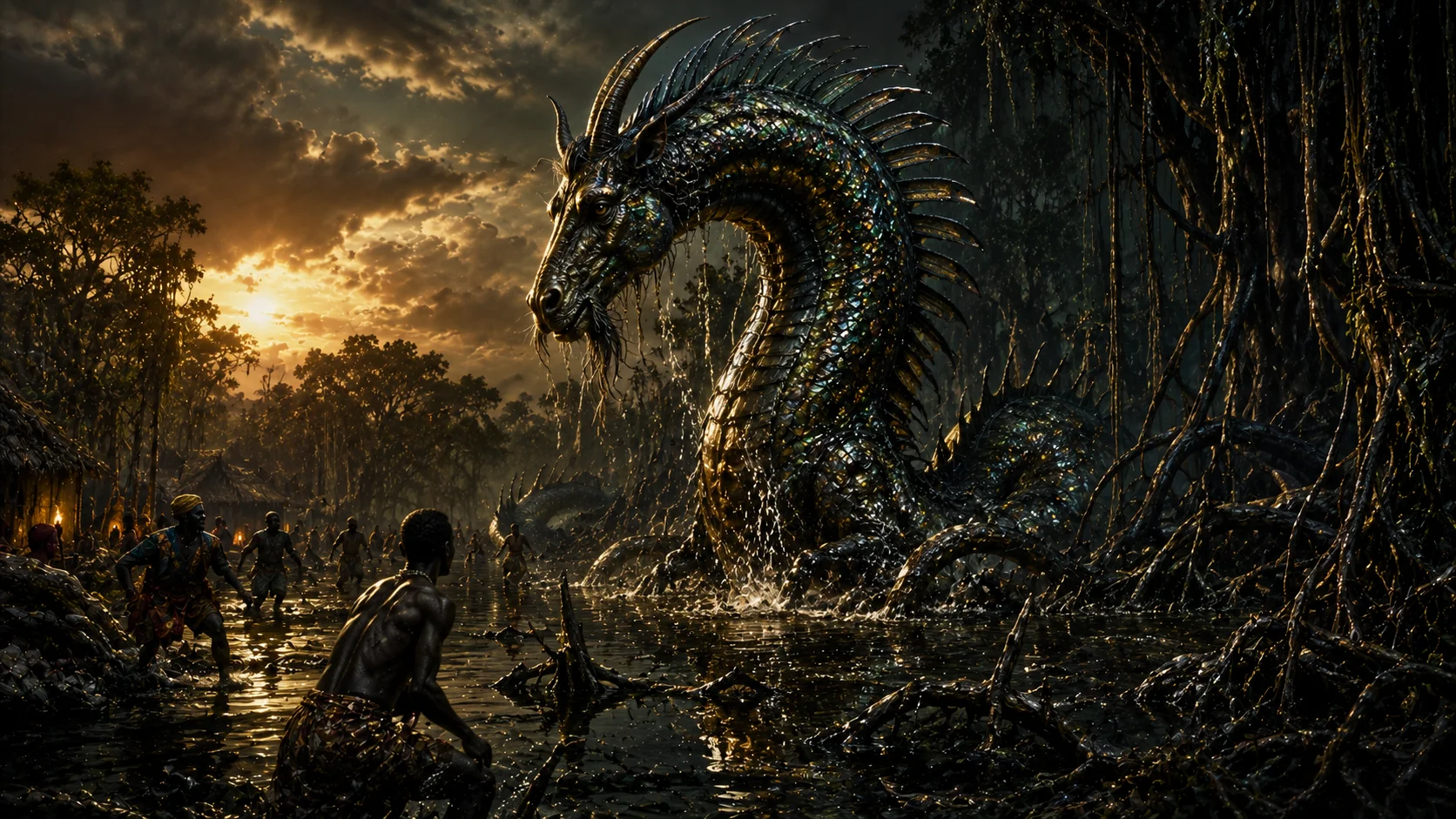
Along the marshy backwaters of the Gambia River, where mangrove roots knot into the mud and the reeds close overhead, there lives a name that is rarely spoken above a whisper. The Ninki Nanka — sometimes rendered Nikinanka — is the great swamp-monster of Mandinka, Wolof, and neighboring oral traditions across the Gambia, southern Senegal, and Guinea-Bissau: a huge, horned, dragon-like reptile whose very sight is said to be fatal. It is not a myth confined to old books. It is a living warning, told and retold in villages along the river to this day, and it deserves to be approached as exactly that — a serious piece of a living cultural inheritance, not a monster-movie curiosity.
A River That Keeps Its Own Counsel
The Gambia River does not behave like a single, knowable thing. It widens into brackish estuary near the coast, narrows into forested channels upriver, and everywhere along its length it feeds a labyrinth of tributaries, creeks, and seasonal marsh that flood and recede with the rains. It is in these overlooked margins — the reedy backwaters, the mangrove fringes, the swamps too waterlogged for farming and too tangled for easy passage — that the Ninki Nanka is said to make its home. These are not places people wander into by accident. They are avoided deliberately, by long-standing local knowledge of which stretches of water and wetland are simply not entered.
That avoidance is the heart of the tradition. The Ninki Nanka is not described as ranging freely across the land, hunting the way a lion or crocodile might. It stays where the swamp is deepest, where the water is stillest and least accompanied by other people, and it is there that its presence is most keenly felt — not as an animal one expects to meet, but as a reason not to go looking.
The Shape the Elders Describe
Ask ten different informants what the Ninki Nanka looks like, and — as those who have collected these accounts over the past century have found — you may get ten different answers, and folklorists studying the tradition treat that variation itself as characteristic of it. It is consistently described as enormous. Beyond that, the details shift with the teller and the region. Some describe something close to a giant crocodile or monitor lizard, thick-bodied and heavy in the water. Others describe something more serpentine, long and sinuous, closer to a great snake than a lizard. Still others speak of something closer to a dragon in the fullest sense: horned, scaled in shifting colors that catch the light, dragging a long neck and an unmistakably reptilian head through the shallows.
What holds constant across the variations is the impression of size and the impression of color — a multicolored, scaled hide unlike any ordinary river creature — and horns, in many accounts, crowning a head unmistakably its own. Rather than read this inconsistency as a flaw in the tradition, it is better understood the way oral historians understand it: as evidence of a story alive in many mouths, adapted to what each teller has seen, feared, or been told by their own elders, rather than copied word for word from a single fixed source.
What It Means to Be Seen
Nearly every account agrees on one point, and it is the point that gives the Ninki Nanka its power: to see it is to be marked for death. Not immediately, and not always without recourse, but the pattern told again and again is that a person who glimpses the creature — often someone out fishing alone, traveling at night, or straying off the known paths near the swamp — will sicken afterward, and in the most severe tellings, will not recover. The encounter itself is the misfortune. There is no wrestling it, outrunning it, or besting it; the danger is simply in having looked.
This is why sightings are rare and why so few who claim to have seen it are willing to say so freely. A story built around the terror of being seen back is, by its very design, a story that resists casual retelling by witnesses — which is part of why it has retained its weight for so long.
A Warning Carried in a Child's Ear
Strip away the horns and the scales for a moment, and the Ninki Nanka does something plainly practical: it keeps people, and especially children, away from water that can kill them in far more mundane ways. The swamps and backwaters it is said to haunt are genuinely dangerous — deep mud, sudden drops, strong currents, and crocodiles that need no supernatural embellishment to be lethal. Elders and parents along the river have long invoked the Ninki Nanka to keep the young from wandering into exactly those places, and the warning works because the consequence it threatens is absolute.
Seen this way, the legend functions as a kind of inherited safety instruction, carried in narrative rather than in a rulebook — the sort of cultural technology that does not need to be literally true to do real, protective work across generations. It sits alongside the story's other function without contradicting it: a tale can teach caution and still be told, and felt, as genuinely true.
Told Still, Believed Still
This is not a legend that lives only in colonial-era travel journals. Ethnographic and journalistic accounts from the 2000s and 2010s — including reporting from within the Gambian press and international outlets that traveled to river communities to ask directly — describe active, present-tense belief in the Ninki Nanka among people living along the Gambia River today. Villagers speak of it as a real hazard of the swamp, not a story reserved for children or for outsiders. That continuity, across generations and into the twenty-first century, is itself remarkable: few oral traditions of this kind retain such a firm hold in communities that are otherwise thoroughly connected to the modern world.
A Name Whose Roots Are Not Fully Known
Even the name resists easy explanation. "Ninki Nanka" and its variant "Nikinanka" are the forms most widely recorded, but no firmly established scholarly etymology accounts for where the name comes from or precisely what it originally meant. That uncertainty is worth stating plainly rather than papering over — it is honest to the state of the record, and it is also fitting for a creature whose defining trait is how much about it resists being pinned down.
An Uncompanioned Guardian of the Swamp
Unlike figures embedded in an elaborate cast of related spirits, rivals, or companions, the Ninki Nanka appears in the reviewed record as a solitary figure — no defined pantheon, no named counterpart, no consistent supporting cast of other beings bound to it. Occasional pop-cultural gestures link it loosely to jinn or to generic water-spirits, but those connections are thinly attested at best, and it would be a disservice to the tradition to present them as settled fact. What is well attested is simpler and, in its way, more powerful: a single guardian-monster of the deep swamp, answerable to no one, needing no retinue to be feared.
The Line Between the Village and the Wild
Across West African oral tradition more broadly, the boundary between the settled village and the untamed bush is a recurring and structurally important one — the cleared, known, safe space of home set against the unmapped, dangerous space beyond it. The Ninki Nanka sits squarely on that boundary, embodying everything the swamp represents in that structure: unpredictable, unclearable, indifferent to human safety, and not to be entered lightly. In that sense the creature is not only a monster in its own right but a kind of marker, a way the tradition draws the map between where people belong and where they do not.
Chasers From Elsewhere
In the 2000s and 2010s, the Ninki Nanka drew the attention of Western cryptozoology, most visibly through expeditions publicized by the British cryptozoologist Bill Gibbons, who pursued the creature as a candidate for a surviving unknown reptile — a "living dinosaur," in the language often used for such claims. These expeditions relied on secondhand testimony and local reports gathered in the field, and they brought a wider international audience to the Ninki Nanka's name for the first time.
It is worth being clear about what this attention was and was not. It was never part of the original oral tradition, and it sits outside it — a separate, fringe, and disputed line of inquiry layered on top of a story that existed long before anyone came looking for a hidden species. No verified specimen has ever been recovered. No photograph, carcass, print, or piece of physical evidence has withstood scrutiny. Every account, without exception, remains testimonial — a story told by someone who says they saw, or heard from someone who saw. That does not diminish the Ninki Nanka as a cultural and spiritual reality within the communities that hold it. It simply means the creature belongs, honestly, to the register of legend rather than to the register of documented zoology, and conflating the two does a disservice to both the tradition and to science.
Kin Across the Continent's Waterways
Comparative cryptozoological literature has long grouped the Ninki Nanka alongside other African river-monster legends — most notably Mokele-mbembe, the reputed swamp-dwelling creature of Central African tradition, particularly around the Congo Basin. The comparison is a scholarly one, drawn from shared structural features: a large, reptilian, water-associated monster, tied to specific remote wetlands, feared and avoided by nearby communities, and later drawn into outside cryptozoological interest. It is not a claim that the two traditions share a common origin or that one gave rise to the other — they arise from distinct peoples, regions, and river systems. Rather, it points to something broader: that the pattern of a great hidden guardian in the deep water recurs independently across West and Central African oral traditions, each rooted in its own place and its own people.
A Story Told in the Present Tense
What distinguishes the Ninki Nanka from many legends collected and then set on a shelf is that it has never stopped being told as something current. It is not framed by the communities who hold it as "what our grandparents believed," but as a hazard of the river as it exists now — a reason a particular creek is not fished at night, a reason a child is called back from the reeds. The cautionary tale — a traveler straying off the path, a fisherman out too late, a glimpse in the dark water followed by illness — functions less as folklore recited for its own sake and more as a live warning renewed with every telling.
To encounter the Ninki Nanka honestly, then, is to set aside the frame of "cryptid waiting to be captured" and to meet it instead as it is held by the people who have carried it for generations: a name for the danger and majesty of a river that does not fully reveal itself, a guardian of water no one is meant to enter carelessly, and a story still doing exactly the work it was always meant to do.
Sources & traditions
- EncyclopediaWikipedia — Ninki Nanka
- TraditionWest African folk and village traditions
Myths change from area to area and from time to time. This chronicle follows the most widely told versions; tellings in other villages, regions and eras may differ.