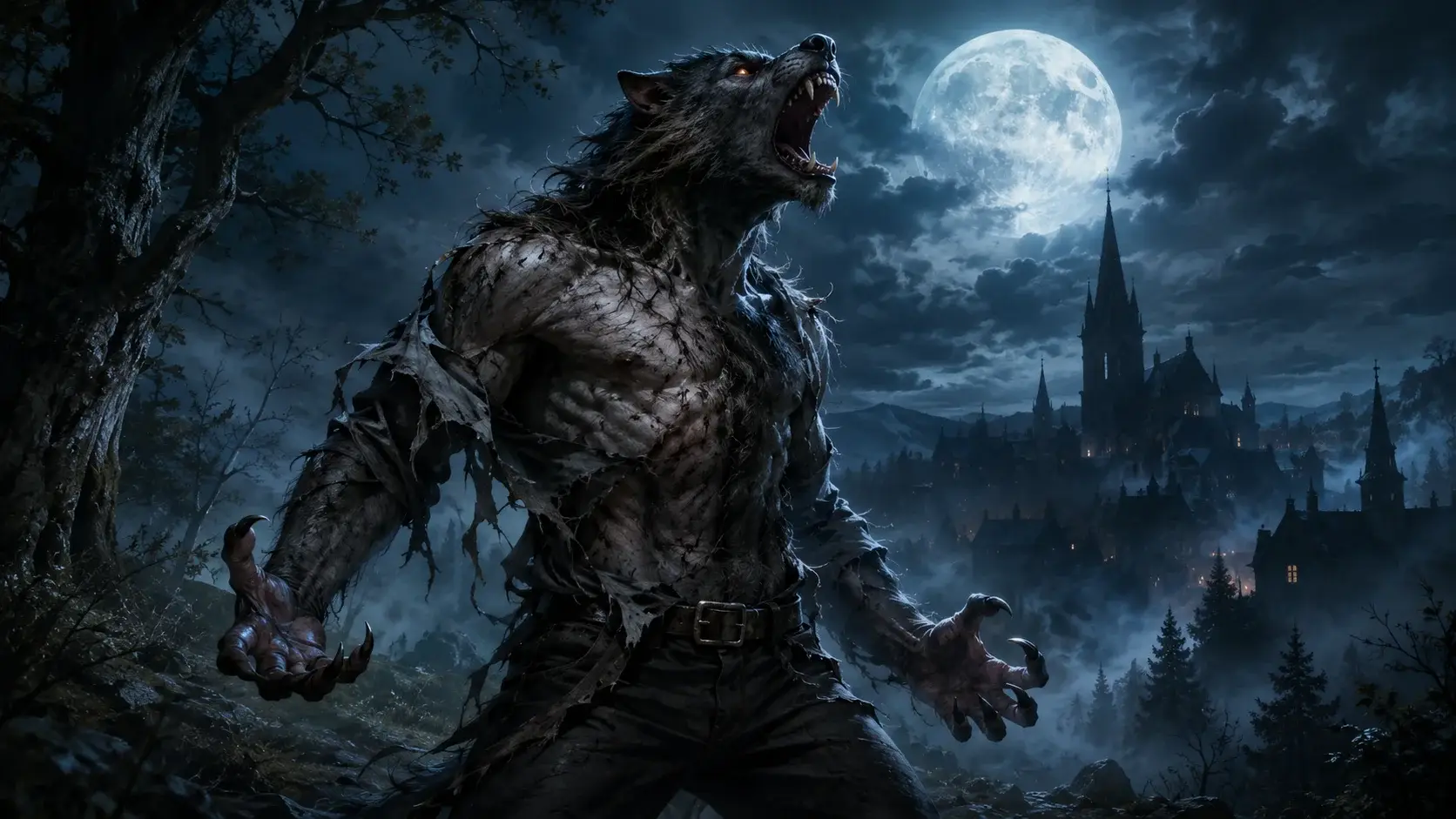
Every culture that ever feared the dark tells a version of the same story, and it always opens the same way: a man you know — a neighbour, a husband, a quiet farmer — walks into the trees as the moon swells full, and something that is no longer entirely a man comes back out.
The werewolf is the oldest nightmare our species keeps about itself. It is not a horror that descends on the village from somewhere far away. It is the village — a familiar face by daylight that sheds its skin by night. And underneath three thousand years of the legend lies a single question that no torch and no silver bullet has ever truly answered: how do you guard against a monster when the monster might be you?
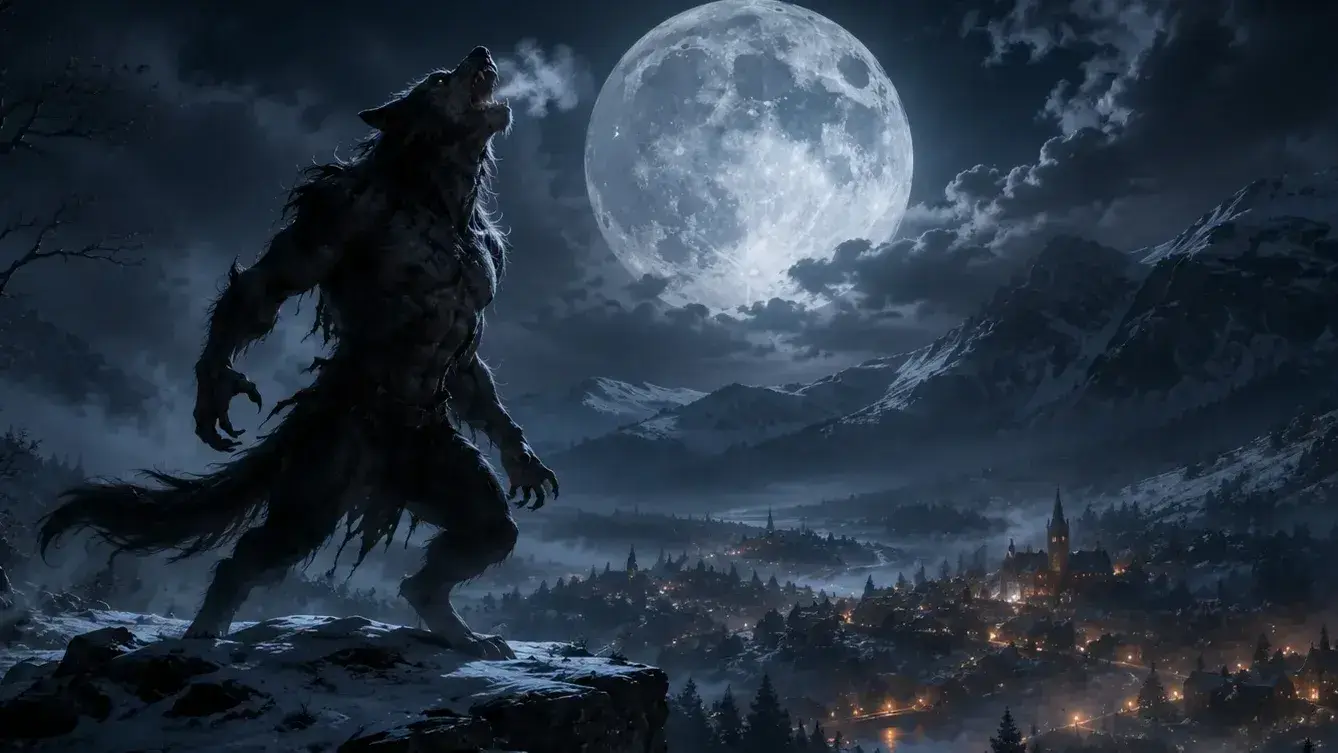
The Beast Beneath the Skin
A werewolf — from the Old English wer (man) and wulf (wolf) — is a human being who transforms, willingly or in agony, into a wolf or a towering wolf-man. The transformation is the whole of the terror. Vampires keep their faces; ghosts keep their grief. The werewolf loses the one thing that made it human: its self. What hunts in the night is not a person making evil choices but a person erased, the reasoning mind drowned beneath instinct, hunger, and the smell of blood.
The Greeks called the affliction lycanthropy, after the Arcadian king Lycaon, whom Zeus turned into a wolf for serving the gods human flesh — already, at the very root of the myth, the wolf is a punishment for a crime against humanity itself.
The Many Roads to the Wolf
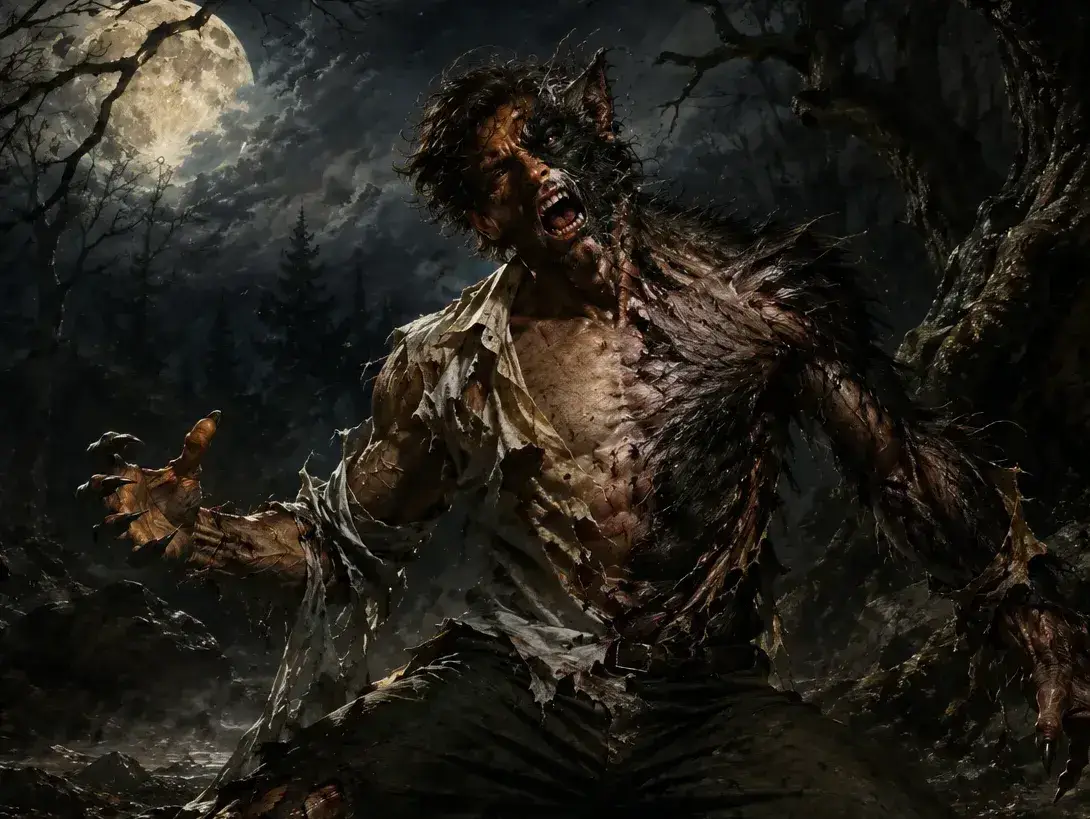
Folklore is unusually specific about how a person crosses over, and the variety is half the dread — because almost any of them could happen to you:
The bite. The modern favourite: survive a werewolf's attack and the curse enters the blood. (This rule is largely a gift of 20th-century cinema, not old folklore.)
The pelt or the belt. Across medieval Germany and Scandinavia, a man became a wolf by donning an enchanted wolf-skin or buckling a wolf-hide belt — strap it on, and the beast strapped itself to you.
The pact. Sorcerers and witches were said to take wolf-shape through a bargain with the Devil, smearing themselves with a salve and running the night roads as beasts.
The curse. A saint's wrath, a parent's dying words, being born on Christmas, or being the seventh son of a seventh son — fate alone could mark a child for the wolf.
The water in the paw-print. In Balkan and Slavic tales, simply drinking rain that had pooled in a wolf's footprint was enough to begin the change.
The Centuries of Blood
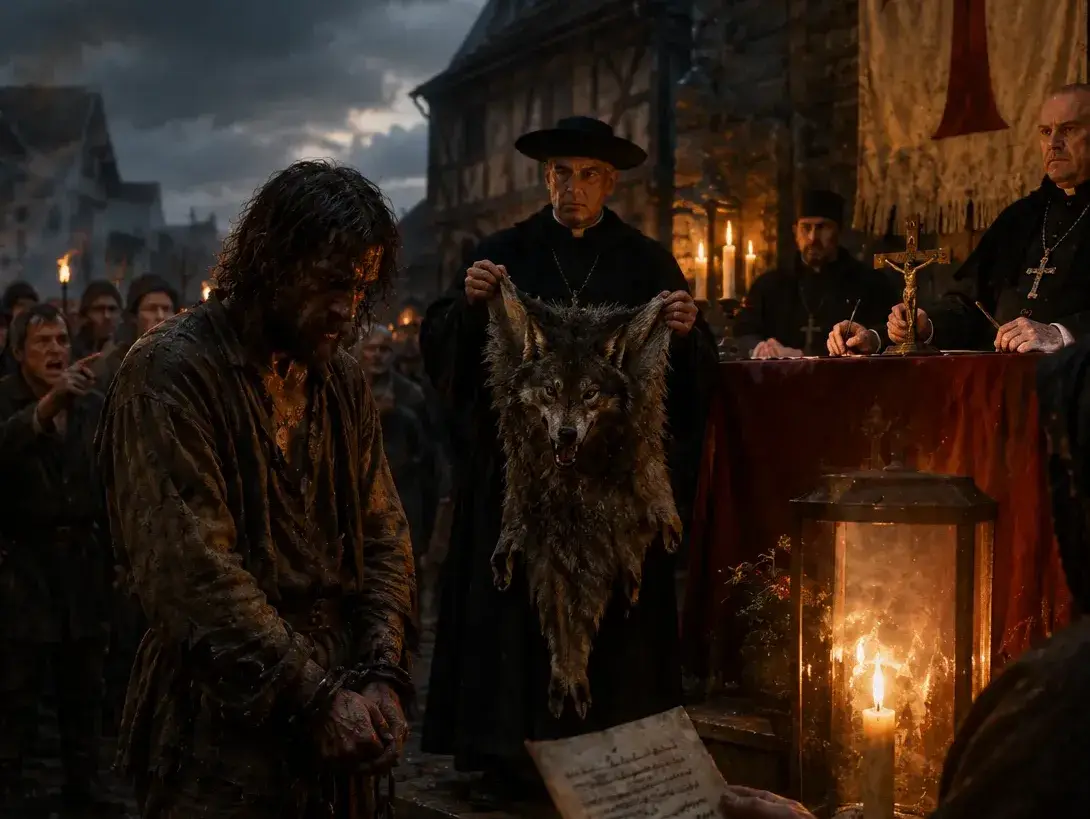
Here the legend turns from story into something far colder — because for two centuries, Europe tried and executed real people as werewolves. The same fever that fed the witch trials gave us the wolf trials, and the records still make the skin crawl.
In 1573 the French hermit Gilles Garnier, the “Werewolf of Dole,” was burned for killing children in the fields, confessing under torture that an ointment let him take wolf-form. In 1589, in Bedburg near Cologne, Peter Stubbe was broken on the wheel after a confession of monstrous crimes committed, he said, while wearing a magical wolf-belt given by the Devil. There was Jean Grenier, a disturbed teenage shepherd; the Gandillon family of the Jura; and thousands more across France and Germany who died for a transformation that, we now believe, lived only in fear, ergot-poisoned grain, mental illness, and the screams of the tortured.
The werewolf trials are the legend's darkest truth: long before it frightened us at the cinema, it was an excuse to burn the strange, the sick, and the unlucky.
Silver, Wolfsbane, and the Ways to End It
Everyone “knows” you kill a werewolf with a silver bullet — yet that, too, is mostly a creation of film. Older folklore offered humbler defences. Wolfsbane (aconite) was the true botanical ward, planted at thresholds and hung in doorways. A wound that drew blood was thought to break the spell and reveal the human beneath. Calling the afflicted by their Christian name could snap them back to themselves. Iron, exhaustion, the cock's crow at dawn, and the simple turning of the moon all returned the wolf to the man — until the next full moon dragged him out again.
Brothers Across the World
The wolf-man is not one creature but a hundred wearing the same hunger, and the older they are the more they bleed into one another:
In France he is the loup-garou; in Portugal and Galicia the lobisomem; carried across the ocean he becomes the lobizón of Argentina and Brazil, fate of the cursed seventh son.
Among the Slavs the vlkodlak / vukodlak blurs unsettlingly into the vampire — in much of Eastern Europe the same word served both, and a dead werewolf was feared to rise as a blood-drinker.
The Greek vrykolakas, the snarling pricolici of Romania, and the Norse úlfheðnar — “wolf-coats,” warriors who fought in a wolf-skinned battle-fury kin to the berserker.
And the cousins that are not the same, however the films confuse them: the Navajo skinwalker and the Algonquian wendigo are their own distinct horrors, born of different soil — proof that humanity reaches for the wolf-man independently, again and again.
Why the Wolf?
Of all the animals, why has the wolf carried this weight for so long? Because for most of human history the wolf was the predator at the exact edge of the firelight — the wild watching the warmth, the thing our herds and our children were lost to in the dark. To imagine a man becoming that was to give shape to the fear we carry about ourselves: that civilisation is only a skin; that beneath the manners and the morning prayers there is an animal that remembers how to hunt, and that the right moonlight could call it out.
The werewolf endures because it is never really about wolves. It is about the beast we are afraid we already are.
So when the moon comes full and the dogs in the village will not stop barking — look around the fire at the faces you trust most. The old stories swear that one of them already knows which way the change is coming.
The Oldest Testimony
The werewolf does not begin in a German forest or a French courtroom. It begins in a Greek historian’s notebook, written down with an audible shrug. In the fifth century BC Herodotus reported that the Neuri, a people living north of Scythia, were said by their neighbours to turn into wolves for a few days once every year, and then turn back. He wrote the claim down and refused to believe it — which tells us something more interesting than belief would have: the story was already so widespread that a sceptic could not get through his account of the northern world without addressing it.
The first werewolf we actually watch transform, though, appears in a Roman novel. In the Satyricon of Petronius, written under Nero, a freedman named Niceros tells a dinner-party story about walking to a lover’s house by moonlight with a soldier for company. They stop at a roadside cemetery. The soldier strips, piles his clothes by the road, makes water in a ring around them — and becomes a wolf, howling into the trees. When Niceros tries to gather the abandoned clothes, they have turned to stone. He reaches the farmhouse to find chaos: a wolf has been in among the livestock, and a farmhand drove a spear through its neck. At dawn he passes the spot where the clothes lay; there is nothing but a pool of blood. Back home, the soldier is lying in bed with a doctor dressing a wound in his throat.
Niceros has a word for him: versipellis — turnskin, the one who reverses his hide. Two thousand years before any film, the story already contains the single most durable rule in werewolf folklore: wound the beast and you wound the man. Injure the wolf in the field, and the neighbour you suspect will be nursing the same cut in the morning. That motif runs straight through the early modern trial literature, and in the hands of magistrates who wrote books about their own prosecutions it was treated as evidence.
Arcadia and the Nine-Year Wolf
Greek writers were unusually specific about where werewolves came from, and the answer was always the same place: Arcadia, the wild mountainous heart of the Peloponnese, the one region of Greece the rest of Greece thought had never quite finished becoming civilised.
Pliny the Elder preserves the strangest version, and he is careful to attribute it to a Greek author rather than vouch for it himself. A family of Arcadia, the story runs, chose one of its members by lot; the man hung his clothes on an oak, swam across a marsh-pool, and lived among wolves for nine years. If in all that time he tasted no human flesh, he could swim back, find his clothes where he had left them, and put on his own body again — nine years older. Pliny records it and then sneers at Greek credulity in the same breath, but the shape of the story matters: this is not a curse. It is an ordeal, a term of exile in animal form with a rule of abstinence attached and a way home at the end.
The engine driving all of it is Lycaon, and Ovid gives the fullest account in the Metamorphoses. Jupiter, disguised as a traveller, tests the notorious king of Arcadia; Lycaon serves him the cooked flesh of a hostage. The god blasts the palace, and the king runs howling into the fields, his rage finding a form that fits it: his clothes stiffen into hair, his arms drop to the ground, and he keeps — this is the part Ovid lingers on — the same grey hair, the same violent face, the same glittering eyes. Ovid’s point is that nothing about Lycaon really changed. Only the packaging.
And this was not merely literary. On Mount Lykaion in Arcadia stood a sanctuary of Zeus Lykaios with an enormous ash altar, built up over millennia from the burnt bone of sacrifice; excavation has traced activity there back into the Bronze Age and earlier. Ancient authors whispered that at the festival on that mountain a man tasted a portion of human flesh among the sacrificial meat and became a wolf for nine years. Pausanias, touring Greece in the second century AD, reports the belief as current and repeats the tale of the Arcadian boxer Damarchus, said to have spent nine years as a wolf before winning at Olympia — while pointedly declining to believe that part. A human burial found within the ash altar in modern excavation reopened the old question without settling it, and the excavators were careful to say it proves nothing on its own. What is certain is that Greeks living within a day’s walk of the mountain thought something happened up there that made men into wolves.
The Skins That Would Not Come Off
The North supplies the most physical werewolf story in European literature, and it is not a horror tale — it is a father-and-son story that goes wrong. In the Völsunga saga, Sigmund and his son Sinfjötli, living as outlaws in the woods, come upon two men asleep in a house with wolf-skins hanging above them. They put the skins on and cannot take them off. They can only speak in howls; the pelts can only be shed every tenth day. They agree a rule — neither will take on more than seven men alone — and Sinfjötli, being young, kills eleven and boasts about it. His father goes for his throat and nearly kills him. When they finally burn the skins, they do it hoping no one will ever wear them again.
That story is bound up with a word. Old Norse vargr means wolf — and it also means criminal, oath-breaker, outlaw. A man declared vargr í véum, “wolf in the sanctuary,” had put himself outside the community; the fully outlawed man was a skógarmaðr, a forest-man, driven into the woods where wolves live. English law thought the same way: the outlaw was said to bear a wolf’s head, caput lupinum, and might lawfully be killed on sight by anyone who met him, exactly like vermin.
This is the werewolf’s unglamorous root, and it is worth sitting with. Before the transformation was supernatural it was legal. To be made a wolf meant to be stripped of the protection of law and the recognition of your neighbours — and then to be hunted. The medieval peasant who feared a man could turn into a wolf had watched it happen to real men, in daylight, by verdict.
The Werewolf Who Was Not a Monster
Almost everything modern audiences assume about werewolves is inverted by the medieval romances — because there, the werewolf is the victim, and usually the most loyal character in the story.
The finest of them is Bisclavret, a Breton lai composed in the twelfth century by Marie de France. A well-loved baron disappears three days of every week. His wife, frightened, coaxes the truth from him: he becomes a wolf, and he must hide his clothes, because without them he can never return to human shape. Having learned this, she takes a knight as an ally, steals the clothes, and leaves her husband stranded in his own body. A year later the king’s hunt corners the wolf, and the animal does something wolves do not do — it seizes the king’s stirrup and kisses his foot. It becomes the gentlest creature at court, and stays gentle until the day it sees the wife and her new husband, and tears the nose from her face. Under questioning she confesses; the clothes are returned; and Marie adds a last, chilling note — the woman’s daughters were born without noses, and so were their daughters after them.
Marie’s werewolf is never once the villain of his own story. The betrayal, the cruelty and the disfigurement all originate on the human side of it. The same sympathy runs through the lai of Melion, whose knight is trapped in wolf-form when his wife steals the ring that changes him back; through the Latin tale of Arthur and Gorlagon; and through the romance of Guillaume de Palerne, in which a prince enchanted into a wolf by his stepmother spends the book protecting a lost child, stealing food for him, and guarding him while he sleeps. In every case the trigger of the tragedy is a wife, a stepmother, a stolen garment — and the wolf is the wronged party waiting to be recognised.
The Wolves of Ossory and the Problem of the Soul
Around 1188, Gerald of Wales recorded a story he presents as recent fact. A priest travelling through the Irish woods is approached at his campfire by a wolf that speaks courteously and asks him not to be afraid. The wolf explains that by the curse of an abbot, Saint Natalis, two people of Ossory must every seven years leave human shape and live as wolves; when the term ends, if they survive, two others take their place. His companion is dying, and wants the last rites.
The priest hesitates — and here the tale becomes theologically explosive. To give the sacrament to an animal is a grave error. So the male wolf goes to the dying she-wolf and, with his claw, peels the wolf-skin back from her head to her navel, revealing the body of an old woman underneath. The priest, satisfied, administers communion.
What makes this more than a campfire story is the argument Gerald builds around it, because the Church had a firm position and this collided with it. Augustine, in The City of God, had considered the Arcadian wolf-tales and Circe’s enchanted sailors and concluded that demons cannot make or unmake a nature; they can only counterfeit appearances and deceive the senses. The Canon Episcopi, carried into canon law in a collection of the early tenth century and copied for centuries afterwards, went further and made it a matter of orthodoxy: to believe that any creature can be changed into another shape or likeness by anyone other than God is faithlessness. So a werewolf could not be real — and yet men confessed to it, courts convicted for it, and a Welsh archdeacon wrote up a wolf receiving the Eucharist.
That contradiction is precisely why the werewolf became so dangerous later. Once theologians shifted from “transformation is impossible” to “transformation is a diabolical illusion, and consorting with the Devil is real,” the impossibility of the crime stopped being a defence. You could be burned for a thing that could not happen.
The Hounds of God
In 1692, in Livonia, an old man called Thiess was brought before a court and cheerfully admitted, without any torture at all, that he was a werewolf. Then he told the judges something they were entirely unprepared for.
Werewolves, Thiess said, are the hounds of God. Three nights a year — Pentecost, Midsummer, and the night of Saint Lucia — he and others went down to hell to fight the Devil and his witches, who had carried off the grain, the livestock and the fruits of the earth. The werewolves drove them with long iron rods and chased them like dogs; a witch once struck him on the nose with a broom handle trailing horses’ tails. If the werewolves won, the barley and the oats and the rye came back. Everything the village ate depended on their winning. He would go to heaven, he said, and it was the witches who went to the Devil.
The court pressed him hard, across hearings that ran from 1691 into the following year, and could not make him recant or make his account fit the theology it wanted. In the end it convicted him of leading people away from the Church and sentenced him to a flogging and lifelong banishment — and the record he left behind is one of the most valuable documents in the whole subject, because it preserves a folk belief the trials were busy erasing everywhere else: that the man who runs with wolves at night might be the one keeping the village alive.
How to Know One by Daylight
Folklore is full of tells, and they share an ugly logic: every one of them is a feature some real person actually has. Eyebrows that meet above the nose. Hair on the palms of the hands. An index finger longer than the middle finger. Curving nails, low-set ears, a reddish cast to the hair, a restlessness in sleep.
Two “proofs” went further, and both were lethal. The first is the wound transfer already old in Petronius: injure the wolf, then look for the matching injury on your neighbour. The second is grimmer — the belief that the werewolf’s hair grows inward, so that the skin looks ordinary while the pelt lies hidden beneath it. A much-repeated account has a farmer taken near Pavia in 1541 telling his captors that the only difference between him and a real wolf was that a wolf’s hair grows outward and his grew in. To test it, the magistrates cut off his arms and legs. He died of the mutilation, and the question was never settled.
Read the list again and the werewolf panic stops looking like a supernatural episode and starts looking like a machine for converting oddness into guilt. Hairiness, isolation, poverty, a strange manner, a wound of unlucky timing — the diagnostics were designed, whether anyone intended it or not, to find someone.
The Beast of Gévaudan
Between 1764 and 1767, something killed close to a hundred people in the uplands of Gévaudan in south-central France. The victims were overwhelmingly women, children and shepherds working alone; the attacks went for the head and throat; survivors described an animal larger than a wolf, russet-coloured, with a dark stripe along its spine. Terror emptied the pastures, and the affair became national news through the printed broadsheets — arguably the first mass-media monster.
Louis XV sent dragoons, then professional wolf-hunters, then his own gun-bearer, François Antoine, who in September 1765 shot an exceptionally large wolf, had it stuffed and carried to Versailles, and was rewarded for it. The killings resumed within months. They finally stopped in June 1767, after a local hunt on the slopes of the Mont Mouchet in which a farmer named Jean Chastel shot an animal.
What the Beast actually was — an unusually bold wolf, several wolves, a wolf-dog hybrid, or a human killer sheltering behind the panic — has never been settled, and the honest answer is that it probably cannot be. What is certain is the myth-making. The now-famous detail that Chastel loaded a silver bullet blessed by a priest does not appear in the contemporary record; it accreted later, as stories do. Gévaudan is where the folk werewolf met the modern newspaper, and the newspaper won.
The Illness That Carries the Wolf’s Name
While theologians argued about demons, physicians were quietly treating werewolves as patients. Greek and Byzantine medical writers — Aëtius of Amida in the sixth century, Paulus Aegineta in the seventh, both drawing on earlier work — describe lycanthropia as a specific form of melancholy with a recognisable clinical picture, and one of them is precise enough to say the cases cluster in February. The sufferer goes out at night, imitates a wolf or a dog, and haunts the tombs until daylight. He is pale; his eyes are hollow and dry and will not produce tears; his tongue is parched, he makes little saliva, he is desperately thirsty; and his shins are covered in open sores from striking them over and over in the dark. The prescribed treatment is to open a vein and bleed him until he nearly faints, then wet compresses, then opium rubbed into the ears and nostrils to force sleep. It is not superstition. It is a doctor describing a syndrome he has seen more than once and giving it the only name that fitted.
Modern medicine still recognises it. Clinical lycanthropy — the delusion of having been transformed into an animal — remains a rare but documented presentation in the psychiatric literature, usually alongside psychosis or severe mood disorder. Other explanations cover other parts of the legend without exhausting it: rabies, which produces agitation, aggression and hydrophobia and spreads by bite, a disease that behaves almost exactly like the curse; and hypertrichosis, the condition that covers a body in hair. In the sixteenth century a Canary Islander named Petrus Gonsalvus, born with it, was raised at the French court and displayed across the courts of Europe as a marvel — a man everyone agreed looked like a wolf, and who was, by every account, entirely gentle.
The Werewolf Hollywood Actually Wrote
Most of the “ancient” werewolf rules are about eighty years old, and we can very nearly name the author. The screenwriter Curt Siodmak, working on Universal’s The Wolf Man (1941), supplied most of the modern legend himself: the doomed man who wants to be stopped, and the verse that sounds like something recited by peasants for centuries — the man pure in heart who becomes a wolf when the wolfsbane blooms — which Siodmak wrote for the film. The pentagram appearing in the palm of the next victim is his too. Even the moon rule is not quite where people think: the explicit full moon trigger was only fixed in the 1943 sequel, and Lawrence Talbot dies not by silver bullet but beaten down with his father’s silver-headed cane.
Everything after grows from that root. An American Werewolf in London (1981) put the transformation on screen in unbroken agony — stretching bone, splitting skin, a man screaming that it hurts — and won Rick Baker the first competitive Academy Award ever given for makeup, permanently establishing that the change itself is the set-piece. The Howling arrived the same year with a rival approach. Ginger Snaps (2000) rebuilt the whole myth around menarche and adolescence, which is where it had always secretly lived. Angela Carter’s The Company of Wolves, and Neil Jordan’s film of it, gave the wolf back to the fairy tale and to female desire. In games the wolf-man became something you choose — a playable curse in The Elder Scrolls, a whole tabletop mythology in Werewolf: The Apocalypse, a city drowning in beasthood in Bloodborne.
The Curse That Keeps Changing Its Meaning
Each age gets the werewolf it needs, and the shape of the curse is a fairly precise reading of what that age is frightened of.
For the Greeks it was pollution — a man who eats what must not be eaten stops being a man. For medieval law it was exile: the wolf is what a community makes of someone it has cast out. For the Church it was the integrity of the soul, and the horror was less the fangs than the possibility that a human being could be unmade. For the early modern courts it was the neighbour with a secret, and the wolf-skin was an excuse to search a village for someone to blame. In the nineteenth century, as the wolves themselves were hunted out of one western European country after another, the werewolf drifted into fiction and became a study of the divided self. And since 1941 it has been an infection — something in the blood, contracted from an attacker, incurable, carried in secret by someone who did nothing to deserve it and would give anything to be free of it.
That last version is why the story refuses to die in an age with streetlights. Nobody now fears a wolf at the edge of the pasture. What people do fear is the body doing something they did not authorise — a rage that arrives from nowhere, a craving stronger than the will, an illness that changes who they are to the people who love them, a diagnosis that turns a familiar face into a stranger’s. The werewolf is the only monster whose central terror is not being hunted. It is becoming the thing that hunts, and being unable to warn anyone in time.
Sources & traditions
- EncyclopediaWikipedia — Werewolf
- TraditionMedieval European texts, inscriptions and later retellings
Myths change from area to area and from time to time. This chronicle follows the most widely told versions; tellings in other villages, regions and eras may differ.