Talos was a giant made of bronze — the ancient world's dream (and nightmare) of the robot, an artificial man of living metal who guarded the island of Crete by circling its shores three times a day and hurling boulders at approaching ships. Forged not born, he is one of the oldest automatons in all of human imagination.
The Bronze Guardian
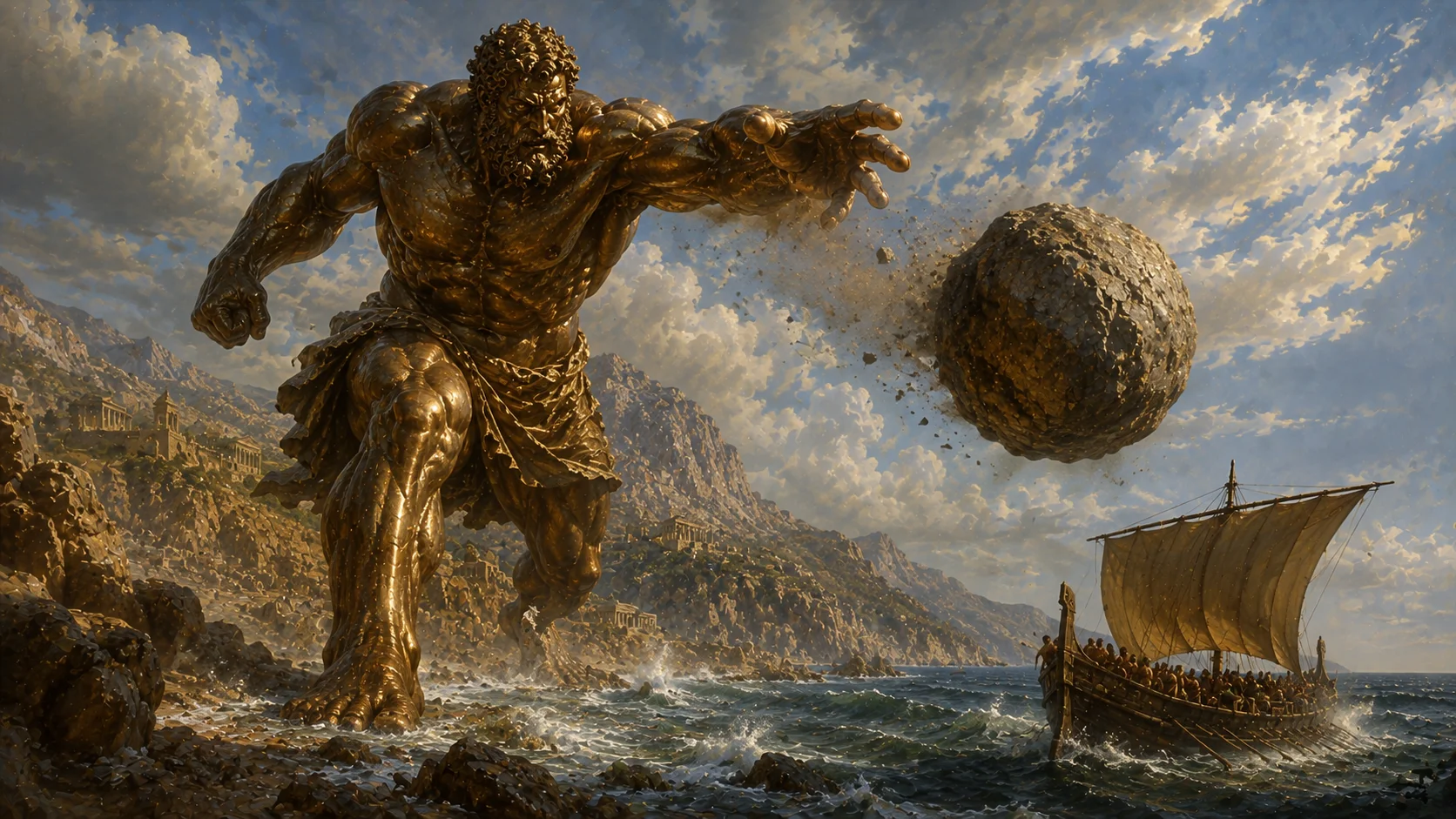
Talos was a colossal automaton of gleaming bronze, made (in most accounts) by the smith-god Hephaestus and given to King Minos of Crete — or to Europa — to protect the island. His task was relentless and mechanical: he marched around the entire coast of Crete three times every day, watching for intruders. When enemy ships approached, he pelted them with great stones; and if invaders landed, he would heat his own bronze body red-hot in a fire and crush them against his burning chest in a deadly embrace.
The Single Vein
But this living machine had one secret weakness. Talos was animated by a single vein or channel of ichor (the divine fluid that served as his “blood”) that ran the length of his body from his neck to his ankle, sealed at the bottom by a single bronze nail or bolt. Pull that nail, and the ichor would drain out, and the bronze giant would die. It is the original “single point of failure” in a mechanical being — the one flaw in an otherwise invincible machine.
The Death by Medea's Magic
When the Argonauts arrived at Crete, Talos moved to drive them off with his boulders. It was the sorceress Medea who undid him — either by bewitching him into a frenzy until he grazed his ankle and bled out his ichor, or by hypnotising him with promises of immortality while she removed the fatal bronze nail. Either way, the divine fluid that gave him life drained away, and the great bronze guardian collapsed, lifeless, the first robot in literature to be defeated by exploiting its hidden flaw.
The First Robot
Talos endures as a remarkable creation of the ancient mind — a sentient artificial being of metal, made rather than born, with a power source and a fatal vulnerability. He prefigures every robot, golem, and android in the millennia of stories since, and remains one of mythology's most strikingly modern monsters: the man of bronze who patrolled the shore until someone found the one nail that held his life in.
An invincible giant of living bronze — undone by a single nail, the first machine in history to fall to its own flaw.
Two Different Bronze Men
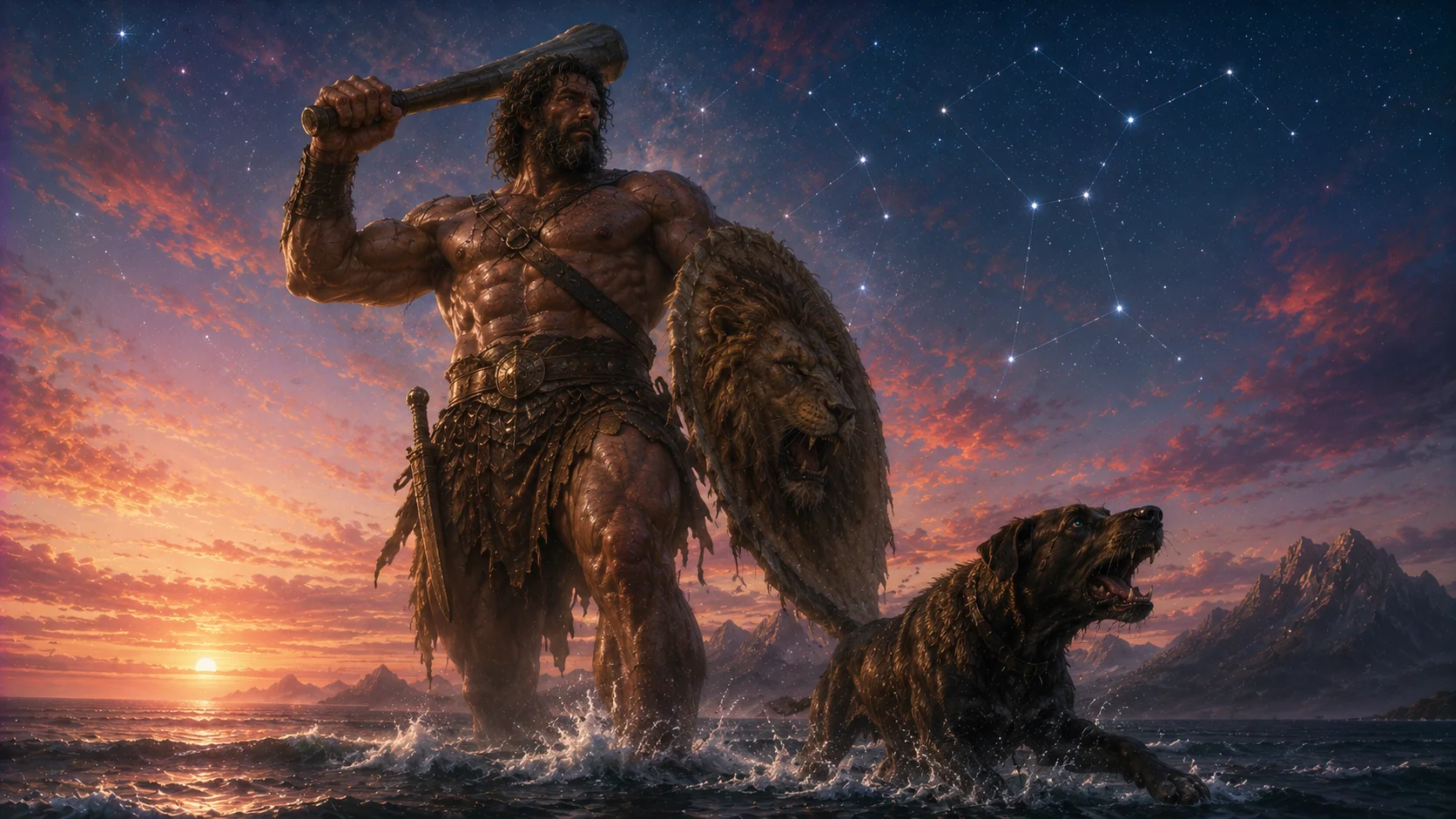
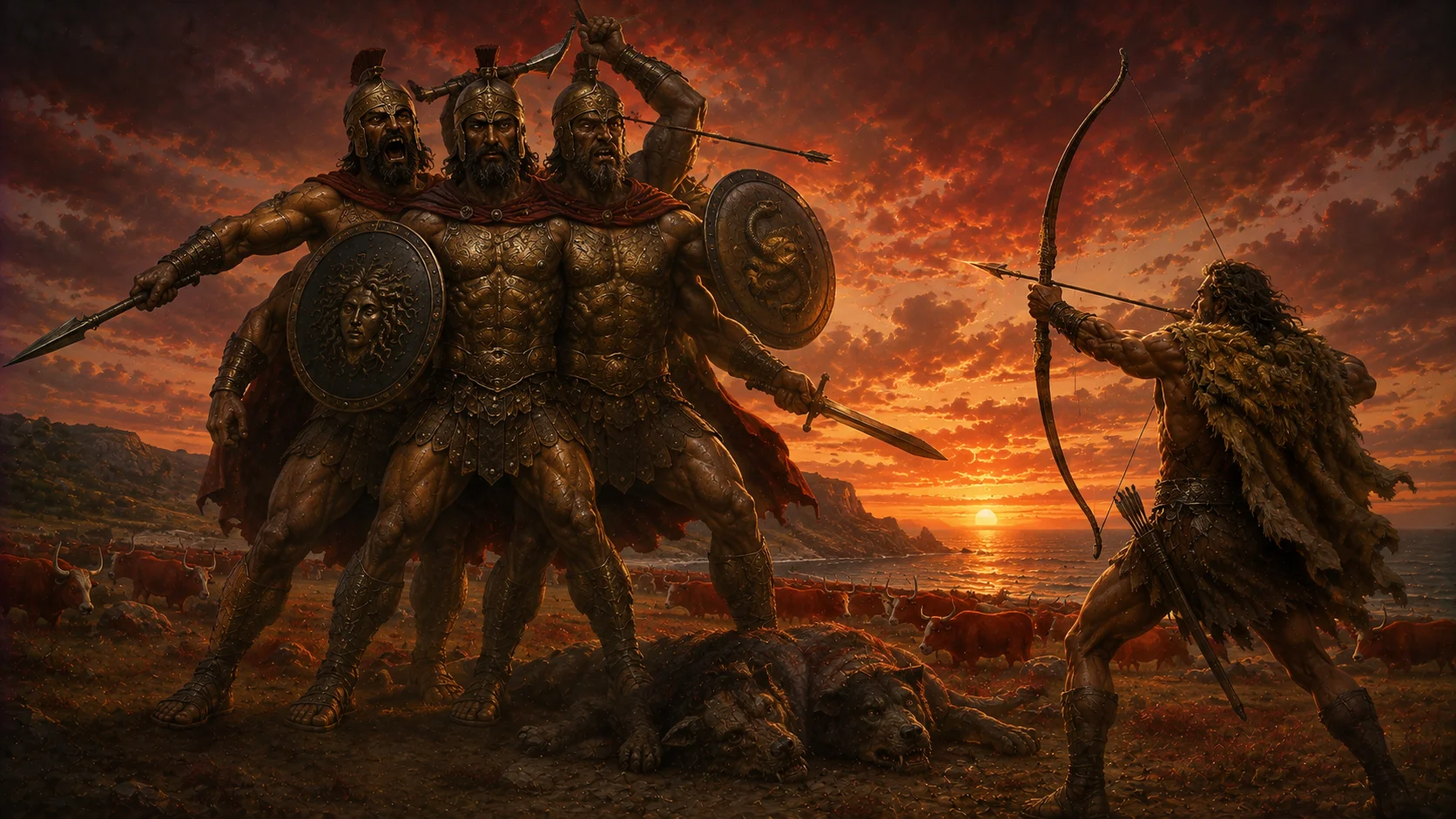
Ask two ancient writers where Talos came from and you get two different giants. Apollonius of Rhodes, whose Argonautica preserves the fullest surviving account, describes no smith's commission at all: his Talos is the last of the bronze race, the men sprung from ash trees, a survivor of an earlier humanity whom Zeus handed to Europa to keep watch over Crete. The phrase echoes Hesiod's third age of men — though Hesiod himself never names Talos, and the connection is Apollonius's to make. Apollodorus, cataloguing the myths later, refuses to choose: some say Talos belonged to the brazen race, he reports, others that Hephaestus made him and gave him to Minos — and then, in a single startling clause that almost no retelling picks up, he adds that some say he was a bull. Elsewhere the same writer lists Talos among three gifts Zeus gave Europa after carrying her to Crete on his back: the bronze man, a hound named Laelaps that never lost what it hunted, and a javelin that never missed. In that version he is not a private commission but part of a set — three impossible objects meant to make an island unconquerable. None of these accounts cancels the others out. Myth rarely settles on a single lineage for its strangest figures, and Talos — neither wholly made nor wholly born — sits at the seam between all of them.
A God Behind the Machine
Long before Apollonius wrote his epic, Crete was already swearing oaths by something called Zeus Tallaios. He appears by name in the treaty oaths of Dreros and Olous, invoked alongside Helios and a crowd of other gods, and Olous struck coins carrying his head. The Tallaia, a spur of the Ida range, bore the same name. And the ancient lexicographer Hesychius glosses the Cretan word talos with a single word: the sun. Put those threads together and the bronze sentry starts to look less like a poet's invention than the shadow of a solar cult, recast as a giant who paces the coastline the way the sun paces the sky — a fixed, tireless circuit that never rests and never looks away. It is a suggestive alignment rather than a proven descent; no ancient text says outright that the god became the automaton. But the machine of the Argonautica may well be the literary afterimage of a god Crete had been naming in its most binding oaths for generations before anyone thought to give him a single vein of ichor.
The Bronze Man of Sardinia
Crete did not keep Talos to itself. The poet Simonides, writing around 500 BCE and surviving here only because later proverb-collectors quoted him, placed Talos in Sardinia: when the Sardinians refused to hand him over to Minos, the bronze man leapt into a fire to heat himself and crushed them against his chest until they died — and their faces, the story goes, were left locked in a grin. That grin is the ancient explanation for the phrase sardonic laughter: mirth with nothing warm in it, named for the island. The ancients themselves disagreed about it, and it is worth saying so. Others derived the phrase from a Sardinian plant, the sardonion, said to convulse the face of anyone who ate it; modern etymologists generally prefer that route, or trace the word further back to the obscure sardanios smile Homer gives Odysseus. What survives regardless of the etymology is the shape of the thing — a burning bronze guardian who kills by embrace — portable enough to be reattached to a different coastline and a different set of fears.
The Death Scene in Clay
Ancient painters rarely lingered over a monster's death with anything resembling tenderness, but Talos got exactly that. An Attic red-figure volute krater of around 400 BCE — found at Ruvo in southern Italy, and so celebrated that its anonymous maker is known simply as the Talos Painter — shows him not mid-battle but already going down: the bronze body painted white to set it apart from living flesh, the legs buckling, the giant falling backwards into the arms of the Dioscuri, Castor and Polydeuces, while Medea works at the fatal ankle and the Argonauts look on from the ship. It is a strangely gentle composition for a killing, closer to a deposition than a monster-slaying, as though the painter understood that something was being lost as well as defeated. And on Crete itself the city of Phaistos struck silver staters around 300 BCE showing a winged Talos with his arm drawn back to throw, his name spelled out beneath him and a bull on the reverse — the animal Zeus wore to carry Europa to the island in the first place. A city does not put a monster on its money. On the shore he guarded, Talos was read as a protector worth minting.
Afterlife: From Papyrus to the Screen
Talos's most famous modern moment arrived in 1963, when the stop-motion animator Ray Harryhausen put him on screen in Jason and the Argonauts. The sequence has become one of the most studied minutes in special-effects history: the enormous head grinding round on its plinth, the slow horror of realising the statue has noticed the men robbing its treasury, the stiff-jointed pursuit — and finally the plug at the back of the ankle, which Jason unseals on Hera's advice so that the ichor drains away in a bright stream. Harryhausen's creatures are named again and again by the animators and directors who followed him as the reason they went into the business of building monsters. It was a second life precisely suited to what Talos already was in antiquity — not organic, not supernatural in the ordinary way, but built, and therefore open to being rebuilt by each age according to its own idea of what a metal guardian would be.
Why We Keep Building Him
The earlier telling of this myth dwells on the flaw — the one nail, the one vein, the single point of failure. Sit with the story a little longer and a quieter anxiety surfaces underneath it: Talos cannot be reasoned with, and that is what makes him both the perfect guardian and the perfect victim. He does not sleep, cannot be bribed, cannot be worn down by a long siege — and for exactly that reason he cannot recognise a lie when Medea tells him one, because recognising a lie would require the judgment his makers deliberately left out of him. Every culture that has since imagined a tireless mechanical protector has walked into the same trade-off: the more perfectly a guardian obeys its instructions, the more completely it can be undone by someone who understands those instructions better than its maker did. Talos has been circling that shoreline for something like twenty-five centuries of retelling, and the trade-off has never once been solved. It simply keeps finding new bronze to live in.
Sources & traditions
- EncyclopediaWikipedia — Talos
- TraditionGreek texts, inscriptions and later retellings (Greece)
Myths change from area to area and from time to time. This chronicle follows the most widely told versions; tellings in other villages, regions and eras may differ.