Before Apollo, the most sacred site in Greece belonged to a monster: Python, the colossal earth-serpent who guarded the oracle at Delphi. The slaying of Python by the young sun-god is the myth of how the bright Olympian order claimed the most ancient and powerful holy place on earth — and it left its mark on the oracle forever.
The Serpent of the Sacred Chasm
Python was a monstrous serpent or dragon, a child of Gaia the Earth, who dwelt at the foot of Mount Parnassus and guarded the chasm at Delphi — a place sacred to the most primal earth-powers, where prophetic vapours were said to rise from the ground. The oracle there was originally Gaia's own, and Python was its ancient, chthonic guardian.
The Slaying by Apollo
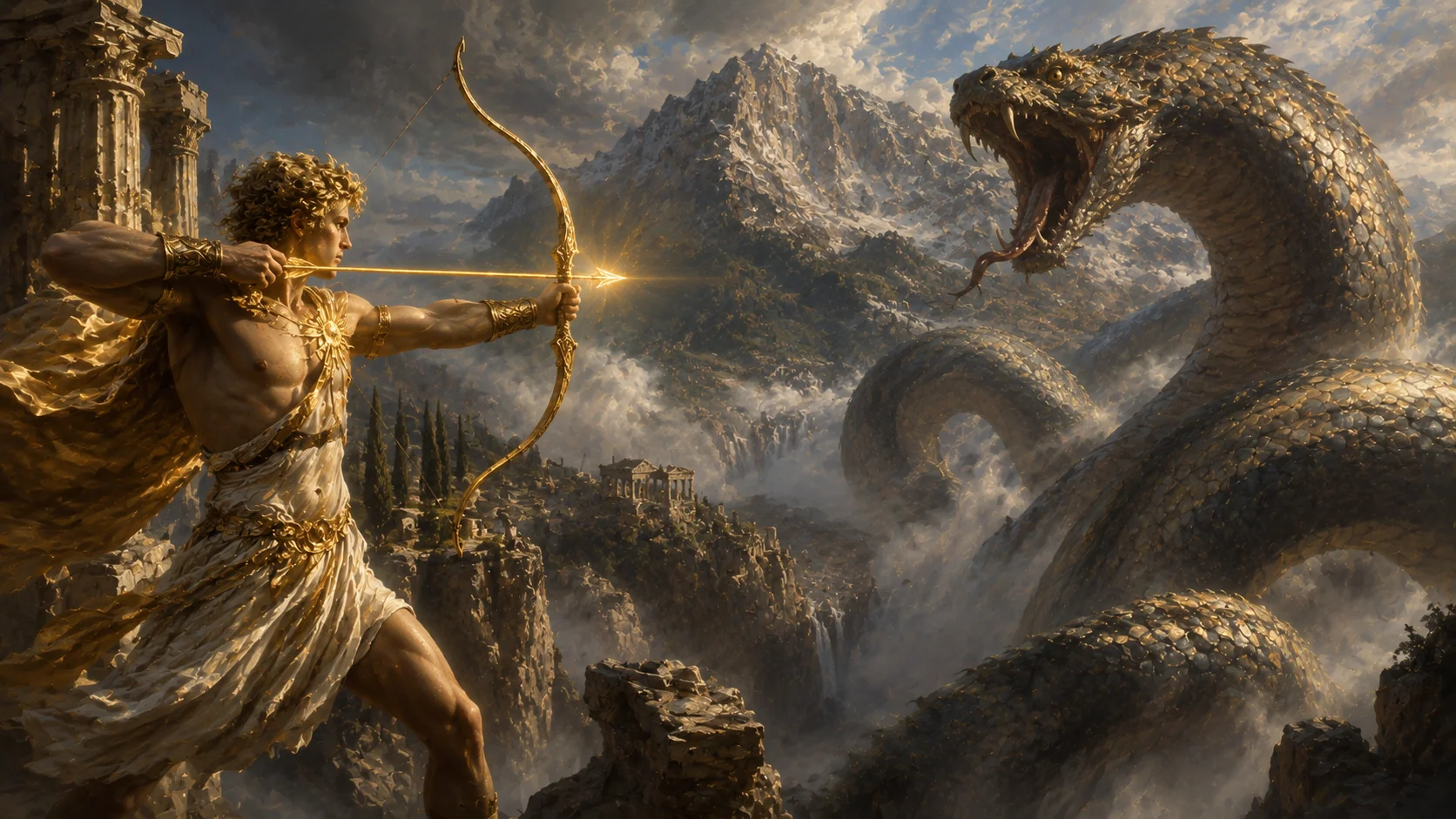
The young god Apollo, seeking a site for his own oracle, came to Delphi and slew Python with his arrows — some say to avenge the serpent's pursuit of his mother Leto. With the old guardian dead, Apollo claimed the oracle as his own, and Delphi became the centre of his worship and the most important prophetic site in the entire Greek world. The bright god of order had wrested the sacred chasm from the powers of the primal earth.
The Pythia and the Pythian Games
Python's memory was woven into everything that followed. Apollo's prophetic priestess was called the Pythia after the slain serpent; the athletic festival held at Delphi was named the Pythian Games; and Apollo himself bore the title Pythios. Some traditions even said the prophetic vapours rose from the rotting body of Python deep in the earth — so that every prophecy spoken at Delphi carried, in a sense, the breath of the monster Apollo had killed.
Order Over the Ancient Earth
The myth of Python is really the myth of a religious transition — the newer Olympian gods taking over the holy places of the older earth-deities. But the old power was never fully erased; it lingered in the names, the vapours, and the serpent coiled forever beneath the most famous oracle in history.
Apollo killed the serpent — but he ruled its chasm, and spoke through its breath, ever after.
A Name Carved From Decay
Most Greek monsters carry names whose meaning has worn away with time. Python's has not. The Homeric Hymn to Apollo, the oldest surviving account of the slaying, stops over the corpse: Apollo stands above the dying serpent and tells it to rot where it lies, and the sun of that valley does the rest. From that rotting, the hymn says, the sanctuary took its name — Pytho, from the Greek verb pythein, "to rot" or "to putrefy" — and the god took his title from it too. It is a rare case of a myth stopping to explain its own vocabulary in the same breath as the killing, and the explanation is not a flattering one. The most famous holy place in the Greek world was named neither for its god nor for its oracle, but for a smell.
The Earliest Telling: A She-Dragon and the Monster She Nursed
The version most readers know — a clean duel between a young god and an ancient guardian — is already a simplification of the oldest text we have. The Homeric Hymn to Apollo never calls the creature Python at all. It describes a drakaina, a she-dragon, and gives her a second and stranger role long before Apollo ever reaches Parnassus: she was the nurse of Typhaon, the monster Hera bore by herself, without Zeus, in fury at his having produced Athena from his own head without her. Delphi's guardian belonged, in this telling, to the same household of chaos as the creature who came closest to unseating the king of the gods.
The name Python fastens onto the figure only in later retellings, and the serpent's sex drifts as it does: female in the hymn, male in Ovid and in the mythographers who follow him. It is a seam the tradition papered over and never quite closed, and it is worth noticing, because it means the monster at Delphi was being rewritten while the sanctuary was still working.
Ovid's Flood-Born Serpent
By the time Ovid retold the story in the Metamorphoses, it had been transplanted into an entirely different setting: the aftermath of the flood sent to drown a corrupt humanity. When the waters withdrew, Ovid writes, the sun struck the leftover mud and the warmed slime bred life of its own accord — exactly as the Nile's silt was believed to do when it fell back from the fields. Most of what crawled out was ordinary. One thing was not. Python arrived as an accident of that fertile ooze, a serpent on a scale the resettled world had never seen, and Apollo — who by Ovid's own admission had until that day used his bow on nothing larger than deer and fleeing goats — spent a thousand shafts on it and emptied his quiver almost to the last arrow.
Ovid founds the games on the slaughter directly, and adds a detail no later summary keeps: the victors were crowned with oak, because the laurel did not exist yet. It appears in his next scene. Still boasting of the kill, Apollo mocks the small bow carried by Cupid, who shoots him with it, and the chase after Daphne — who becomes the laurel — begins immediately. The god's first triumph and the god's first humiliation are consecutive paragraphs.
Blood-Guilt at Delphi
Killing Python did not simply hand Apollo an oracle. It left him owing a debt. Blood spilled — even a monster's, even by a god — had to be washed off before the killer could stand inside a sanctuary, and Delphic tradition duly sent Apollo into exile for it: north to the Vale of Tempe in Thessaly, purified there, and home again crowned with laurel cut in that valley, fit at last to take up the shrine.
The Delphians did not let this fade into background colour. Every eighth year they staged the entire sequence as a festival, the Septerion (the name also comes down to us as Stepterion), one of a small group of rites the Greeks reckoned on an enneateris — a "nine-year" cycle in name only, since they counted both end points, which makes it our eight. Plutarch, our fullest source for it, describes a hut erected near the temple and set alight, a boy standing in for the god, a flight from the sanctuary, the long road to Tempe, purification, and a return in procession with the laurel. Even in antiquity there was no agreement about what the hut was meant to represent; Plutarch runs through several explanations and is not persuaded by the obvious one. What survives intact is the shape of the thing. The sanctuary the whole Greek world travelled to in order to be cleansed of a killing rehearsed, once every eight years, the killing its own god had needed cleansing for.
Python's Kin
Python reads differently beside his relatives. Hesiod's Theogony gives Typhaon — the infant the Delphic she-dragon nursed — and Echidna a brood that includes the many-headed Hydra of Lerna. Ladon, the serpent coiled around the golden apples at the western edge of the world, is assigned to that same monstrous family by some authors and to the sea-powers Phorcys and Ceto by others. The parentage wobbles from writer to writer; the job description never does. Each is a coiled thing set over something that matters — a spring, a garden, a chasm — and each is eventually shot or clubbed or strangled by a younger power that wants what it is guarding.
Comparative scholars have long noted how far past Greece that pattern runs: Indra against Vritra, Marduk against Tiamat, Thor against the world-serpent. Whatever is local to Delphi, the skeleton of the story is old and very widely shared, which is part of why Python feels less like a character than like a role the earth keeps casting.
The Serpent in the Sanctuary's Furniture
Delphi kept its dead monster in plain sight. The priestess prophesied seated on a tripod, the three-legged bronze stand that became the emblem of the place; the omphalos, a carved stone, marked the sanctuary as the navel of the world. But the most spectacular survival is neither of those. After the Greek cities broke the Persian army at Plataea in 479 BC, they sent their thanks-offering to Delphi in the form of a golden tripod raised on a column of three bronze serpents twisted together, with the names of the allied cities cut into the coils.
The gold vanished in antiquity. The bronze serpents did not. Constantine had the column hauled to his new capital, and it is still standing there, heads broken away, sunk into the ground of the old Hippodrome in the middle of Istanbul — the last serpent of Delphi, a very long way from Parnassus.
From Sacred Chasm to Scientific Name
Python outlived his own religion twice over. In 1803 the French naturalist François Marie Daudin, working through the reptiles, reached for the Delphic monster when he needed a name for a group of very large snakes that kill by constriction rather than venom. The genus Python is still current, and every python alive is filed under the family built on it, Pythonidae.
Long before that, the name had slipped loose of Delphi and become a word for the prophetic voice itself. Plutarch reports that the ventriloquists once known as Eurycleis were called Pythons in his own day, on the theory that the spirit spoke from inside the body. The Acts of the Apostles uses the word in precisely that sense: the enslaved girl at Philippi whose fortune-telling earns her owners a good living is possessed, in the Greek, by a pneuma python, a "spirit of Python", until Paul orders it out of her — at which point the owners, their income gone, have him dragged in front of the magistrates. Centuries after the hymn was composed, in a Macedonian market town that had no particular stake in Parnassus, a rotted serpent's name was still the ordinary word for a voice that knew too much.
Sources & traditions
- EncyclopediaWikipedia — Python (mythology)
- TraditionGreek texts, inscriptions and later retellings (Greece)
Myths change from area to area and from time to time. This chronicle follows the most widely told versions; tellings in other villages, regions and eras may differ.