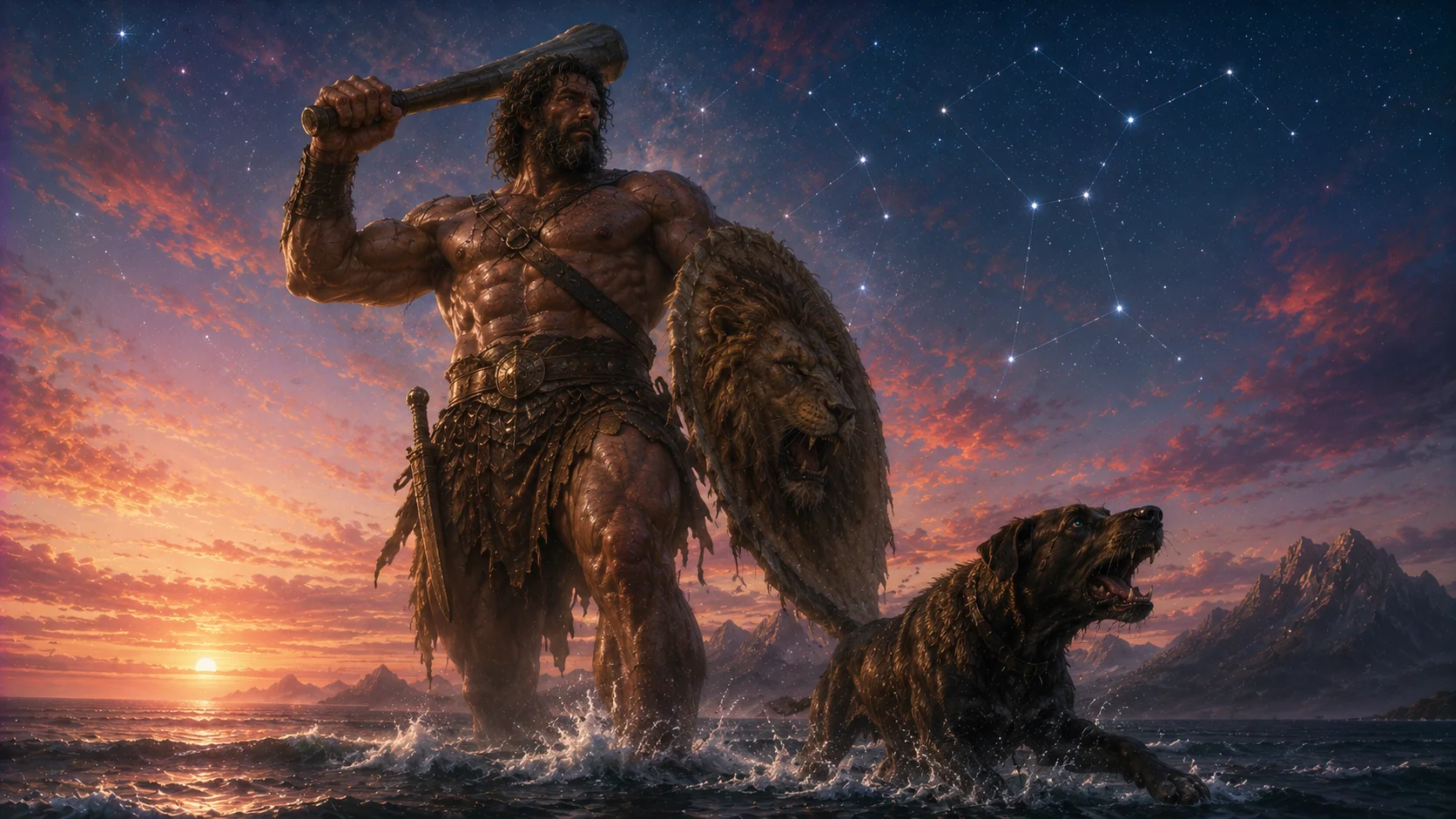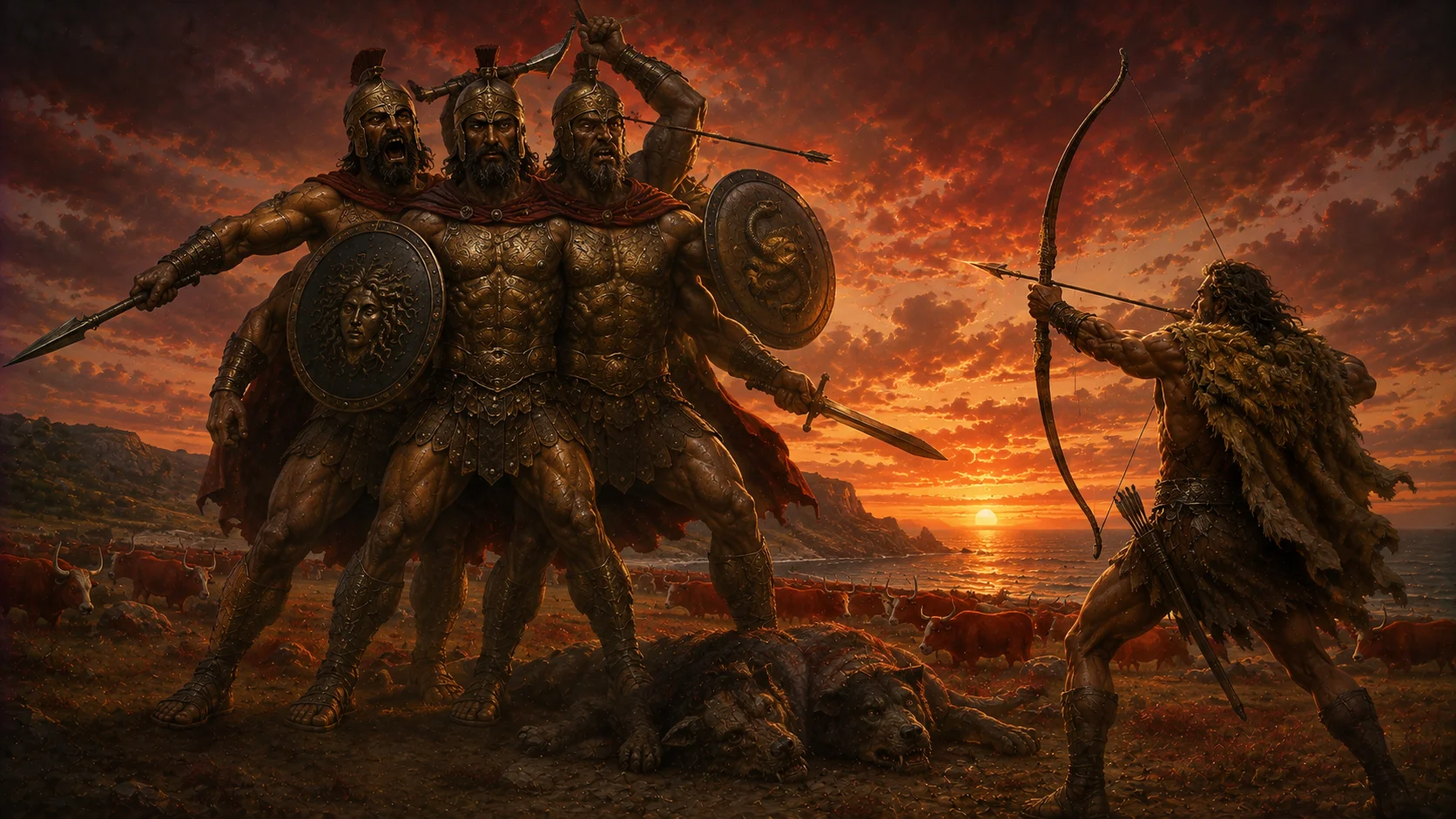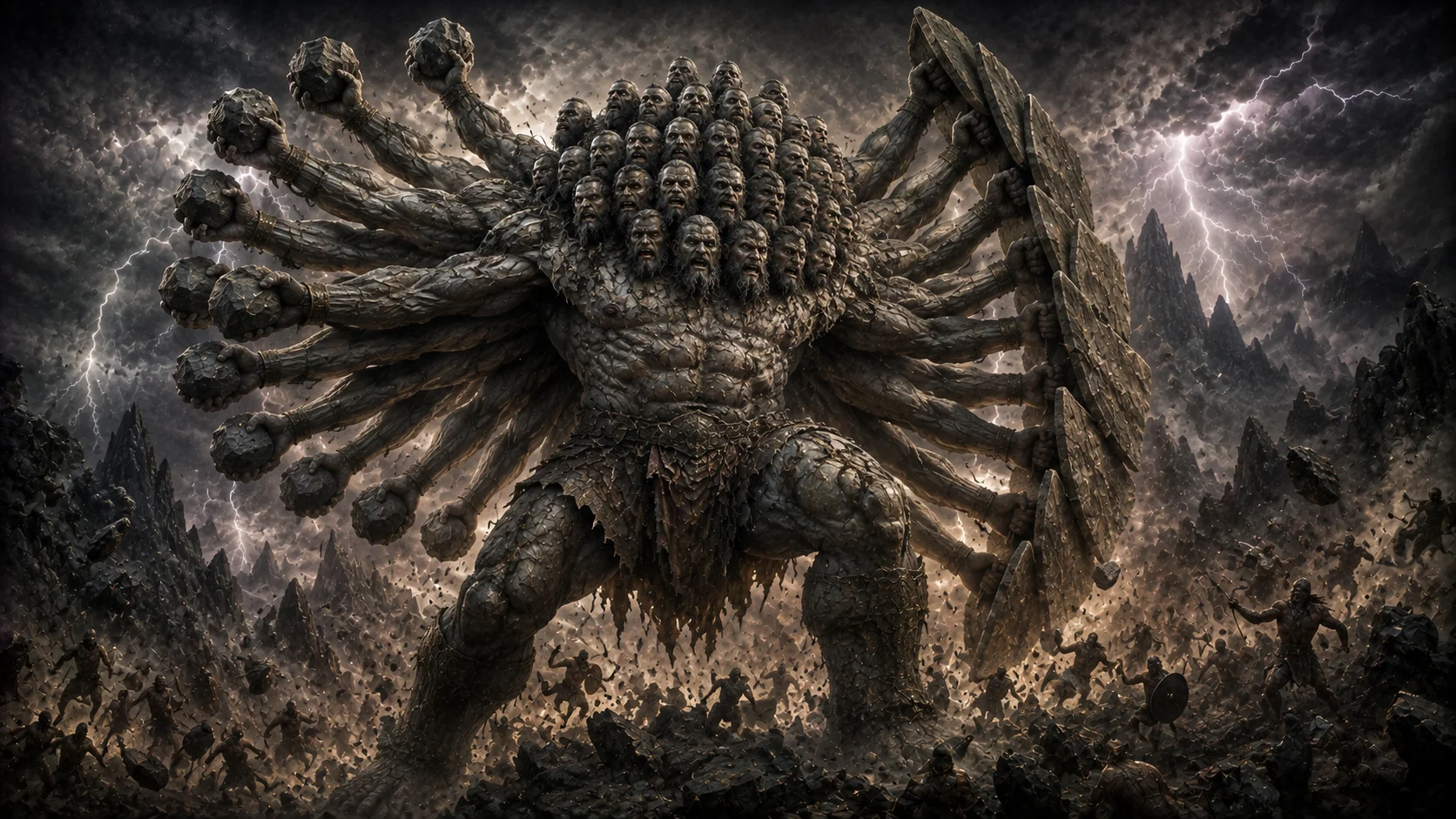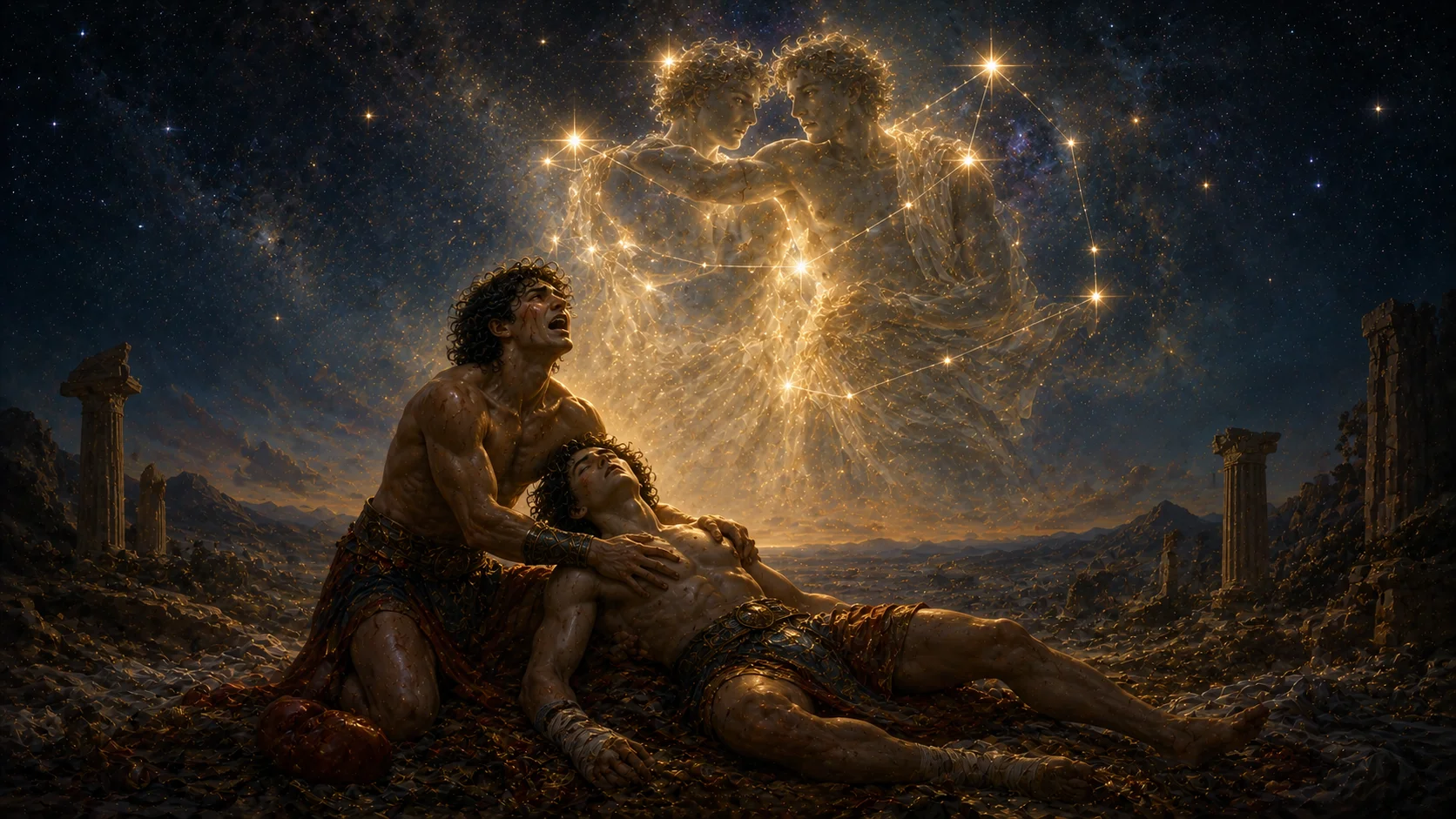
Pollux — Polydeuces in Greek — was the immortal half of the divine twins the Dioscuri, and the brother whose boundless love for his mortal twin Castor gave their myth its unforgettable ending. A son of Zeus and a champion boxer, his story is the same as Castor's, but told from the side of the one who could not die — and could not bear to live alone.
The Immortal Twin
Pollux was the son of Zeus, who came to Leda in the form of a swan; his twin Castor was the son of Leda's mortal husband. Thus Pollux was born immortal, Castor mortal — a fateful difference between two brothers who were otherwise inseparable. Pollux was famed as the greatest boxer of the heroic age, just as Castor was the greatest horseman; together the Dioscuri were a matched pair of champions.
The Adventures of the Dioscuri
With his brother, Pollux joined the voyage of the Argonauts, where his fists won glory: he defeated and killed the brutal king Amycus, a giant who forced all strangers to box him to the death, in a famous bout. The twins were honoured everywhere as protectors of sailors in storms, guardians of guests and oaths, and patrons of athletic games.
The Choice of Love
The defining moment of Pollux's story is his grief. When his mortal brother Castor was killed in a fight, Pollux was destroyed by sorrow. As an immortal, he could not follow his brother into death — and the prospect of eternal life without Castor was unbearable to him. He prayed to his father Zeus, begging either to bring Castor back or to let himself die too. Zeus, moved by a love so great that a god would renounce immortality for it, offered a compromise: Pollux could share his own immortality with his brother, the two of them alternating between Olympus and the underworld — together for eternity, on either side of death. Pollux accepted at once. He gave away half of his own deathlessness rather than spend a single day apart from his brother.
The Brothers Forever
For this, Zeus honoured the twins among the stars as Gemini, and they became the beloved patron gods of sailors, appearing as the twin flames of St Elmo's fire to promise safe passage. Pollux's story is the heart of the Dioscuri myth: the immortal who proved that even endless life is worth nothing without the one you love beside you.
Offered eternity, he gave half of it away — because eternity without his brother was not worth having.
Polydeuces — the Name That Had to Be Translated
The Greek name is Polydeukēs. The first half is plain enough — poly-, much, many — but the second has never been securely explained. The traditional gloss, "very sweet," rests on a link to an old word for sweet wine that philologists still argue over, and the honest position is that nobody knows. It is in any case a strangely gentle name for the deadliest pair of fists in the heroic age.
Latin wore the name down. A bronze plaque dedicated at Lavinium, south of Rome, in the sixth century BC already spells the second twin Podlouquei and calls the pair qurois — a straight transliteration of the Greek kouroi, "young men." From that the name compresses to Polluces and finally to Pollux, the form the star in Gemini still answers to. His brother needed no such adjustment: Kastōr is Castor in Latin, unchanged, the horse-tamer whose name travelled intact. Pollux is the twin whose name itself had to give something up in order to survive the crossing. It is a small rehearsal of everything that follows.
What the Oldest Poems Already Knew
Homer knows the twins mainly as an absence. In the third book of the Iliad, Helen stands on the wall of Troy naming the Greek captains for old Priam, searches the plain for her two brothers, and cannot find them. The poet, not Helen, supplies the answer: the life-giving earth already held them, back home in Lacedaemon. She does not know they are dead. It is one of the quietest devastations in the poem — and it tells us that the audience already knew the twins were gone and buried at home, a thing the poem can gesture at without ever explaining how it happened.
The Odyssey goes further. When Odysseus meets the dead, Leda's sons appear among them — Castor the breaker of horses and Polydeuces good with his fists — and the poem grants them something no other shade in that catalogue is granted: the earth holds them, and yet they live. They are alive on alternate days and dead on alternate days, and they have honour equal to the gods. Note the shape of it. Here the brothers do not swap places across the boundary; they cross it together, in step, sharing the same day above and the same day below. The other arrangement — one twin in the halls of heaven while the other lies in the hollows of Therapne — is a different bargain, and a lonelier one.
The lost epic Cypria, which survives only in summary and scraps quoted by later writers, states the asymmetry flatly: Castor was mortal and the portion of death was fated for him, while Polydeuces was immortal. That one sentence is the engine of the whole myth. Everything Pollux does afterwards is an attempt to undo a difference he did not choose and cannot bear.
The Egg, and the Uneven Birth
The ancients could not agree on the arithmetic of that night. In some tellings Leda lays a single egg and all four children — Pollux, Castor, Helen, Clytemnestra — come out of it. In others there are two eggs, and the division is the theologically tidy one: Zeus's children, Pollux and Helen, in one shell; Tyndareus's children, Castor and Clytemnestra, in the other. Ancient art and ancient commentary shuffle these arrangements freely, and some sources make both boys sons of Zeus, or both sons of Tyndareus, which dissolves the tragedy entirely.
The versions that survived are the ones that keep the wound open. A myth is not a report; it is a machine for producing a feeling, and this machine only runs when the twins are unequal. Two brothers raised identically, trained identically, famous as a matched pair — and one of them has a father who will let him die.
The Quarrel That Killed Castor
The fight that killed Castor has a name, and it is one of the ugliest stories in Greek myth, because it is not a heroic duel with a monster but a falling-out between cousins.
The other pair are Idas and Lynceus, sons of Aphareus — the Apharetidae, themselves a famous twinned team from Messenia. Idas the Iliad calls the strongest man then on earth. Lynceus had sight so keen that tradition credited him with seeing through tree trunks and down into the ground, and Greek and Latin writers alike used his name as the standard byword for sharp eyes. The quarrel's cause differs by source. In one strand it is cattle: the four raid a herd together, the division of the spoil is rigged, and the theft turns on itself. In another it is women: Castor and Pollux carry off Phoebe and Hilaeira, the daughters of Leucippus, who were promised to Idas and Lynceus already. The bride-theft version is the one that gives the brothers children at all — Polydeuces a son by Phoebe, Castor a son by Hilaeira — and it makes the Dioscuri distinctly less sympathetic, which is precisely why later retellings prefer the cattle.
Pindar's tenth Nemean gives the fullest surviving telling of the end, and it is brutally physical. The twins are hidden inside the hollow trunk of an oak. Lynceus, from the summit of Taygetus, sees them — through the wood. Idas drives a spear into Castor. Pollux comes on at a run; the Apharetidae wrench their own father's gravestone out of the ground and hurl the marble at his chest, and it neither breaks him nor turns him back. He kills Lynceus with his spear, and Zeus ends the rest of it with a thunderbolt. Then Pollux, unhurt and undamageable, kneels over a brother who is dying and asks his father to let him die too.
Pindar has Zeus put the choice in the coldest possible terms: you are my son, immortality is yours by right, and you may keep it and live with the gods — or you may share it, and spend half of forever underground. Pindar's phrase for what happens next is that Pollux set no double counsel in his mind. There is no scene of weighing. The refusal of a divine privilege takes him no time at all, and that instantaneousness is the whole point of the myth.
The Rescue of Helen
Long before the war that Helen's face is blamed for, she was taken once already — carried off as a girl by Theseus and hidden at Aphidna in Attica while he went adventuring. The Dioscuri came for her. They invaded Attica with an army, took Aphidna, and brought their sister home, and they took Theseus's own mother Aethra back with them as Helen's servant — a detail that pays off decades later in the Iliad, where the old woman is still at Helen's side inside Troy.
This is the myth that shows what the twins were for in the Spartan imagination: they are the brothers who come. Whatever has been taken, they retrieve; whoever is in danger, they arrive. It is the same instinct that makes them the gods of sailors, and the same instinct that makes Pollux, at the end, refuse to leave one man behind — even when that man is dead and the one refusing is a god.
The Fists
Greek boxing was not a sport of rounds and points. There were no weight classes and no ring; the fighters wrapped their hands in leather thongs and hit each other until one raised a finger in surrender or stopped moving. The head was the target. To be remembered as the finest boxer of the heroic age is to be remembered for something specific and unlovely — and it is worth noticing that of the two brothers, the immortal one has the violent craft and the mortal one has the horses.
The bout with Amycus survives in two great treatments that end differently. Apollonius of Rhodes lets Pollux kill him with a blow above the ear that breaks the bone beneath. Theocritus, in his twenty-second Idyll, has Pollux beat him to ruin and then spare him, extracting an oath that he will never again molest a stranger. The second version is the more interesting one, because it turns the fight into a lesson in the very thing the twins were worshipped for: the sanctity of the guest, the stranger who lands on your coast. Amycus had perverted hospitality into a death-trap. Pollux corrected him with the only argument Amycus understood.
The Lords of Sparta
To Spartans the twins were not a charming story but the presiding powers of the state. They were called the Tyndaridae, and at Athens the Anakes, "the Lords." Their oldest Spartan emblem was not a statue at all but the dokana, which Plutarch describes as two parallel upright timbers joined by two crossbeams — and which he says the Spartans read as an image of the brothers' love itself, a shape that cannot be divided without falling down.
Sparta's peculiar constitution had two kings, always, from two royal houses, and the twins stood behind that arrangement as its divine pattern. Herodotus records the consequence exactly. After a disastrous quarrel between two kings on campaign at Eleusis, the Spartans made a law that both kings should never march out with the army again — and, he adds, one of the sons of Tyndareus could then be left at home too, since before that both of them had also been invoked and had gone along with the army. That is not decoration. That is a state adjusting its gods to match a change in its constitution.
Ordinary worship of them took a warmer form. At a theoxenia — literally the "hosting of gods" — a couch was spread and a table laid, and the twins were invited to dinner as guests of the household. Of all the ways Greeks approached their gods, this is the most domestic: not a burnt offering at a distance, but two places set at your table for two young men who might arrive.
Castores: The Twins at Rome
Rome adopted them early and told a story about it. At the battle of Lake Regillus, in the first uncertain years of the Republic, two young horsemen of more than mortal size were seen fighting at the head of the Roman line; the same two were then seen in the Forum, watering their horses at the spring of Juturna, announcing the victory before any messenger could have arrived. A temple was vowed on the battlefield and dedicated in the Forum in 484 BC, and three of its columns still stand there — among the most photographed ruins in Rome, and rarely recognised for whose they are.
Romans called the pair simply Castores, "the Castors," folding Pollux into his brother's name; the Forum temple is likewise the aedes Castoris, the House of Castor alone. The immortal twin is grammatically absorbed by the mortal one — which is, when you think about it, precisely what he asked for.
He kept one distinction. Roman oaths divided along lines of gender that Aulus Gellius found worth explaining: in the old writers, women did not swear by Hercules and men did not swear by Castor, but edepol — by Pollux — was common to both. Of all the gods of Rome, the one whose name was equally available in the mouth of any citizen, male or female, was the god who had refused to be greater than someone else.
How to Recognise Him
Look for a pair of young men, beardless, nearly identical, usually mounted or standing beside horses, each carrying a spear. On their heads sits the pilos, a plain conical felt cap, and above each cap a star. The star is the surest identifier in Greek and Roman art. A long-standing modern reading — appealing, though not something the ancient sources tell us — takes the two rounded caps as the two halves of Leda's shattered eggshell, still worn by the men who hatched from it.
On Spartan reliefs they may appear with amphorae and with snakes, the snake being an old sign of a hero receiving cult from beneath the earth. And where the whole figure is absent, the dokana stands in: two posts, two beams, and nothing else. It is one of the most abstract god-symbols the Greek world produced, and it says only one thing — these two hold each other up.
Twin Flames on the Mast
Pliny describes the sailors' experience precisely: in storms, lights settle on the yards and masts of ships, and a single light appearing alone is called Helen and is a dire sign, but if two appear together they are Castor and Pollux, and the ship will be saved. Modern physics calls this corona discharge, St Elmo's fire, and it is real; ancient sailors were reporting something they genuinely saw. The theology built on top of it is exact and rather beautiful. One flame is the sister who went to Troy and brought down a generation. Two flames are the brothers who refused to be separated. The number is the omen.
The cult was so ordinary that it turns up in the New Testament without comment: in Acts, the ship that carries Paul from Malta towards Italy is an Alexandrian vessel bearing the sign of the Twin Brothers. It is a passing detail of maritime realism — of course a working grain ship sails under the Dioscuri. Everyone did.
Brothers of the Sky
The Dioscuri are not a Greek invention. They are one of the clearest inherited figures in Indo-European tradition: a pair of divine twins, associated with horses, who rescue people from the sea and who are attached to a radiant female relative.
In the Vedic hymns the Aśvins — also called the Nāsatyas — are twin horsemen who race across the sky in a chariot, healers and rescuers, famous for hauling the drowning Bhujyu out of the ocean; they are close companions of the sun-maiden Sūryā. Baltic tradition preserves the same pair: the Latvian Dieva dēli, sons of the sky-god, who court the daughter of the Sun, and the Lithuanian Ašvieniai, horse-twins whose carved heads still crown the gables of old farmhouses. The name Nāsatya even surfaces in a Bronze Age treaty from the Near East, sworn between a Hittite king and a king of Mitanni — which makes this pair of twins one of the oldest divine partnerships anywhere on record.
Set beside these, Helen looks less like a beautiful queen with unlucky judgement and more like a shining daughter of the sky whom the twins are eternally recovering. And Pollux's bargain looks less like Greek sentimentalism and more like the ancient logic of the pair itself: the twins are defined by being two. A single Dioscurus is a contradiction in terms. That is why he could not accept the offer.
The Star That Outshines Its Brother
The afterlife of the myth is written on the sky, and the details are worth knowing. Pollux is Beta Geminorum and Castor is Alpha Geminorum — yet Pollux is the brighter of the two, plainly so to the naked eye. The lettering says second; the sky says first. It is the one arena in which the self-effacing twin comes out ahead, and he did not even have to compete for it.
The irony deepens under a telescope. Pollux is a single orange giant about thirty-four light years away, the nearest giant star to our Sun, and in 2006 a planet of at least twice Jupiter's mass was announced in orbit around it — confirming a suspicion its discoverer had first published in 1993, though astronomers have gone on arguing about whether the signal is really a planet or the star's own magnetic field. Castor, meanwhile, is not one star but six: three gravitationally bound binary pairs. The immortal brother is one steady light with a world of its own, and possibly not even that. The mortal brother is a crowd.
Why the Story Will Not Let Go
Almost every myth about mortality is about cheating it. Heroes go down to fetch someone back, or eat something that stops the clock, or trick a god into a loophole. The Pollux myth does the opposite, and that is why it has outlasted flashier stories.
He does not save his brother. Castor stays dead — half of every eternity, permanently, for ever. What Pollux does is refuse to be exempt. The bargain does not defeat death; it only insists that death be shared.
That is a startlingly ordinary thing to want, and it is why the myth lands on people who care nothing for Greek religion. Anyone who has sat with someone who is dying already knows the impulse: not to fix it, which is impossible, but to go where they are going, which is also impossible. The Greeks gave that impulse a god's name and a place in the sky. Pollux is the patron of the survivor — every brother, every sister, every friend left holding the better half of an unequal deal and wishing they could hand some of it back.
Look up on a winter night. Two stars, close together, one a little brighter. They are not doing anything remarkable. They are just still there, both of them, which was the entire request.
Sources & traditions
- EncyclopediaWikipedia — Castor and Pollux
- TraditionGreek texts, inscriptions and later retellings (Greece)
Myths change from area to area and from time to time. This chronicle follows the most widely told versions; tellings in other villages, regions and eras may differ.