Orestes was the son who avenged his murdered father by killing his own mother — and was hunted to the edge of madness for it. His story is the climax of the great curse of the House of Atreus, and the vehicle for one of the most important transformations in Greek thought: the moment when blind blood-vengeance gave way to the rule of law.
The Cursed Inheritance
Orestes was the son of Agamemnon, the king who led the Greeks to Troy, and Clytemnestra. While Agamemnon was away at war, Clytemnestra (nursing her hatred for his sacrifice of their daughter Iphigenia) took a lover and, on the king's triumphant return, murdered him in his bath. Orestes, still a boy, was sent away for safety — growing up in exile with the knowledge that his mother had killed his father.
The Unbearable Command
Grown, Orestes faced an impossible duty. The code of his world demanded that a son avenge his murdered father — and the oracle of Apollo explicitly commanded him to do so. But the murderer was his own mother. To obey the gods and the code of vengeance, he would have to commit the most unnatural crime imaginable: matricide. With his sister Electra and his loyal friend Pylades, Orestes returned in secret, and killed both his mother's lover Aegisthus and then Clytemnestra herself. He had avenged his father by becoming a mother-killer.
Hunted by the Furies
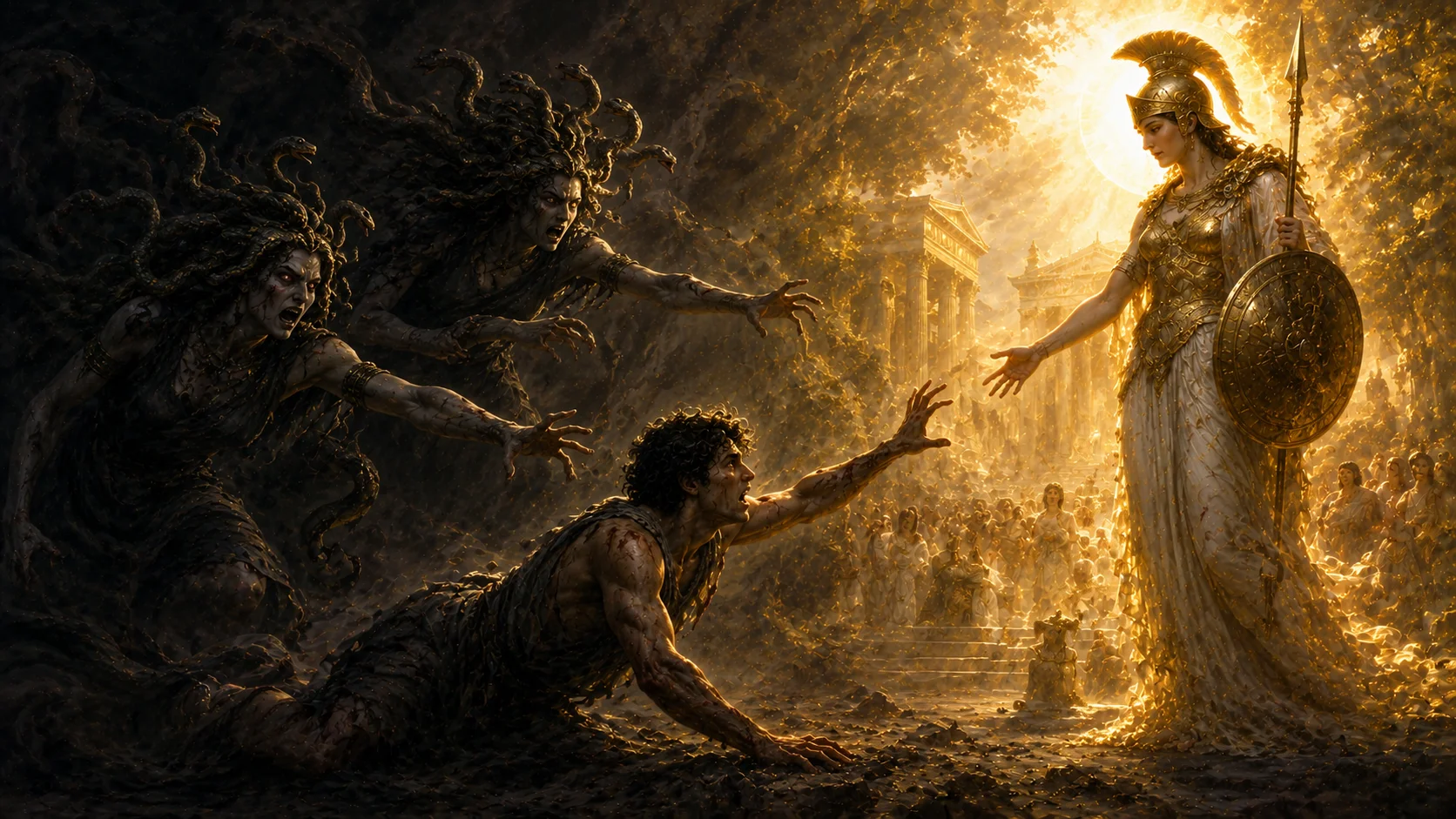
For the crime of spilling kindred blood, the ancient Erinyes (Furies) rose to torment him, hounding him across the world, driving him toward madness, giving him no rest. Here was the terrible logic of the old order laid bare: vengeance demanded the killing, and the killing demanded vengeance in turn — an endless, unbreakable cycle of blood for blood.
The Birth of Justice
The cycle was broken at last not by more blood, but by law. The goddess Athena intervened, establishing the first court of justice (the Areopagus in Athens) to try Orestes by reason and the vote of a jury, rather than by the Furies' automatic vengeance. With Apollo speaking in his defence and Athena casting the deciding vote, Orestes was acquitted; the Furies were appeased and transformed into the “Kindly Ones.” In Aeschylus's great trilogy, this is nothing less than the foundational myth of civilisation itself — the moment humanity replaced the blood feud with the courtroom.
He ended one curse with a crime and another with a trial — and in his acquittal, the world traded vengeance for justice.
A Different Orestes: What Homer Remembers
Long before Aeschylus staged a trial on the Areopagus, Homer's Odyssey already knew this story — and told it as something closer to a triumph than a horror. More than once the poem holds Orestes up to young Telemachus as the model a son should follow, asking whether he has heard of the glory Orestes won by avenging his murdered father. There is no Furies-driven madness here, no year of wandering afterwards, no trial at all. Homer's Orestes simply comes home, kills the “crafty” Aegisthus, and holds a funeral feast for both his mother and the man who shared her crime — a single glancing line that is as close as the epic ever comes to admitting the matricide happened. The transformation of that clean, exemplary revenge into the era's most agonised meditation on guilt was the work of the tragedians two or three centuries later, reshaping the same bones into something far darker.
The Bones of a Hero
By the sixth century BC, Orestes had stopped being only a character in a story and become property worth fighting a war over. Herodotus records that Sparta, locked in a war it could not win against neighbouring Tegea, consulted the oracle at Delphi and was told that victory required bringing home the bones of Orestes. The oracle's answer came wrapped in a riddle, describing a place where two winds blow under hard compulsion, where blow falls upon blow and woe upon woe — which a Spartan named Lichas eventually worked out to mean a blacksmith's forge, where bellows blow and hammer strikes anvil and iron is worked to men's harm. Renting the smithy's courtyard at Tegea and digging there, he uncovered a coffin holding the skeleton of an enormous man, and carried it home to Sparta. From that point on, Herodotus says, the Spartans had much the better of the fighting. Whatever those bones actually were, the story shows exactly what a hero cult was for: a city did not simply admire Orestes, it wanted physical custody of him, on the belief that a hero's remains carried his power into whatever ground held them.
The Sister Who Did Not Die
The Areopagus verdict did not end every version of Orestes's story. In Euripides's Iphigenia in Tauris, a stubborn faction of the old Furies refuses to accept his acquittal, and Apollo sends him on one last task to be free of them for good: sail to the remote land of the Taurians and steal the cult statue of Artemis kept in her temple there. What Orestes does not know is that his sister Iphigenia — sacrificed by their father at Aulis to buy the winds for Troy — never actually died. Artemis, this branch of the myth holds, snatched her from the altar at the last instant and set her down among the Taurians as a priestess, where her grim duty is to consecrate shipwrecked Greeks for sacrifice to the goddess. She comes within moments of sending her own brother to that altar. What saves him is a letter she asks a departing captive to carry home to Argos — and recites aloud, in case the ship is lost, so that the message will survive in a living memory. Orestes hears his own name in it. The recognition that follows, each refusing at first to believe the other still alive, is among the most tender scenes to survive from Greek tragedy. Together with the ever-loyal Pylades, the siblings steal the statue and escape by sea, and Orestes's long exile finally closes.
Three Tragedians, Three Verdicts on the Same Crime
Aeschylus was not the only playwright to dramatise the killing, and the surviving differences between the three versions show how unsettled the story remained even in Athens's own theatre. Sophocles's Electra plays the matricide almost as a heroic completion, its final chorus treating the House of Atreus as having come out at last into freedom. Euripides, in his own Electra, will not allow that comfort: his Orestes and Electra kill their mother and collapse immediately into horror at what they have done, Electra taking the guilt onto herself for having driven her brother to it, Orestes turning on Apollo and the oracle that ordered it. Euripides returned to the family once more in his play Orestes, staged in 408 BC and set in the days immediately after the murder, before any trial has taken place. Here Orestes lies bedridden, convulsing under the Furies' torment, while the citizens of Argos vote to stone him and Electra to death for matricide, and their uncle Menelaus — the one relative positioned to save them — abandons them to protect himself. It is the bleakest surviving telling of the myth, written in the exhausted final years of the Peloponnesian War, and it reads like the work of a man who no longer believed a courtroom could fix anything.
After the Verdict: A Throne and a Second Killing
Acquittal did not end Orestes's story; it only allowed him to have one. Tradition married him to Hermione, the only child of Menelaus and Helen, who had first been given to Neoptolemus, the son of Achilles. Euripides's Andromache and, later, Virgil's Aeneid both make Orestes the hand behind Neoptolemus's death at Delphi — one more killing added to a life that had already supplied more than enough — leaving Hermione free to become his wife. Their son, Tisamenus, inherited a combined domain: by marriage and descent, Orestes had joined his father's throne at Mycenae to his father-in-law's at Sparta. Tisamenus held it only briefly. The returning Heraclidae, descendants of Heracles claiming the Peloponnese as their birthright, drove him out, and the line of Atreus ended its rule there in exile — pushed north into the coastal strip that afterwards took his people's name, Achaea.
Orestes in Clay and Stone
Vase-painters kept returning to one image above all others: Orestes crouched at the omphalos, the sacred stone marking the centre of the world at Delphi, sword still in his grip, while winged Furies with snakes coiled through their hair close in around him. Attic and south Italian painters reused this scene for generations, sometimes showing the Furies asleep at his feet — the calm before Athena's intervention — and sometimes wide awake and advancing, letting a viewer who already knew the story choose which moment they were looking at. Placing him at the omphalos did double duty for the painter: it identified Orestes at a glance, and it reminded the viewer that even the worst blood-guilt still had somewhere left to run.
From the Areopagus to the Analyst's Couch
The Oresteia's afterlife has been unusually long even by the standards of Greek myth, because its central question — what do you do when law and blood-loyalty give contradictory orders — never stopped being useful. Jean-Paul Sartre restaged the whole story as The Flies in 1943, under German occupation, turning Orestes's flight from divine punishment into a parable about choosing to act freely rather than live under inherited guilt and inherited gods. Eugene O'Neill went the opposite direction in 1931: he kept the psychology and discarded the gods entirely, transplanting the House of Atreus into a New England family shattered by the American Civil War in his trilogy Mourning Becomes Electra. The modern vocabulary of family psychology leans on this household too — Carl Jung coined the term “Electra complex” in 1913, naming a daughter's rivalry with her mother after Orestes's own sister as a deliberate counterpart to Freud's Oedipus complex, a term Freud himself never accepted as equivalent to his own. None of these later versions agree with each other, or with Aeschylus, about what Orestes's story actually means, which is itself the clearest evidence that the House of Atreus never finished being useful to think with.
Why the Furies Never Fully Left
Strip away the gods and the trial, and Orestes's dilemma is still recognisable to anyone who has ever been caught between two loyalties that each claim to be absolute. What makes the Furies the myth's most enduring invention is not that they are monstrous — it is that they are indifferent to justification. They do not check whether your reasons were sound before they start hunting you, and no amount of being right slows them down. That is the observation underneath the courtroom: a reckoning conducted entirely inside a person's own head has no mechanism for ever stopping. Orestes endures not because his story answers the question of justified violence, but because it refuses to let anyone — god, playwright, or reader — answer it too easily.
Sources & traditions
- EncyclopediaWikipedia — Orestes
- TraditionGreek texts, inscriptions and later retellings (Greece)
Myths change from area to area and from time to time. This chronicle follows the most widely told versions; tellings in other villages, regions and eras may differ.