Mastema, from the Hebrew מַשְׂטֵמָה, mastemah, "hostility," "animosity," or "accusation," is a named adversary of Jewish demonology, prince of the evil spirits and accuser of the faithful. He is not a figure of the Hebrew Bible itself, though the common noun from which his name is drawn appears there, in Hosea's lament of a people met with hostility. His life as a named, personal adversary belongs instead to the Book of Jubilees, a Second Temple work of the second century BCE, where he is drawn as the ruler of the spirits left behind after the Flood, the tester of Abraham, and the opponent who stands against Moses in Egypt. Called "Prince Mastema," sar mastema, he takes his place among a class of angelic princes granted delegated authority, his own authority turned to affliction rather than service.
The Naming of Hostility
To call something Mastema in Hebrew is, first, simply to name a condition: hostility, enmity, the animus that sets one party against another. Hosea's ninth chapter uses the word this way, describing a people surrounded by hostility, with no demon implied. It is the Book of Jubilees that takes this common noun and makes of it a proper name, a title borne by a particular prince of spirits. This double life, abstract noun and personal name, runs through the entire history of the figure, and it is worth holding onto from the outset, because later tradition will return to the noun and largely set the name aside.
Chief Over the Spirits of Ruin
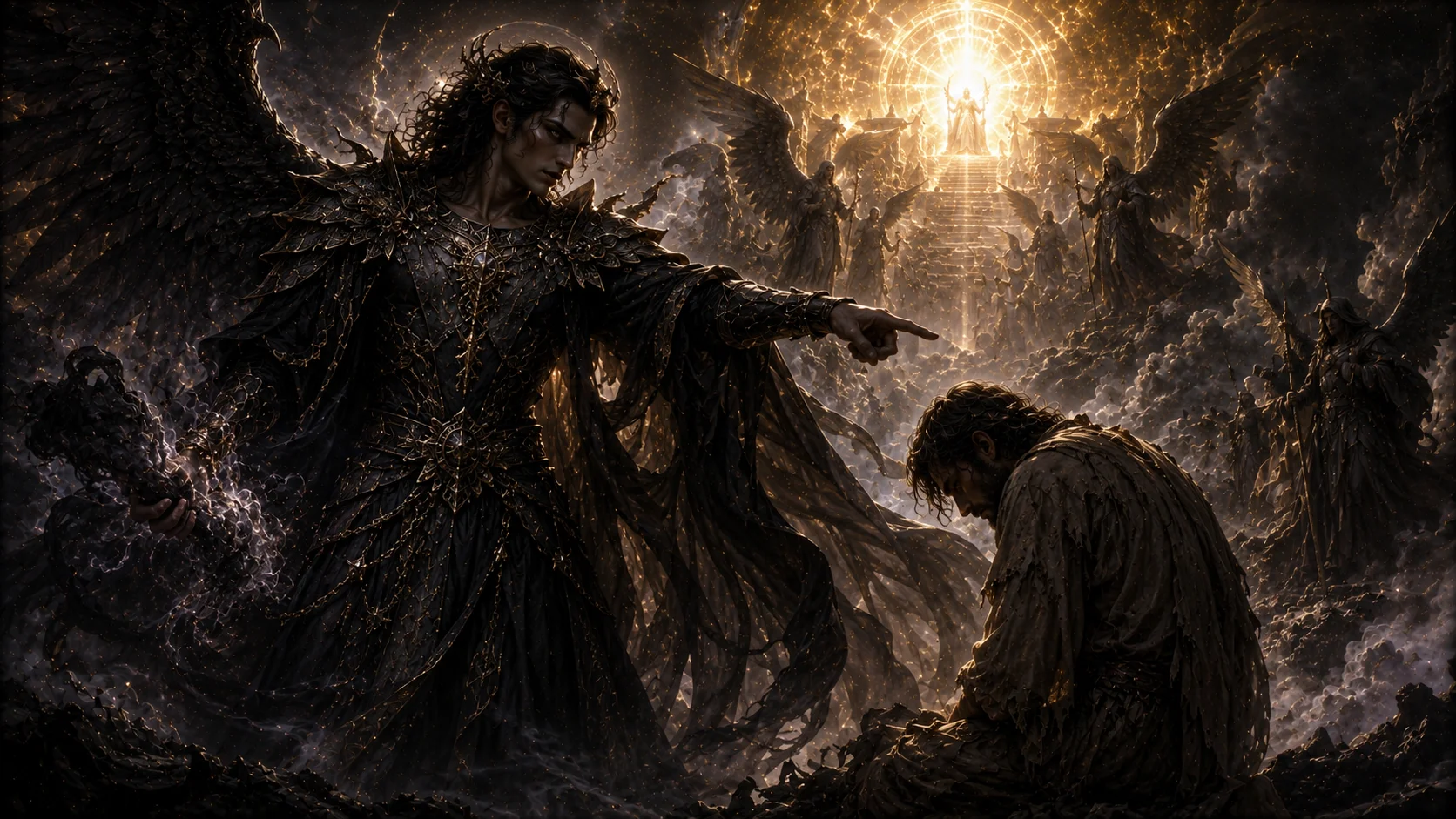
Jubilees introduces Mastema in its tenth chapter as the chief of the evil spirits, the offspring of the Watchers, those angels who in the older Enochic tradition had descended and fathered the Nephilim upon the daughters of men. When the Nephilim perished, their spirits did not perish with them; they remained, disembodied and malicious, a host without a body but not without purpose. Jubilees names Mastema as the one who stands at the head of this host, its prince, its commander, the figure through whom the surviving demonic order is organized and directed. He is not merely one evil spirit among many; he is the one who rules them, and it is through him that they act.
The Petition After the Deluge
The Flood, in Jubilees' retelling, was meant to cleanse the earth not only of corrupted flesh but of the spirits that had corrupted it. God moved to destroy the evil spirits outright. It is at this moment that Mastema is given voice: he comes before God and petitions that some of the spirits be spared, left under his own command, so that he might continue to lead humanity astray. His argument, as Jubilees frames it, is one of purpose: without spirits at large to tempt and corrupt, there would be no meaning in warning humankind against sin, no test by which righteousness could be distinguished from wickedness. It is a request made openly, before God, and God's answer becomes the founding condition of Mastema's continued existence.
One Tenth Left to Him
God grants the petition, but not without limit. Of the full host of evil spirits, only one-tenth is left free, under Mastema's command; the remainder are bound, removed from the world's affairs. This proportion is the crux of the theology Jubilees builds around him: evil is permitted to persist, but only in a fraction, only under supervision, only for a stated end. Mastema's rule over the surviving spirits is real, but it is a rule inside a cage whose bars God alone set. He commands what he commands because he was allowed to keep it, not because he seized it, and Jubilees never lets the reader forget the difference.
The Testing of the Patriarch
The best known of Mastema's acts is his role in the binding of Isaac. Genesis twenty-two names no instigator; it opens simply with God testing Abraham, and no accuser stands in the frame. Jubilees, in its seventeenth and eighteenth chapters, supplies what Genesis withholds: it is Mastema who incites the trial, who presses the test of Abraham's son upon him, in a role directly parallel to that of "the satan," ha-satan, "the accuser," in the Book of Job, who moves God to test a righteous man's loyalty through suffering. Scholars have long read Jubilees' Mastema-Akedah narrative as a conscious reworking of Job's opening scenes, transplanting the accuser's function from Job's unnamed heavenly court onto a figure now given a name and a standing office. Fragments among the Dead Sea Scrolls, notably the text known as 4Q225, sometimes called Pseudo-Jubilees, preserve traditions closely paralleling this same episode, suggesting Mastema's place in the Akedah was not a solitary invention but a current running through at least part of the Qumran community's own textual world.
Adversary in the House of Pharaoh
Jubilees' forty-eighth chapter carries Mastema into Egypt, where he becomes the adversary of Moses himself. He is described there as attempting to kill Moses, a passage that reaches back to strengthen one of the most obscure verses in Exodus, the account of the LORD seeking to kill Moses at a lodging place on the road, a scene the Torah gives almost no explanation for. Jubilees supplies an actor where Exodus supplies only unease. In the same chapter, Mastema is also cast as the power behind Pharaoh's magicians, strengthening their hearts and their arts against Moses and Aaron as the contest of the plagues unfolds, an opposition mounted not by Pharaoh's will alone but by the prince of hostility working through it.
The Night the Destroyer Walked
Jubilees' forty-ninth chapter draws Mastema still closer to the Exodus narrative, crediting forces under his command with a role like that of the "destroyer" of Exodus twelve, the figure who passed through Egypt on the night of the first Passover. This is interpretive layering rather than a simple one-to-one identification in the text, Jubilees reworking the biblical tradition of the destroying angel so that it, too, falls within Mastema's domain. The effect is to draw a continuous thread through Jubilees' retelling: the same prince who tested Abraham and who opposed Moses is present again on the night that broke Pharaoh's resistance, hostility woven through the whole of Israel's founding story rather than confined to a single episode.
An Office as Much as a Name
Jubilees consistently styles him "Prince Mastema," sar ha-mastema, and that title matters. "Prince," sar, is the same word used elsewhere in Second Temple and later Jewish angelology for angelic princes holding delegated authority over some portion of the created order, a Prince of the World, a Prince of the Sea. Mastema's title places him inside this same class of office-bearing angels, but with his commission turned toward affliction rather than guardianship. This has led readers to treat "Mastema" as functioning partly as an epithet or office, "the Hostility," "the Accuser," rather than purely as a personal name in the way a human name would be, even as the texts also use it as his proper designation.
Kinship With Belial and the Accuser
Mastema does not stand alone in the demonology of his period. Other Second Temple and Qumran sectarian texts speak of a figure called Belial, or Beliar, occupying a strikingly similar role, and canonical usage elsewhere speaks of Satan, ha-satan, the accuser. Many scholars treat Mastema as functionally equivalent to, or a variant title for, these same figures, different textual communities naming the same adversarial office by different words. This is not, however, a settled equation. The precise relationship between Mastema, Belial, and Satan across the surviving Second Temple literature remains debated; some scholars see one figure under several names, others see meaningful distinctions of role and origin between them, and no single authoritative identification should be taken as established fact.
Silence in the Rabbinic Halls
For all his prominence in Jubilees, Mastema has no significant independent presence in the classical rabbinic literature, the Mishnah, the Talmud, or the major midrashic collections. He is, in the normative rabbinic tradition, essentially absent. His survival belongs almost entirely to the pseudepigraphal and Second Temple textual stream that passed outside the boundaries of the later rabbinic canon, preserved chiefly through the Ethiopian biblical tradition, where the Book of Jubilees remains scripture to this day. Where the great rabbinic demonology elaborated figures such as Samael, Lilith, or Ashmedai at length across generations of commentary, Mastema simply was not carried forward by that same current.
A Word That Outlived the Figure
Later Kabbalistic literature does not develop Mastema into a distinct, named figure with anything like the elaboration given to Samael, Lilith, or Ashmedai. Where the word mastemah appears in later mystical or liturgical Hebrew, in penitential prayers, in piyyutim, it functions generally as the abstract noun once more, "accusation," "hostility," rather than an invocation of the Jubilees demon-prince by name. This distinction deserves to be held clearly rather than blurred: a later prayer that speaks of being delivered from mastemah is not necessarily addressing the prince of Jubilees at all, but reaching back to the plain meaning of the word itself, the condition of being accused or beset by hostility.
What Mastema Explains
Theologically, Mastema serves a specific and important function within Second Temple demonology. He accounts for the persistence of evil and temptation in the world after the Flood without abandoning a monotheistic frame in which nothing operates outside divine permission. The spirits under his command act because they were allowed to remain, in a fixed proportion, for a stated purpose bound up with testing and warning against sin. This is structurally the same solution Job offers through its own accuser: the adversary is real, his effects on human life are real, and still he acts by sufferance rather than as an independent power standing outside or against God's authority.
The Bound and the Unbound
The arithmetic of Jubilees' account, nine parts bound, one part left to Mastema, is not incidental detail; it is the shape of the whole theology. It draws a visible line between the evil that was judged and removed and the evil that persists in the world by design, under a named command, answerable in its origin to a decision made at the Flood. The unbound tenth is Mastema's own, and his rule over it is the mechanism by which trial, temptation, and accusation continue to reach the living, generation after generation, without positing a second, rival source of power in the world.
The Accuser's Place in the Order
Across the Akedah, the Egyptian court, and the Passover night, the pattern of Mastema's activity in Jubilees is consistent: he tests, he opposes, he strengthens hearts against the righteous, and in every instance the text places his action inside a divine order he did not create and cannot exceed. He is the prince of hostility and of the accusation, a figure whose kinship to Belial and to the accuser of Job remains a subject of real scholarly disagreement rather than settled fact, and whose afterlife outside Jubilees is thin, carried more by a preserved canon in one tradition and a persistent word in Hebrew prayer than by any developed figure in the rabbinic or Kabbalistic imagination. What Jubilees leaves behind is a single, coherent portrait: the prince granted just enough freedom to test what the Flood could not simply wash away.
Sources & traditions
- EncyclopediaWikipedia — Mastema
- TraditionJewish/Kabbalistic texts, grimoires and later commentary
Myths change from area to area and from time to time. This chronicle follows the most widely told versions; tellings in other villages, regions and eras may differ.