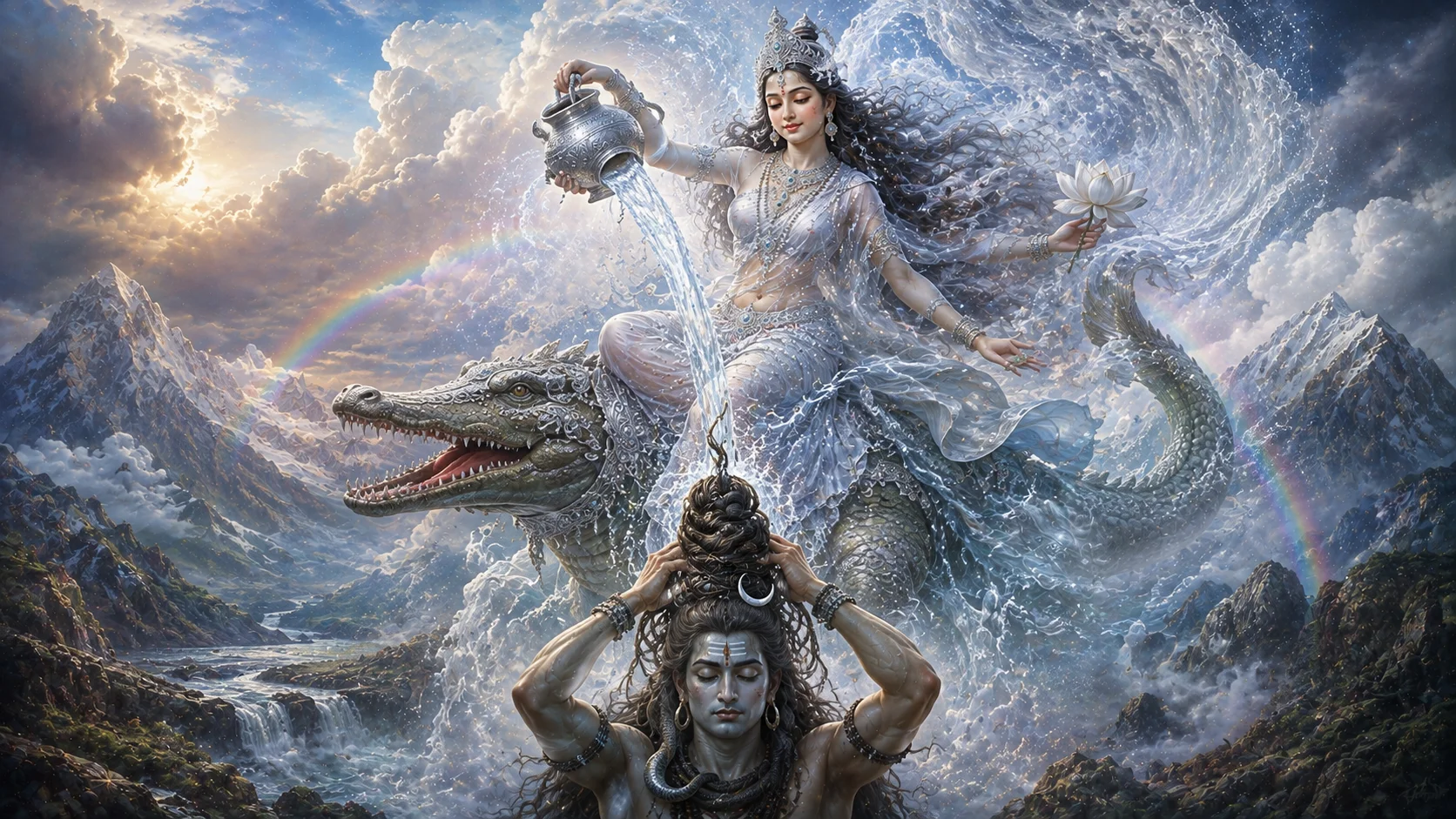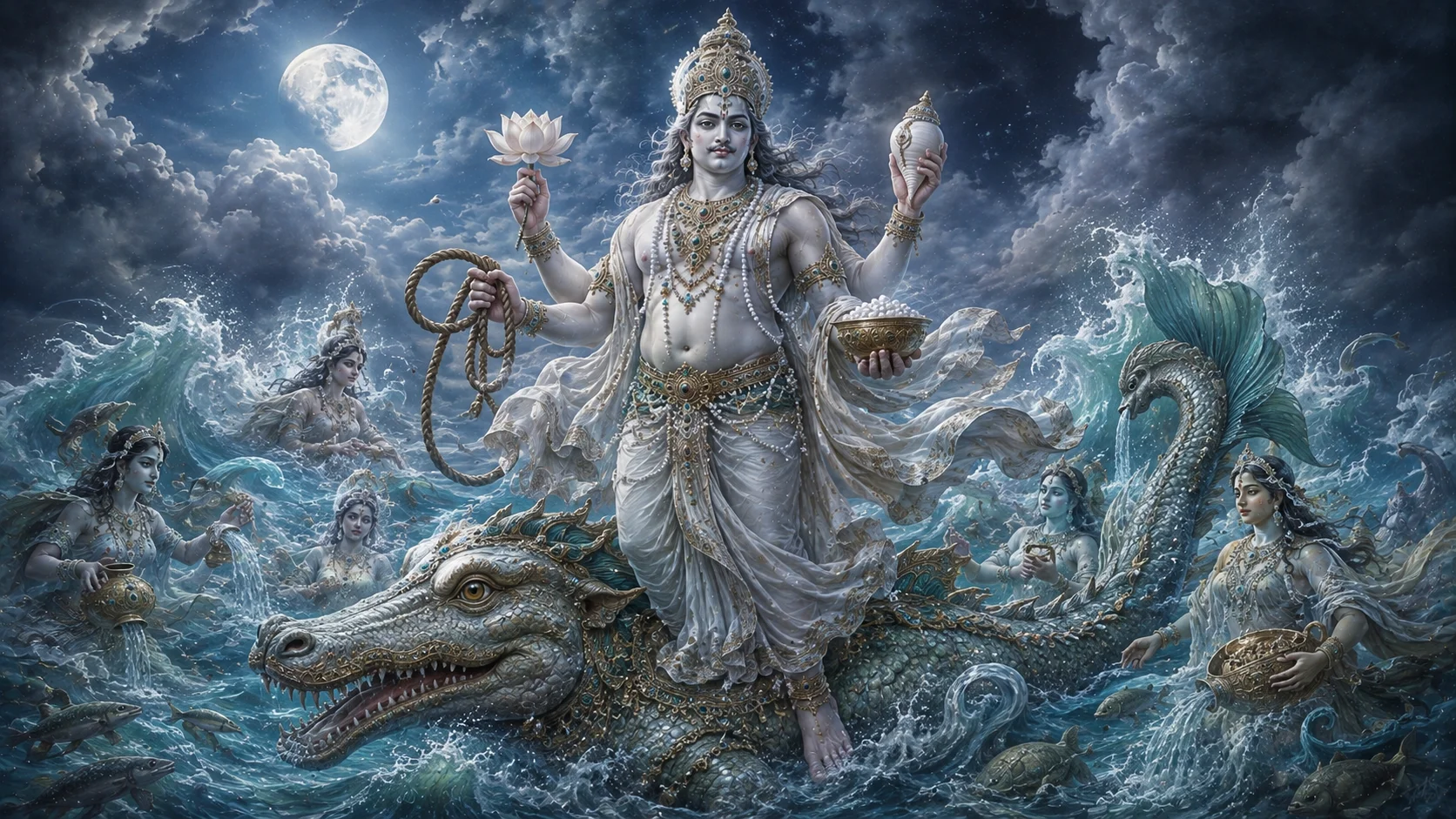
The Makara is a composite aquatic creature of Hindu tradition — a hybrid sea-beast most often shown with the forequarters of a crocodile or a deer and the hindquarters of a fish, its silhouette in temple stone and river-goddess bronze sometimes gathering in elephantine trunks or curling aquatic-plant fronds as regional and period styles demand. It is the vahana of Ganga, the river-goddess, and of Varuna, the Vedic lord of the cosmic ocean; it is the banner-emblem of Kamadeva, the god of love; and it lends its name to a sign of the Hindu zodiac and to a festival that marks the turning of the sun.
A Body Assembled From the Waters
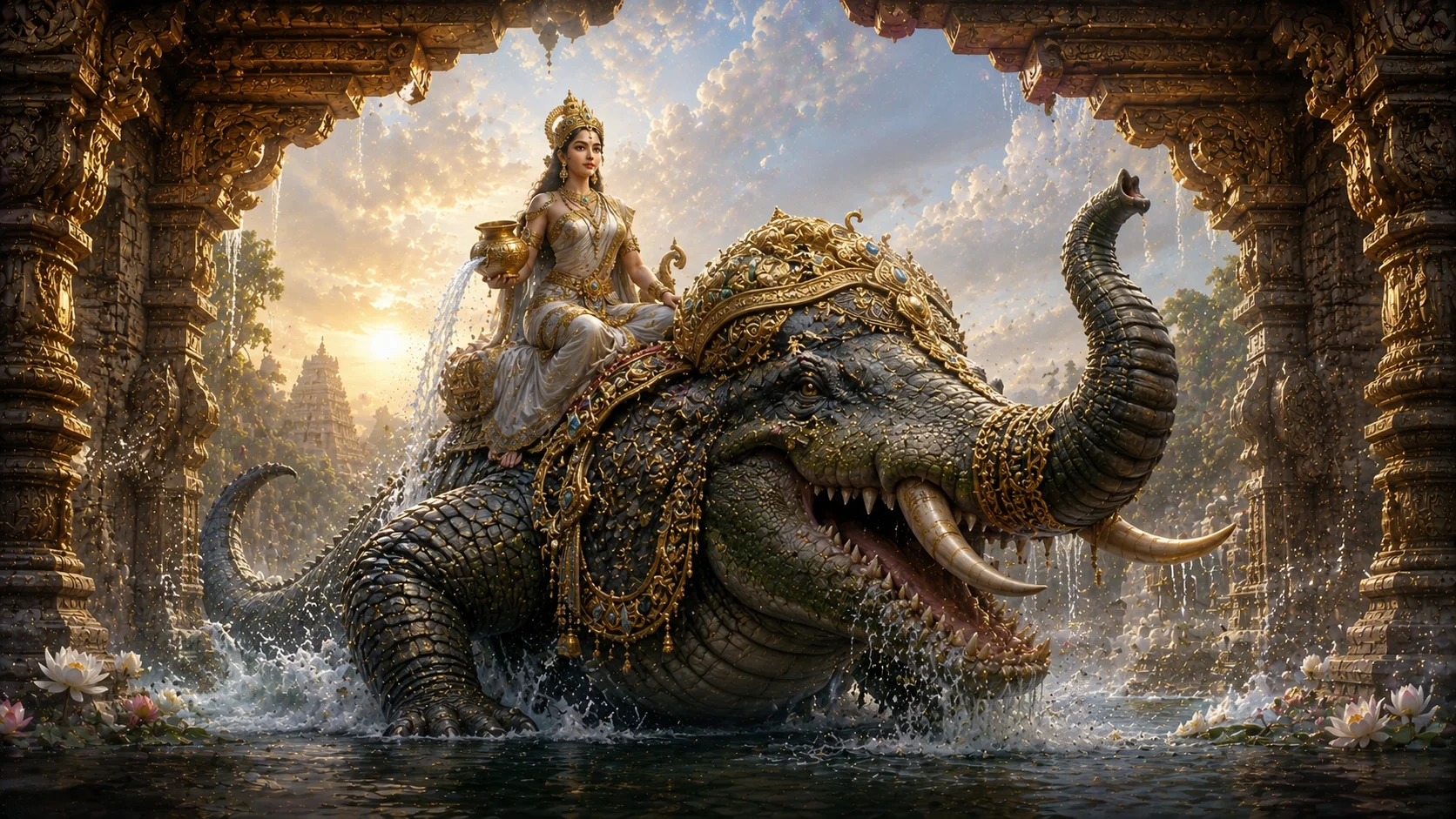
No single animal explains the Makara, because no single animal was meant to. Its makers reached across the visible world and pulled together the parts that mattered: the armored snout and gripping jaw of a crocodile, or in other renderings the light-footed head of a deer, set against the sweeping, scaled hindquarters of a fish. Regional workshops and different centuries did not agree on the recipe past that core division — some added the curved trunk of an elephant, some let the tail dissolve into stylised aquatic foliage, curling like a wave caught mid-break. This is not inconsistency so much as a working principle: the Makara is defined by the seam between its halves, not by a fixed inventory of parts. Wherever it appears, the front is drawn from the land or the muscular certainty of a predator, and the rear surrenders to the fluid, tapering logic of the sea. Scholars reading the figure have long treated that seam as the point of the whole design, a single body arguing that dry ground and water are not opposites so much as one continuous fabric, stitched together at the waist.
Riding at Ganga's Side
Of all the roles assigned to the Makara, none binds it more tightly to a single deity than its place beneath Ganga. The river-goddess is shown mounted upon it, the creature carrying her the way a throne carries a monarch, except that this throne is alive, aquatic, and inseparable from what she represents. Ganga is the sacred river given form and devotion; the Makara beneath her is the wider category of water itself, deep, populated, and untamed, made docile enough to bear a goddess without losing its strangeness. The pairing is not incidental ornament — it is a compact statement about what a river is understood to hold. A river is not simply moving water; it is a channel through which something vast and creature-filled passes, and the goddess who personifies it travels astride the very depth and danger that make a river worth naming and worshipping. In this pairing the Makara is at its most intimate, closest to a single face, rather than the wandering guardian it becomes elsewhere.
Bearing the Lord of the Cosmic Ocean
Varuna, the Vedic god who presides over the cosmic and celestial waters, also claims the Makara as his mount, and here the creature's register shifts from riverine intimacy to oceanic scale. Where Ganga's Makara carries a single sacred current, Varuna's carries the totality of the waters — not a river but the encompassing deep from which rivers themselves are thought to descend. The same beast serves both offices without contradiction, because the Makara was never bound to one body of water; it is water's guardian creature in general, scalable from a temple's ritual tank to the boundless ocean a Vedic god commands. That a single hybrid form can serve as mount to both a beloved river-goddess and a cosmic sovereign shows how flexible the symbol was allowed to be — personal in one setting, oceanic in another, without ever needing to be redesigned.
The Banner Kamadeva Raises
Away from the rivers and the ocean altogether, the Makara reappears on the standard of Kamadeva, the god of love, whose banner is known by the compound name Makaradhvaja — literally, the Makara-banner. Carried into the god's iconography as his emblem, the creature here speaks a different dialect of the same language: water as the medium of fertility and generative force rather than of navigation or threat. Desire, in the logic that assigns Kamadeva this standard, moves and swells the way water does, unpredictable and fecund at once. That the same hybrid beast serves as mount for solemn river-goddesses and as banner for the god of romantic longing shows how wide a net the Makara's symbolism was cast — fixed to the element it embodies rather than to any single emotional register.
Where the Sun Turns Toward Capricorn
The Makara's reach extends past myth and architecture into the sky itself. It names one of the twelve signs of the Hindu zodiac, corresponding to the constellation known elsewhere as Capricorn, and its name marks the calendar at one of the year's genuine turning points. Makar Sankranti, the festival celebrating the sun's transit into this sign, is reckoned by that solar movement rather than by a lunar cycle, which gives it a comparatively fixed date and ties it to the discernible motion of the sun rather than to a myth-cycle needing retelling each season. A creature born of crocodile and fish thereby becomes, without any narrative bridge explaining the leap, a fixture of the heavens too — proof that in this tradition a symbol earns residence across astronomy, architecture, and river-worship all at once, its coherence lying in what it stands for rather than in where it is allowed to appear.
Standing Watch at the Temple Threshold
Step toward the entrance of a Hindu temple, and the Makara is very often the first thing carved to greet you. The makara-torana — an arched gateway framed by paired Makara figures — marks the boundary between the ordinary world outside and the consecrated space within, and the creature's placement there is deliberate rather than decorative alone. A threshold is a vulnerable point, the seam where the sacred could in principle be breached by the mundane, and the Makara's own compound body — itself a seam between land-creature and water-creature — makes it an apt sentinel for exactly that kind of boundary. It does not merely decorate the doorway; it embodies the idea of one, a being that is already, in its own anatomy, a crossing-point made flesh.
Set Into Roofline and Doorframe
Beyond the great gateway arches, the Makara recurs across temple architecture at a smaller, more constant scale — worked into roof-corners, set along doorframes, positioned as an ornament that is never purely ornamental. It is frequently paired with the kirtimukha, the fierce guardian face carved above lintels and niches, and the two together form a familiar visual grammar: a protective face at the height a devotee looks up to, a protective sea-beast at the corners and edges where a building's form gives way to open air. Multiplied across a temple's exterior in this way, the Makara stops being a single mythic figure with a single story and becomes closer to a structural idea, repeated wherever the building's edges needed a guardian, the way a threshold needed one at the door.
The Channel Where Sacred Water Runs
Water in temple ritual has to travel somewhere — off a roof, out of a tank, away from an image after it has been bathed — and the Makara supplies the mouth that water is imagined to pass through. Makara-spouts, carved to let sacred water stream from the creature's jaws, turn a purely functional drainage point into an image consistent with everything else the Makara stands for: it is not incidental that the water-guardian's own mouth is where the temple's water is made to flow. The device is practical, plumbing dressed as myth, but the dressing is not arbitrary — of all the shapes available to carve a spout into, the tradition reached for the one creature whose entire identity already belonged to water, so that even the mundane act of runoff carried its guardian along with it.
A Posture Named for the Crocodile
The Makara's imprint reaches even into the body itself, in later hatha yoga texts that name a resting posture makarasana — the crocodile pose — after the creature's own low, ground-hugging profile. Practiced lying prone, the pose borrows its name from the same half of the Makara's anatomy that gives the creature its front-end ferocity, a small but telling instance of the myth's vocabulary leaking into disciplines well outside temple wall or river cult. That a yogic posture would reach for this name, rather than inventing a plainer descriptive one, suggests how thoroughly the Makara had become a shared point of reference — a shape recognisable enough that naming a pose after it required no further explanation.
Among the Sea's Wilder Company
Puranic descriptions of the ocean's inhabitants, including the marine beings referenced around the churning of the ocean, place the Makara among the jalachara, the creatures that make the sea their home, without ever elevating it into a named protagonist of that particular episode. It belongs there the way any true sea-creature would belong in an inventory of the deep — present because the deep is its native ground, not because the myth required it to act. This modest, background placement is worth holding onto precisely because it is unglamorous: the Makara's importance across Hindu tradition does not rest on starring in any one dramatic tale, but on being everywhere water itself is imagined, whether that is a goddess's mount, a temple's threshold, or simply one more resident among the many strange things the ocean was believed to contain.
A Dolphin Half-Glimpsed Behind the Myth
Some scholars have proposed the Ganges river dolphin, the susu, as one possible zoological thread running behind the Makara's image — a real animal glimpsed at the water's surface and folded, however loosely, into a form that grew far stranger than its source. The identification is not settled, and it would be a mistake to read the Makara as a dolphin in costume; the creature remains first and foremost a composite mythic beast, assembled from crocodile, deer, fish, and more, rather than a portrait of any single living species. The possibility is worth holding lightly rather than discarding, since it points to how such a figure tends to form: not invented from nothing, but built up in layers around a kernel of something once actually seen in the river.
Carried Beyond Its Hindu Home
The Makara's later travels took it well past the tradition that first shaped it. As Buddhist art spread across South and Southeast Asia, the motif travelled with it, reappearing as a protective and decorative architectural element on structures far from its Hindu origins — in Sri Lanka, in Java, in Thailand, wherever temple builders in related but distinct traditions found a use for a guardian creature of the threshold and the waters. This later spread belongs to the history of reception rather than to the core Hindu material itself — a separate, later chapter in which other cultures recognised something useful in the form and adapted it to their own architectural grammar. The Makara that stands watch over a Hindu temple gateway and the Makara worked into a Buddhist roofline elsewhere are kin, not identical, shaped by the same root but grown in different soil.
What the Seam Between Water and Land Still Holds
Draw it together — the mount beneath Ganga and beneath Varuna, the banner Kamadeva raises, the sign the sun enters at Makar Sankranti, the arch a devotee passes beneath, the spout where temple water finds its way out, even the posture a yogi's body borrows from it — and the Makara resolves into something more coherent than a simple monster catalogue entry. It is the figure a tradition reached for whenever it needed to give shape to water's full range: life-giving in a river goddess's care, vast and sovereign in Varuna's ocean, fertile in Kamadeva's banner, threshold-guarding at a temple door, and quietly present wherever the deep itself was imagined. Its hybrid body, crocodile or deer grafted onto fish, states plainly what it was built to say: that land and water meet at a seam, and something has to stand guard exactly there.
Sources & traditions
- EncyclopediaWikipedia — Makara
- TraditionHindu texts, oral tradition and village tellings (South Asia)
Myths change from area to area and from time to time. This chronicle follows the most widely told versions; tellings in other villages, regions and eras may differ.