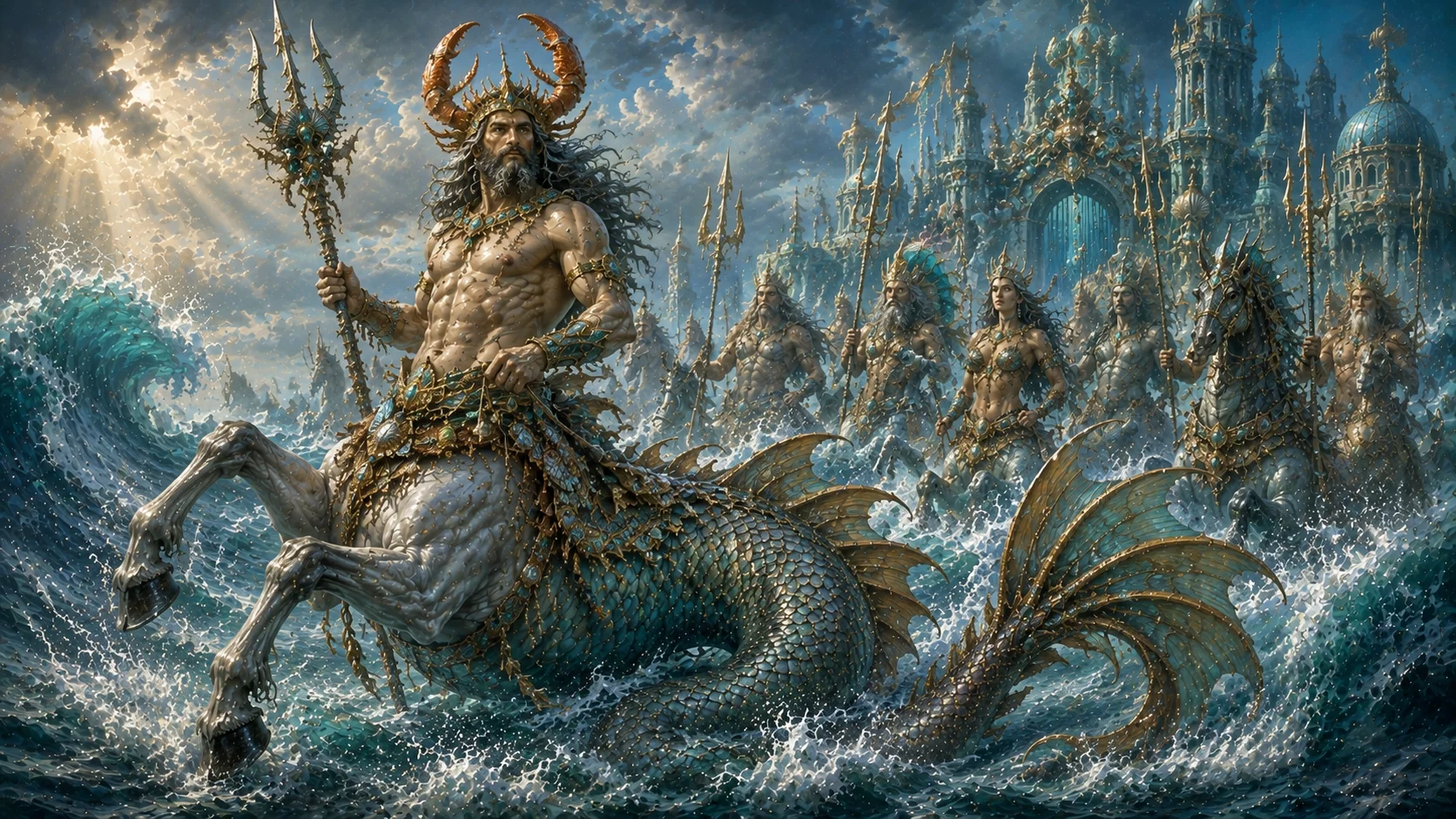
The Ichthyocentaurs were sea-centaurs — marine demigods with the upper body of a man, the foreparts and legs of a horse, and the long, coiling tail of a fish, often crowned with lobster-claw horns. They were the gentle, learned cousins of the land-centaurs, dwellers in the deep who attended the great gods of the sea, and a vivid example of the Greek delight in combining the forms of the world into a single wondrous being.
The Centaurs of the Sea
The name Ichthyocentaur joins the Greek ichthys (“fish”) and kentauros (“centaur”) — the fish-centaur. In art they were depicted with a striking triple form: a human torso rising from the body and front legs of a horse, which in turn gave way to the scaly, serpentine tail of a great fish or sea-dragon. Many were shown with a pair of crab- or lobster-claw “horns” sprouting from their brows, marking them as creatures of the deep. They were imagined as dignified, even kindly beings, a far cry from the wild, brawling centaurs of the mountains.
Aphros and Bythos
Two Ichthyocentaurs were named in tradition: Aphros (“Sea-Foam”) and Bythos (“Sea-Depths”), brothers and sons, in some accounts, of the Titan Cronus and a sea-nymph, making them half-brothers of the wise centaur Chiron. They were said to be learned and benevolent, and Aphros was even reckoned the foster-father and tutor of the goddess Aphrodite when she rose newborn from the sea-foam — a fitting role, given that his very name meant the foam from which she was born. The two brothers were sometimes identified with the constellation Pisces.
Attendants of the Deep
The Ichthyocentaurs belonged to the rich population of the Greek sea — the Nereids, Tritons, hippocamps and other marine wonders that made the ocean a realm as crowded with divine life as the land. They were frequently shown in the great processions (the thiasos) that escorted the sea-gods across the waves, bearing the trident of Poseidon or carrying sea-goddesses on their backs, the dignified scholars among the creatures of the deep.
The Wise Sea-Folk
The Ichthyocentaurs endure as one of the most elegant of the Greek hybrid creatures — the centaur reimagined for the ocean, learned and gentle where their land-cousins were wild. They embody the Greek vision of the sea as a living, ordered realm full of noble beings, and the tender myth that the goddess of love herself was raised by a kindly creature of the foam.
Where the mountain centaurs brawled and raged, the centaurs of the sea kept wisdom — and one of them cradled love itself, newborn from the foam.
Two Bloodlines of Centaur
Not every centaur shared the same parentage, and the difference runs deeper than a footnote. The savage horde that brawled through Thessaly and overturned the wedding tables of the Lapiths traced its descent to Ixion and a cloud shaped in the likeness of a queen — a lineage begun in deceit and appetite, and it told in their manners ever after. Chiron did not come from that stock. Tradition made him the son of Cronus, got upon the Oceanid Philyra; when Rhea came upon the pair, the Titan sprang up in the shape of a stallion and bolted, and the child was born carrying the form of that flight without any of its shame. He grew instead into the gentlest and most learned of his kind, tutor to physicians and heroes. It is to this second, quieter line that the Ichthyocentaurs are attached. The late tradition that assigns Aphros and Bythos to Cronus and a nymph of the sea makes them Chiron’s half-brothers in more than name, and it settles at a stroke why they were spared the family temper — and why they wore that inheritance, fittingly, in the one element the mountain centaurs never entered.
Telling the Sea-Centaur from Its Kin
Stand in front of a Roman mosaic crowded with marine wonders and the whole court can blur into a single tangle of scales and tails. The distinctions are worth learning, because the Ichthyocentaur is the only figure in that company built out of three animals rather than two. A hippocamp is horse and fish and nothing further — the head, mane and forelegs of a stallion dissolving straight into a serpentine tail, with no human portion at all; teams of them drew the chariots of Poseidon and Amphitrite across the waves. A Triton is man and fish, a human torso ending in one or two coiling tails, usually caught mid-blast on a twisted conch — a herald rather than a sage, and by far the commoner sight in the repertoire. The Ichthyocentaur holds all three natures at once, which makes it the most elaborate hybrid the Greek sea produced and, in the surviving art, much the scarcer figure: a creature nobody thought to hand a trumpet, better employed carrying a Nereid steadily on its back than announcing anyone’s arrival.
The Sea as a Road
Processions of this kind became one of the stock subjects of Roman funerary sculpture — sarcophagus after sarcophagus carved with Nereids, Tritons and sea-centaurs riding out across a stone ocean. The reading usually given to them is that the voyage itself carried the meaning. Water was the ancient image of passage into the unknown, and a crossing escorted by beautiful and benevolent creatures allowed the journey after death to be suggested gently, without doctrine, as something other than a descent into the dark. Whatever the carvers privately intended, the Ichthyocentaur suits that role exactly: unhurried, weight-bearing, a Nereid or a small Eros settled calmly on its back. It is a psychopomp that never has to say so — a ferryman built from a horse and a scholar rather than a boatman and a coin.
Foam, and the Name of Love
Greek myth-makers built genealogy out of language as readily as out of story, and few pairs of names sit as close as these two. Aphros is simply “foam”, and Aphrodite’s own name was already being explained in antiquity as belonging to the one who rose from that foam. Which way the borrowing ran — whether a minor sea-god was drawn into the goddess’s birth because the words matched, or the words were matched to a story already told — is past recovering at this distance. What survives is the join itself, and it runs against the grain of how modern readers expect stories to work: not always a name fitted to a finished tale, but sometimes a tale assembled to explain why two names so obviously belonged together.
Into Fountains and Fantasy
The sea-centaur outlived the religion that produced it. Renaissance and Baroque patrons who wanted a garden fountain or a grotto to feel properly antique reached for exactly this marine retinue — Tritons, Nereids, hippocamps and, on occasion, an Ichthyocentaur — cut in stone to spout water among the topiary, a private ocean stocked with borrowed Greek courtiers. The type has proved just as durable in the centuries since, resurfacing wherever illustrators and game designers want a sea-dwelling cousin for the centaur. It appeals now for much the reason it appealed then: a hybrid built on top of a hybrid that was already familiar, stranger and more elaborate than a plain merman or a plain centaur can manage alone.
Why the Sea Needed Its Own Wise Ones
The land-centaur gave the Greeks somewhere to put their suspicion of the animal underneath a civilised skin: wine, a wedding, one restraint loosened, and the guest reverts to Ixion’s brood. The sea asked a different question of a people who depended on it for trade, for food, and for every foreign shore they would ever reach. It was the part of their world that stayed genuinely unmastered — no roads, no boundary stones, no law — and its native monsters, Scylla and Charybdis among them, offered no reassurance about what lived down there. The Ichthyocentaur answers that unease with an unlikely consolation: that even in the one place Greek order could never fully reach, something wise and kind might still be swimming — gentle enough to raise a goddess, learned enough to be trusted with her.
Sources & traditions
- EncyclopediaWikipedia — Ichthyocentaur
- TraditionGreek texts, inscriptions and later retellings (Greece)
Myths change from area to area and from time to time. This chronicle follows the most widely told versions; tellings in other villages, regions and eras may differ.