Heka was the Egyptian god and personification of magic itself — not a trickster's tool or a marginal art, but a divine creative power understood to be older than the gods, present at the very moment of creation, and wielded by the gods themselves as the means by which their will became reality. Where other traditions cast magic as suspect or transgressive, the Egyptians gave it a god of unimpeachable legitimacy, and that god was Heka.
A Power Present Before Duality
The Pyramid Texts, among the oldest religious writings to survive from Egypt, place Heka at the side of the creator god in a time before the world had yet resolved into opposites — before sky and earth, before order and chaos, before the pairs that structured Egyptian cosmology had come into being at all. Heka is described as existing with the creator “before duality had yet come into being.” This is a striking theological claim: magic was not something the gods invented once creation was underway, a tool reached for after the fact. It was there at the beginning, coeval with the creative act itself, woven into the fabric of existence before existence had taken shape. To speak of Heka is to speak of a force that predates categorization — magic as a condition of possibility for creation, not a consequence of it.
The Ka of the Sun
Egyptian theology offered more than one account of how Heka related to the great gods of the pantheon, and one of the most resonant identifies him as the ka — the life-force, the vital double — of Ra, the sun god. In this framing, Heka is not a separate deity standing beside Ra but an aspect of Ra's own being: the animating power by which Ra's spoken commands take hold of reality and become fact. Ra's utterances were understood to carry creative force — to name a thing was, for the gods, to bring it into being or to command it — and Heka is the current that carries that force from utterance to effect. He is, in this sense, the mechanism of divine speech: the reason a god's word does not simply dissipate into air but reshapes the world.
The Force Behind Divine Causality
This is what most distinguishes Heka from a simple god of sorcery. He was regarded as the power by which the gods themselves act and create — not a servant they might call upon for aid, but a force intrinsic to how divine causality operates at all. When a god willed something into being, Heka was the medium through which that will became effect. This makes him less a character with rivalries and adventures of his own, and more a principle underlying every exercise of divine power — the current running beneath the surface wherever a god's creative or protective force is felt.
A Man Among Serpents
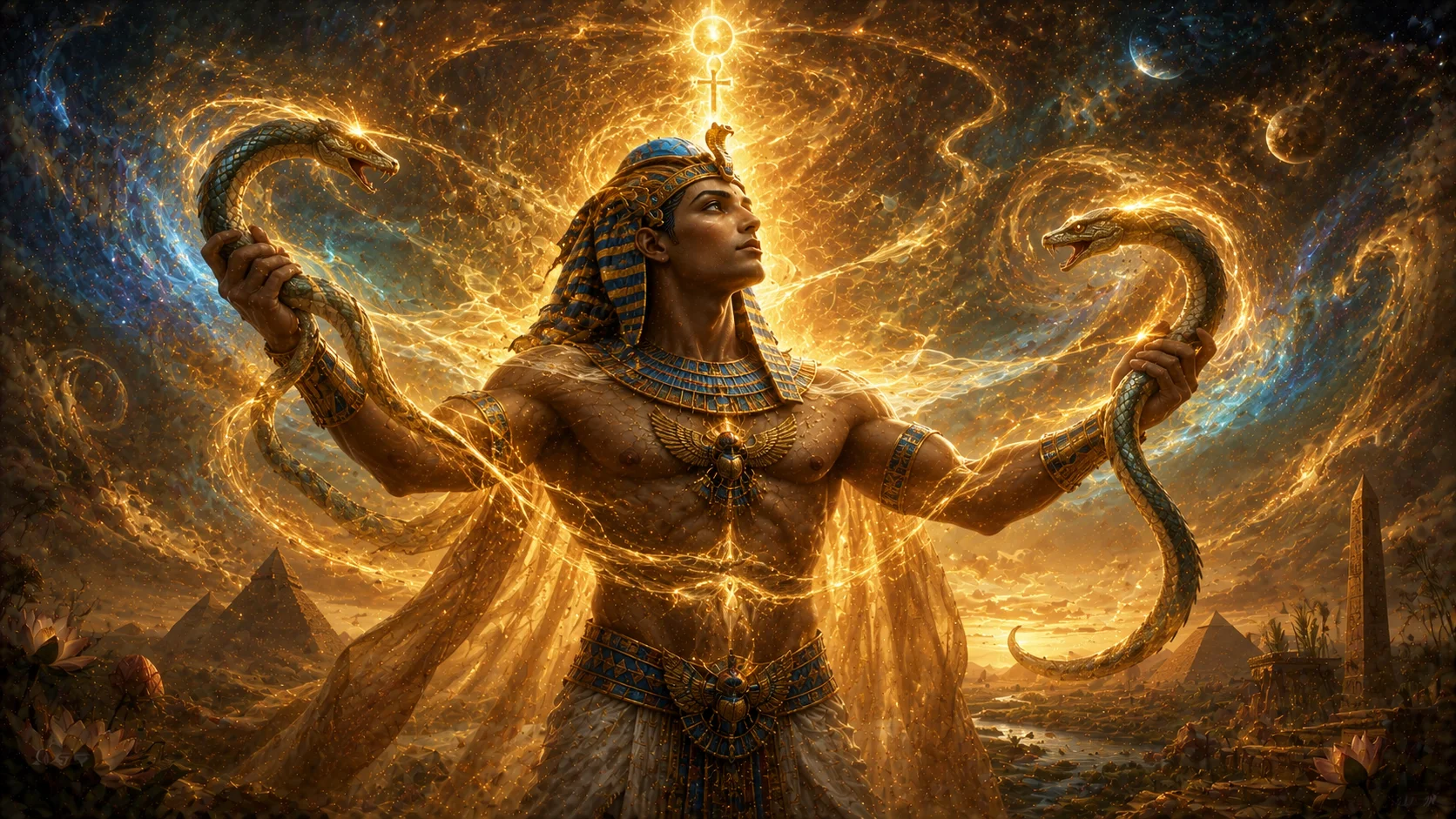
When Heka was given a body at all, Egyptian artists rendered him anthropomorphically, as a man — sometimes shown holding serpents or depicted in close association with them. The imagery is not incidental. Serpents were among the most feared dangers of the Egyptian landscape, and magic's most immediate, practical use for ordinary people was apotropaic: turning danger aside, neutralizing venom, warding off the bite before it could be delivered or countering it after. A god of magic shown mastering serpents is a god shown exercising precisely the power his worshippers most urgently needed — not abstract cosmic order, but protection against the creature that might kill a child fetching water or a farmer working a field at dusk.
Words That Heal
That practical, protective dimension of Heka's power runs through the magico-medical papyri that survive from Egypt in considerable number — collections of spells, incantations, and remedies invoked constantly against snakebite, scorpion sting, fever, and the countless other afflictions that threatened the body. Egyptian medicine did not draw the sharp line between physical treatment and magical recitation that later traditions would insist upon; a spell spoken correctly, with the right words in the right order, was itself a medical act, every bit as real in its effects as a poultice or a splint. Heka's name stood behind these recitations as their source and guarantee — the power that made the words work rather than merely sound like they should.
The Lector-Priest as Channel
These protective and healing rites were not performed by anyone who cared to try them. They were the province of lector-priests and trained healers, ritual specialists who acted as intermediaries channeling Heka's power rather than possessing it as their own personal gift. The distinction mattered: magic in Egyptian understanding was a legitimate, divinely sanctioned force, but wielding it correctly required knowledge, training, and the proper ritual standing to serve as its conduit. Some among these specialists carried titles identifying them explicitly as Heka-priests, magician-priests who invoked the god's name directly in the course of their protective and healing work, particularly the recurring, dreaded business of treating snakebite and scorpion sting.
Passage Through the Underworld
Heka's reach extended past the living body and into the fate of the dead. He appears in the Coffin Texts and in later funerary literature as a force that enabled the deceased to undergo the transformations required to survive the underworld's dangers and complete a safe passage through it. The journey of the dead through the afterlife was not conceived as passive drifting but as a sequence of trials and required changes of form, each demanding the correct knowledge and the correct words to accomplish. Heka's power underwrote those transformations, making him as essential to the successfully buried dead as he was to the living patient recovering from a scorpion's sting — the same fundamental force, applied across the boundary of death.
A Divine Child at Esna
Egyptian religion was never a single fixed system administered from one center; different cult cities developed their own theological genealogies, and these could vary considerably from place to place. At Esna, in some Late Period accounts, Heka appears folded into a local triad alongside Khnum and Menhit (sometimes given instead as Nebtu), cast in this regional grouping as their divine child. Such family arrangements reflect the particular theology of a particular temple rather than a single universal genealogy accepted everywhere; Heka's identity as the ka of Ra and his standing as a primordial, pre-creation force coexisted with these more local, more intimate framings of him as a son within a specific cult center's divine household.
A Principle More Than a Protagonist
Anyone looking for Heka the way one looks for a god with a plot, adversaries, a story that develops, will not find much to hold onto. Heka functions far more as an abstract personified principle underlying priestly and magical ritual practice than as a mythological actor with adventures of his own. He does not journey, is not betrayed, does not avenge or search. His presence in the textual record is instead the presence of an idea given a name and, occasionally, a human shape: the idea that creative-divine power exists, that it can be invoked, and that it underlies both the great cosmic order and the smallest act of a priest treating a scorpion sting.
From the Pyramids to the Temples of a Later Age
What is most remarkable about Heka, set against the record of Egyptian religion as a whole, is simple durability. He is attested from the Old Kingdom's Pyramid Texts — among the very earliest religious writing to survive from Egypt — through to the temple theology of the Greco-Roman period, a continuity of many centuries during which dynasties rose and fell, capitals shifted, and foreign rulers came to sit on Egypt's throne. Across all of that change, the conviction that creative-divine power deserved its own god, its own name, and its own place at the very beginning of things did not weaken. Heka's theological role could be elaborated, relocated into new genealogies at new cult centers, folded into new triads — but the core claim, that magic is primordial and legitimate rather than derivative and suspect, held from the earliest pyramid inscriptions to the last flowering of temple religion under Greek and Roman rule.
Magic Without Apology
What sets Heka apart from how “magic” is so often understood elsewhere is the complete absence of any need for apology or disguise. In Egyptian thought, heka was not sorcery practiced at the margins, not a power borrowed illicitly from forces hostile to the proper order of things. It was a divinely sanctioned creative force, as legitimate as any other instrument of divine or priestly action, exercised openly by lector-priests treating the sick, invoked without embarrassment in funerary texts guiding the dead, and credited without hesitation as the very mechanism by which the gods' own words took effect. Heka stands, in the end, as Egypt's answer to a question most religious traditions prefer to leave uncomfortable: what power makes divine will effective in the world? The Egyptians gave that power a name, a form, and a place beside the sun god himself — older than duality, present at creation, and still being invoked, unapologetically, in the temples of a much later age.
Sources & traditions
- EncyclopediaWikipedia — Heka (god)
- TraditionEgyptian texts, inscriptions and later retellings
Myths change from area to area and from time to time. This chronicle follows the most widely told versions; tellings in other villages, regions and eras may differ.