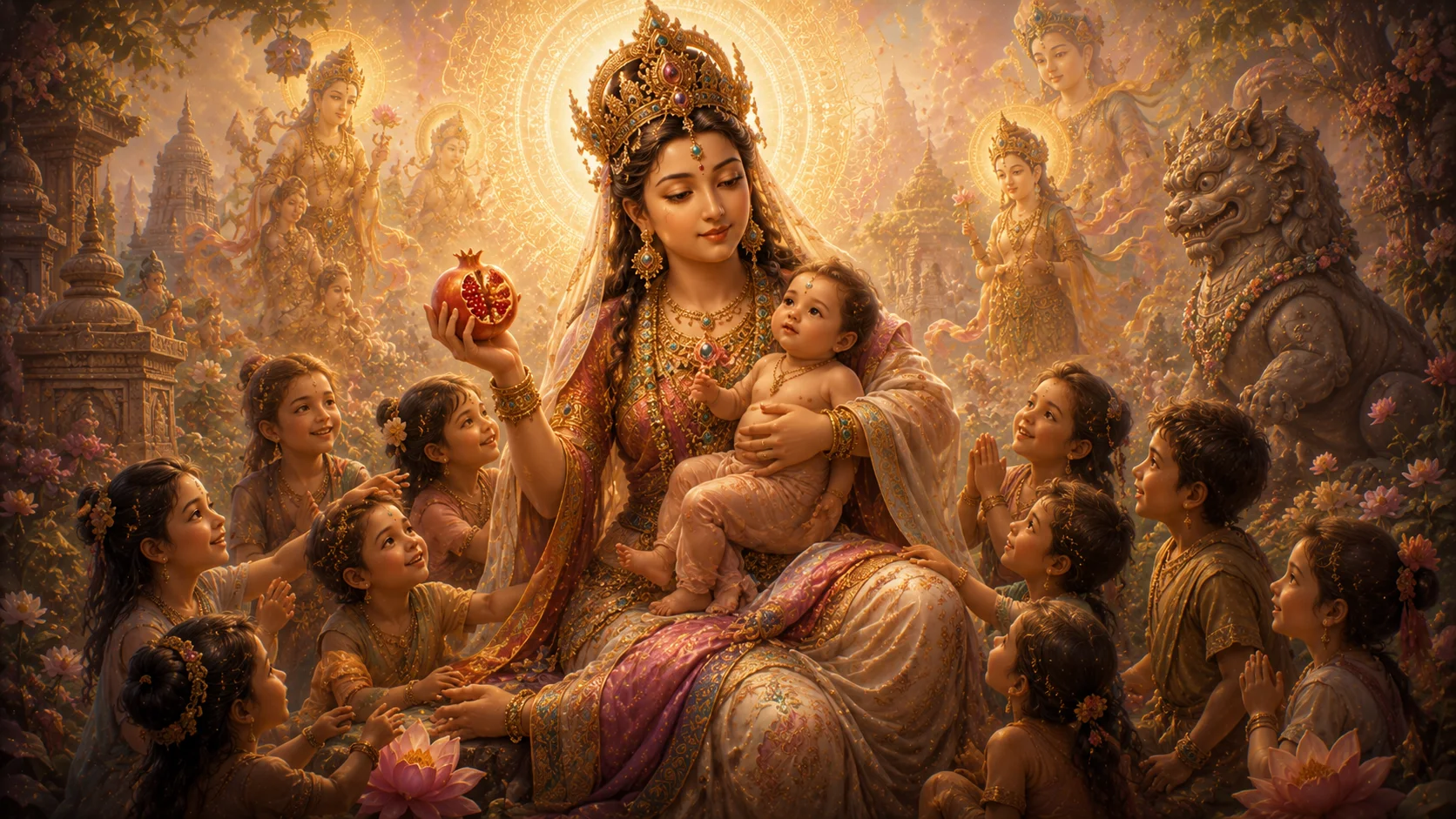
Hariti — the mother-goddess of children and childbirth — is one of the most striking figures of Buddhist legend: a fearsome child-devouring demoness who was converted by the Lord Buddha into a loving protector of children and a goddess of motherhood, fertility, and easy childbirth. Her transformation is one of the great parables of compassion and the power of the dharma to redeem even the most terrible of beings.
The Child-Eating Demoness
In her original nature, Hariti was a yakshini — a fierce ogress or demoness — who had hundreds of children of her own (five hundred, by tradition) whom she loved devotedly. But to feed her own vast brood, she preyed upon the human children of the city, stealing and devouring them, so that the people lived in terror and grief, their children vanishing to feed the demoness’s hunger. The bereaved parents, helpless against her, at last appealed to the Lord Buddha for deliverance.
The Lesson of the Lord Buddha
The Lord Buddha resolved to teach Hariti compassion by letting her feel the suffering she caused. He hid her youngest and most beloved child, Priyankara, beneath his begging-bowl. Frantic, Hariti searched the whole world for her lost child and could not find him, and came at last in despair to the Lord Buddha. He asked her: if she suffered so at the loss of one of five hundred children, how much greater must be the grief of the human parents from whom she had stolen their only or few children? Stricken with understanding and remorse, Hariti repented. The Lord Buddha restored her child and converted her to the dharma, and she vowed to protect children forever after instead of devouring them — the Lord Buddha promising that she and her children would be fed by the offerings of his monasteries.
The Protector of Children
Transformed, Hariti became a beloved goddess — the protector of children, the patroness of childbirth, fertility, and the welfare of families, invoked by parents for the health and safety of their children and by women for easy delivery and the blessing of offspring. She is depicted as a beautiful, benevolent mother surrounded by children, sometimes holding an infant and a pomegranate (a symbol of fertility). Honoured across the Buddhist world (as Kishimojin in Japan), she is the embodiment of redeemed motherhood. In Hariti, Buddhism gave form to the redemption of the terrible into the tender — the child-devouring demoness who, taught compassion by the Lord Buddha, became the loving mother-goddess and protector of all children.
Origins in the Yakshini Cults of Ancient India
Before she wore the halo of a Buddhist goddess, Hariti belonged to an older and wilder religious world — the folk cults of yakshas and yakshinis that flourished across the Indian subcontinent long before organised Buddhism gave them a place in its cosmology. These nature-spirits, tree-deities and local mother-goddesses were worshipped at village shrines, sacred groves and river crossings, feared and placated in roughly equal measure. Buddhism did not erase this older world; it absorbed it, giving fearsome regional deities a narrative reason to become guardians of the dharma rather than threats to it. Hariti’s story is one of the clearest surviving examples of that process: a dangerous local ogress recast, through a single encounter with the Lord Buddha, as a figure of protection — the terror left intact, its appetite redirected.
A Husband Among the Yaksha Generals
Hariti was not solitary in the way the bare outline of her conversion might suggest. Buddhist tradition gives her a husband, Pancika, a yaksha general counted among the retinue of Kubera, king of the yakshas and guardian of wealth. Where Hariti governed fertility and the survival of children, Pancika presided over prosperity and martial strength — together the pair formed a household of abundance, and Gandharan sculptors regularly carved them side by side as a married couple flanked by their swarming brood. It is this domestic pairing, more than the horror of the conversion story alone, that explains why later art shows Hariti seated calmly with children climbing over her lap: she was worshipped not only as a redeemed monster but as half of a functioning divine household, invoked by families who wanted both prosperity and healthy children under one roof.
Fed by the Monasteries: A Custom the Pilgrims Recorded
The bargain struck at the end of her conversion — monastic offerings in place of human flesh — did not stay inside the story. It became an observed practice of Indian monastic life. The Chinese monk Yijing, who travelled through India in the seventh century and set down the daily routines of the monasteries he stayed in, describes an image of Hariti kept in the porch or a corner of the refectory, with a share of the food set aside for her at every meal. Her place at the threshold of the dining hall was not decorative: it was a running settlement of the debt the Lord Buddha had negotiated on humanity’s behalf, renewed each time the monks ate. Xuanzang, travelling a few decades earlier, recorded a stupa in Gandhara marking the spot where the Lord Buddha was said to have subdued her, and noted that the people of that country made offerings there to obtain children — the legend had already hardened into local devotional habit.
Gandhara and the Hellenistic Hariti
Gandhara — the crossroads region straddling modern Pakistan and Afghanistan where Greek, Persian, Central Asian and Indian artistic traditions collided in the centuries after Alexander’s campaigns — produced the most visually startling versions of Hariti to survive. Gandharan sculptors, trained in a Hellenistic idiom, carved her not as a fanged ogress but as a serene, classically draped matron cradling a child, often holding a cornucopia spilling with fruit — an attribute lifted almost wholesale from Tyche, the Greek goddess of fortune and civic prosperity, whose image was familiar throughout the Hellenised cities that dotted the region. Pancika sits beside her with a spear or a money-bag, the martial and the mercantile halves of the household made visible. The result is a genuinely hybrid deity: an Indian yakshini, a Buddhist convert and a Greek fortune-goddess occupying the same carved stone — a reminder that the routes which carried silk and coin through Gandhara carried iconography just as efficiently.
Guizi Mu and Kishimojin: Hariti’s Journey East
As Buddhism carried her story along the trade and pilgrimage routes into East Asia, Hariti kept her essential character while gaining new names and new emphases. In China she became Guizi Mu, the “Mother of Demon Children,” her cult folded into the wider Chinese Buddhist devotion to child-protecting and fertility-granting figures. In Japan she is Kishimojin, also read Kishibojin, among the most widely venerated protective deities in Japanese Buddhism and especially prominent in the Nichiren school — a standing she owes to the Lotus Sutra itself, where she appears among those who vow to shield the sutra’s devotees. Japanese devotional images preserve the Gandharan grammar with remarkable fidelity: a composed mother figure with an infant in one arm and a pomegranate in the other, a visual formula that outlived by more than a thousand years the Hellenistic world which helped shape it.
The Pomegranate and the Taste That Replaced Flesh
The pomegranate that appears in nearly every image of Hariti carries a piece of legend beyond its general symbolism of fertility — though it belongs to later popular tradition rather than to the earliest canonical tellings. In that tradition the Lord Buddha did not ask Hariti to abandon her appetite outright; he gave her something to satisfy it, instructing her to eat the flesh of the pomegranate whenever the old hunger returned, its crowded red seeds standing in for what she could no longer be permitted to take. It is a small, almost domestic detail beside the grandeur of her redemption, and it is the detail that turns Hariti from a goddess who was simply forgiven into one who was handed a permanent daily discipline — a craving managed rather than erased, which is arguably a more honest picture of what reform looks like than any clean one-time conversion.
Why Hariti Endures
Child mortality in the pre-modern world was not a statistic; it was a constant, unpredictable grief that reached almost every family, and it demanded an explanation that placed the danger somewhere other than in the fragile bodies of infants themselves. A demoness who steals children gives that grief a face and, crucially, a reason: children did not simply die, they were taken, by a hunger that could — unlike disease — be reasoned with, fed and bargained down. That is the practical work Hariti did for the households that kept her image by the door, and it explains why a figure born in village folk religion outlasted the empires that carried her from the Indus to the Japanese archipelago: she turned the worst thing that could happen to a family into something a family could act on.
Sources & traditions
- EncyclopediaWikipedia — Hariti
- TraditionBuddhist texts, oral tradition and village tellings (South/Southeast Asia)
Myths change from area to area and from time to time. This chronicle follows the most widely told versions; tellings in other villages, regions and eras may differ.