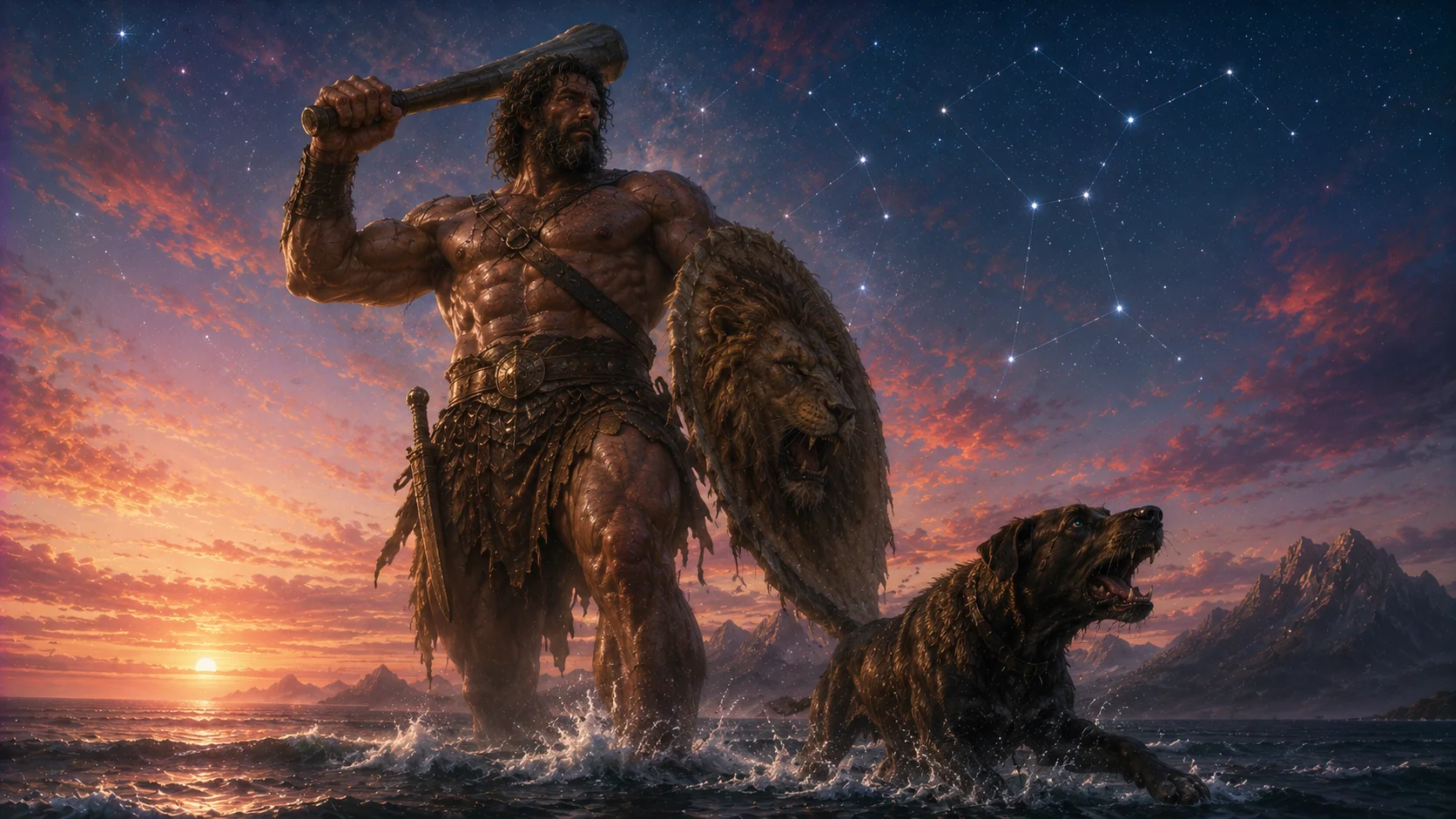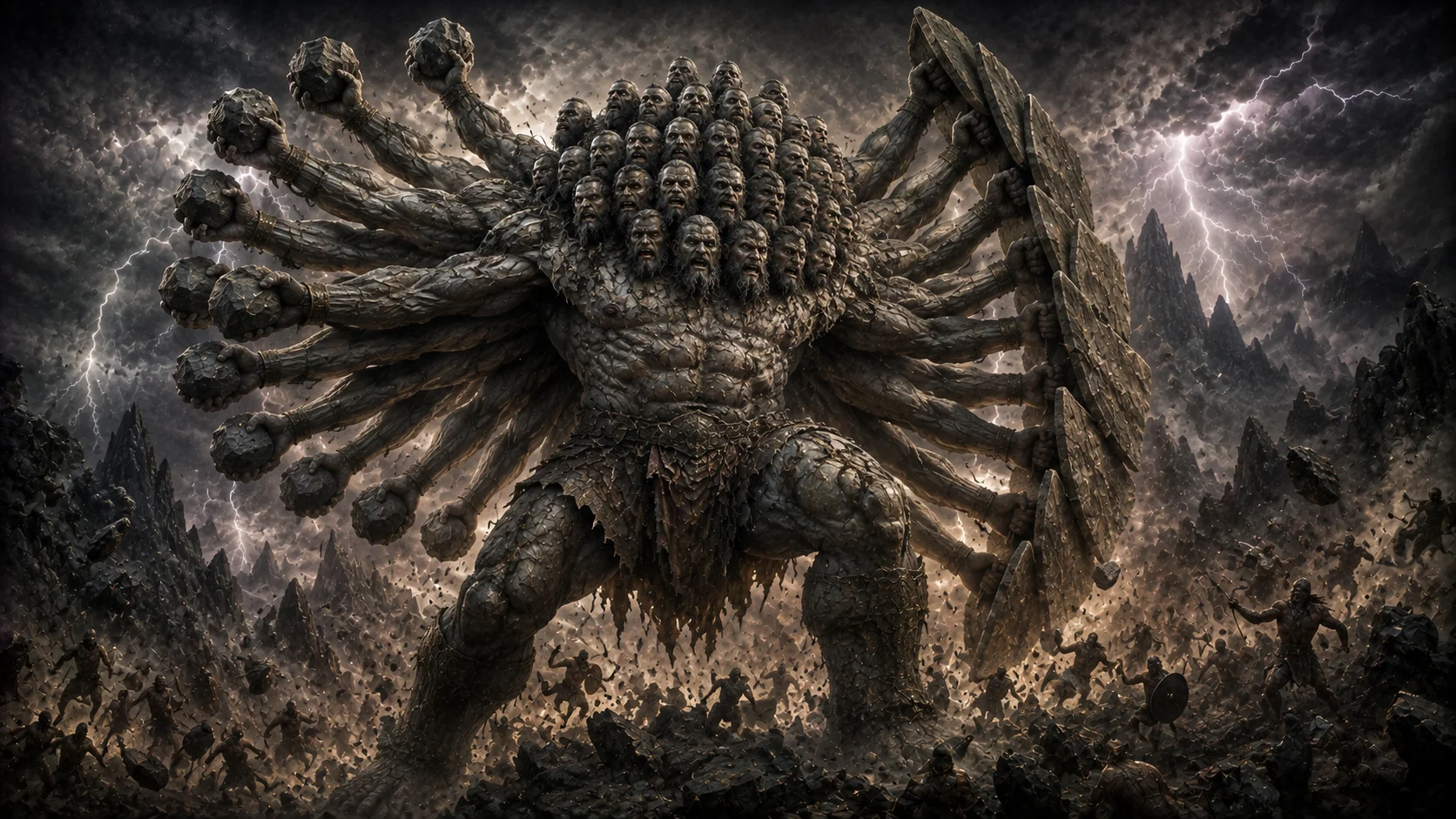
The Erymanthian Boar was a gigantic, savage wild pig that ravaged the slopes of Mount Erymanthus in Arcadia — the monstrous quarry of the fourth Labour of Heracles, who was charged not with killing it, but with bringing it back alive. Its capture is one of the most vivid of the hero's twelve trials, remembered as much for the strange and bloody detour that led there, and for its comic aftermath, as for the feat itself.
A Debt Owed to a Mad Hour
The Labour did not begin on the mountain. It began in disgrace. Heracles undertook his twelve trials as atonement, imposed by King Eurystheus of Tiryns and Mycenae at the command of the Delphic Oracle, after a fit of madness sent by Hera drove him to kill his own children. Each Labour that followed was framed as a task assigned to a man working off an unbearable debt, and the boar-hunt was the fourth in that sequence — though which Labour fell where is not fixed with perfect certainty. Ancient authors did not agree among themselves on the exact order: Euripides, Apollodorus and Diodorus Siculus each hand down a slightly different sequence, so the "fourth Labour" is best understood as the conventional, most widely repeated placing rather than a single settled fact carved into the myth from its origin.
The Terror of Erymanthus
The boar was a beast of enormous size and ferocity, with great tusks and a foul temper, that came down from the wooded heights of Mount Erymanthus to lay waste the surrounding fields and terrorise the people of the region. Wild boars were genuinely feared in the ancient world — fast, powerful and lethal at close quarters — and this one was a monster among them, a single animal that could destroy crops, livestock and men with equal ease. The mountain that gave it its name, and its only name, lay in Arcadia in the Peloponnese, wild country already thick with story: Mount Erymanthus was also linked in myth to the huntress goddess Artemis and to the god Pan, patrons of exactly the untamed, thicketed wilderness the boar called home. Unlike some of the other monsters set against Heracles — the Ceryneian Hind sacred to Artemis, for instance — the boar itself belonged to no particular god. It was not a stolen treasure or a divine pet to be handled carefully. It was simply the wild at its most dangerous, a test of nerve and endurance rather than of sacrilege.
A Command Harder Than It Sounds
Eurystheus's order carried a deliberate cruelty in its precision: Heracles was to capture the boar alive and carry it back to Mycenae, not merely slay it where he found it. This set the Labour apart from trials like the Nemean Lion or the Lernaean Hydra, where the beast's death was the entire point. A dead boar would have proven nothing new about Heracles that killing already had. A living one, dragged bodily off its mountain and delivered still snarling to the king's own hall, proved something else — mastery, not merely slaughter, and a far crueller logistical problem for the man who had to manage it.
A Guest at Pholus's Table
On his way to the hunt, Heracles broke his journey at the cave of the centaur Pholus, who received him with open hospitality. Among the stores Pholus kept was a great jar of wine, but it was not his alone to open — it belonged to the centaurs as a body, a shared inheritance rather than a private store. Pholus opened it anyway for his guest, and the powerful, unmixed scent of the wine did not stay contained within the cave. It carried out across the mountainside and drew the rest of the centaur kind down upon them, already roused to fury at the smell of a jar that was theirs being broached without them.
The Cave Under Siege
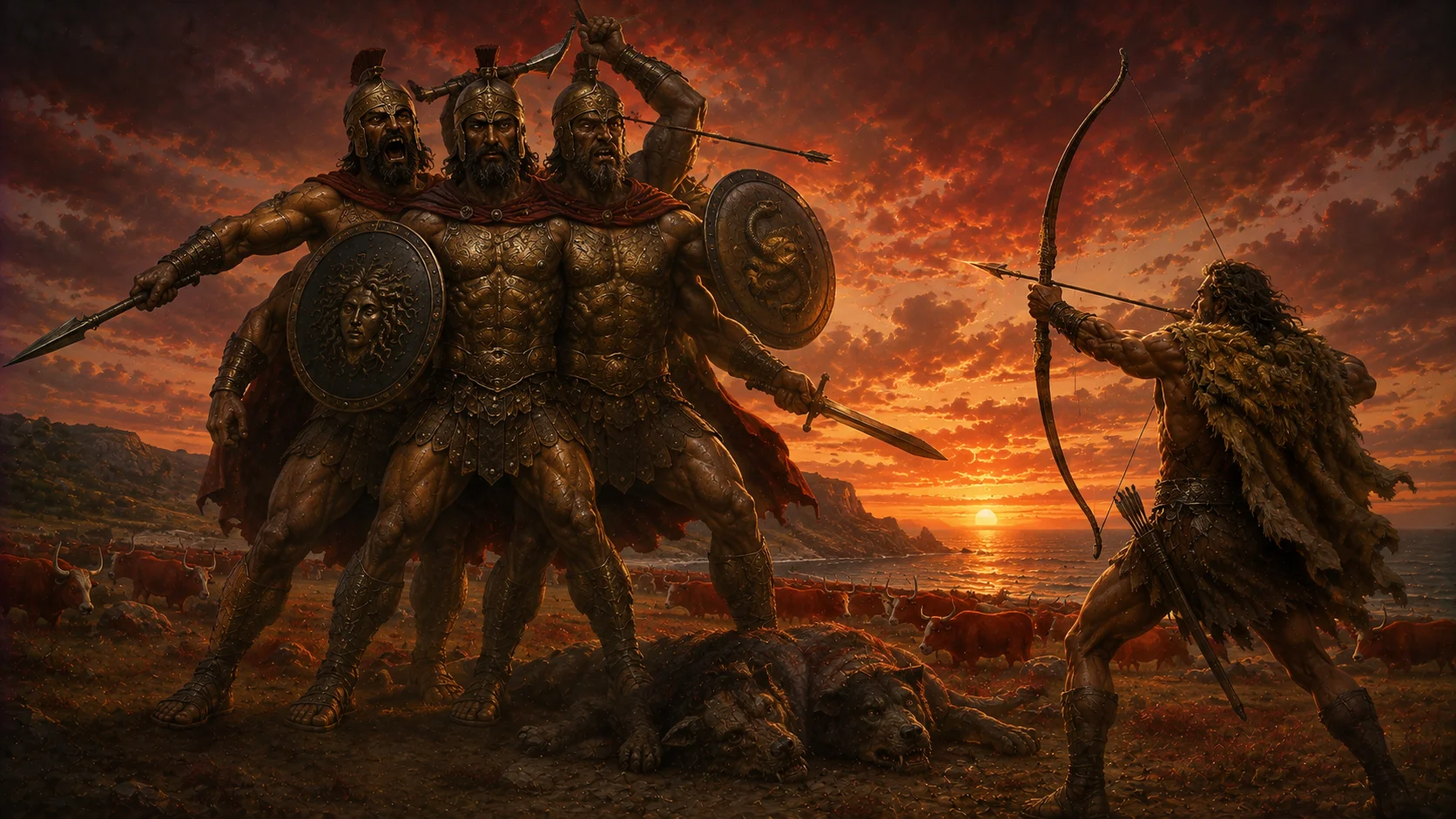
What followed was no polite dispute over a broken custom. The centaurs descended on Pholus's cave in a frenzy, and Heracles found himself defending the place against a mass of enraged kinsmen armed with the wilderness's own weapons — stones, fire-brands, whole uprooted trees. He answered with his bow, and the arrows he loosed were tipped with venom drawn from the Lernaean Hydra, poison potent enough to kill on the barest wound. Several centaurs died on those arrows before the attack broke, a battle that had begun as a hospitality gone wrong and ended as a rout.
The Arrow That Found Chiron
Among the casualties of that chaotic fight was a centaur who had done nothing to provoke it: Chiron, wisest of his kind, teacher and healer, struck by one of Heracles's poisoned arrows in the confusion. Because Chiron was immortal, the wound could not kill him outright — but the Hydra's venom was incurable even by his own famed skill in medicine, and what it gave him instead of death was unending agony, a wound that would not close and would not stop. In the fuller tradition, Chiron's suffering became so unbearable that he chose, in time, to surrender the very immortality that was prolonging it, giving it up in exchange for the release of Prometheus, and so finally found the death that had been denied him. It stands as one of the most consequential outcomes tied to this Labour — a wise and blameless figure undone by a fight he had no part in starting, all because a jar of wine was opened in the wrong company on the way to hunt a pig.
Into the Snow
Only after that detour did Heracles reach the boar itself. The most commonly told version of the hunt has him driving the beast out of its lowland thickets with shouting and pursuit, forcing it up the mountain rather than down into open ground where it might simply run free. Higher on Erymanthus lay deep snow, and it was there that the chase turned in Heracles's favour: the boar's own bulk and fury, so effective against crops and cattle, became a liability once it was floundering belly-deep in drift, exhausted and unable to build the speed or force that had made it a terror below.
The Binding of the Beast
Heracles closed on the spent animal while it struggled in the snow, sprang upon it, and bound it — netted or chained, depending on which telling is followed — before it could recover its footing and its strength. He did not kill it there, as the Labour demanded, and he did not leave it to be dealt with later. He hauled the bound, living boar bodily onto his shoulders and carried it the whole way back down from the mountain and on to Mycenae himself, a feat of raw endurance folded into a feat of strategy, since the trap of snow and exhaustion had done as much of the real work as his own strength had.
The King Who Fled His Own Prize
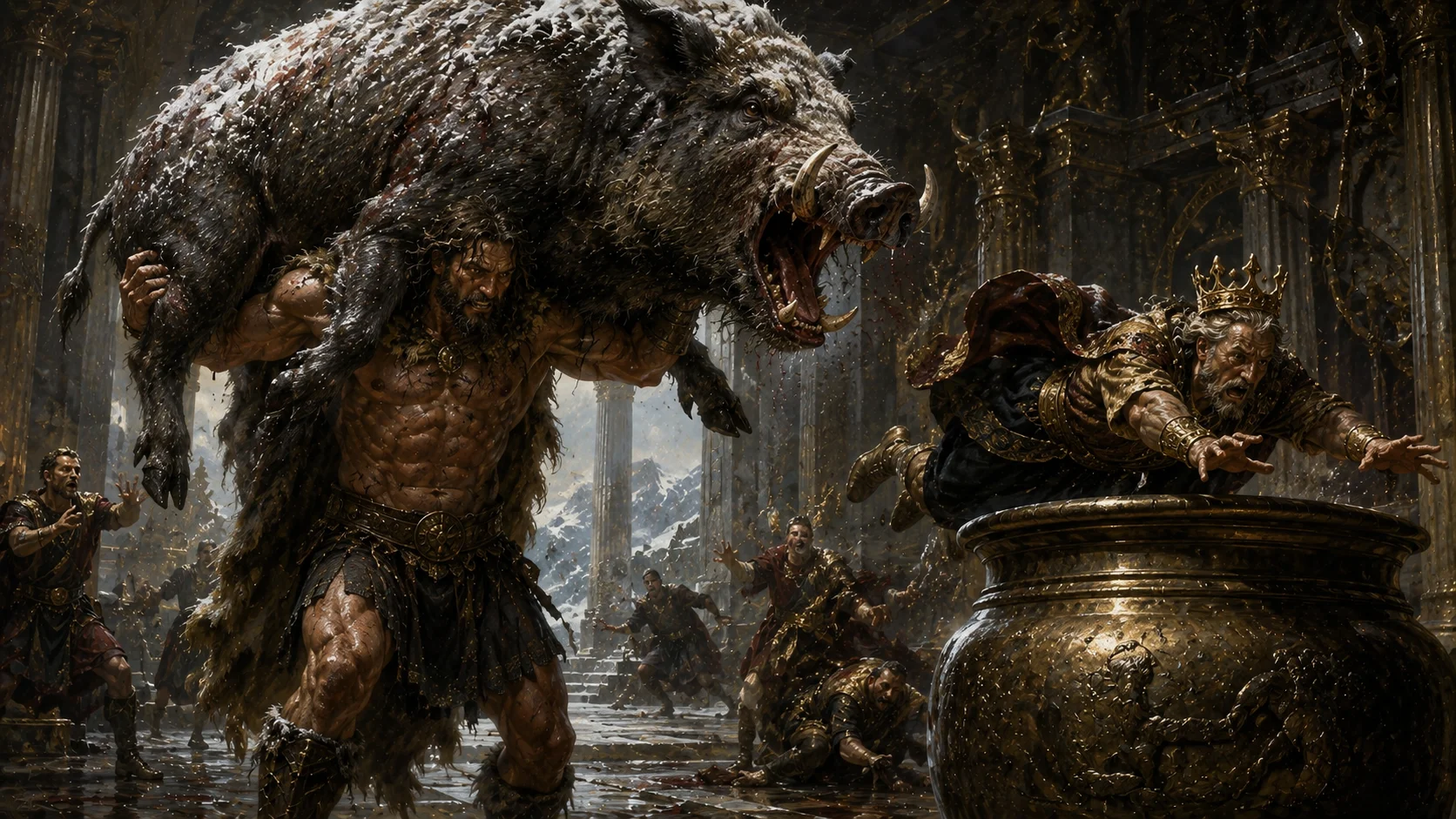
The Labour's most famous moment came at its very end, and it undercuts every ounce of danger that preceded it. When Heracles strode into Mycenae with the enormous, living, snarling boar slung across his shoulders, King Eurystheus — the very man who had set the task — took one look and lost his nerve entirely. He fled and hid himself inside a large bronze storage jar, a pithos, and by the well-attested account stayed there, peering out and imploring Heracles to take the monster away rather than bring it anywhere near him. The hero who had bled Hydra-venomed centaurs and broken a beast in the snow had returned in triumph only to find the man who sent him cowering in a piece of household pottery.
A Favourite of the Painters
That scene of the terrified king in the jar became one of the most popular comic images in ancient Greek vase painting, reproduced again and again across the Archaic and Classical periods. The Twelve Labours as a whole were among the most widely depicted mythic cycles in Greek and later Greco-Roman art, but the Erymanthian Boar's ending held a special appeal precisely because it was funny — a rare beat of outright comedy set against a cycle otherwise built from monsters, poison and death. Painters who might elsewhere show Heracles wrestling a lion or beheading a hydra returned often to this quieter, sillier image: the hero standing with his catch, and the king who ordered the catch folded into a jar meant for grain or oil, too frightened to come out.
What the Mountain Demanded
Set against the rest of the Twelve Labours, the Erymanthian Boar occupies its own particular niche. It is not a Labour about killing something that must die, nor about outwitting a divine trap, but about mastering something wild and bringing it back changed — captured rather than destroyed. The Arcadian setting reinforces that reading: a landscape already associated with the untamed hunt of Artemis and the wilderness-haunting Pan, in which a hero's task was not to purge the mountain of a monster but to prove he could take its fiercest inhabitant and carry it, still alive, into the heart of a king's own city. Endurance in the snow, restraint in not simply killing what would have been far easier to kill, and the grim cost paid at Pholus's cave along the way — these are the threads the Labour actually offers, without needing embellishment to carry weight.
Sources & traditions
- EncyclopediaWikipedia — Erymanthian boar
- TraditionGreek texts, inscriptions and later retellings (Greece)
Myths change from area to area and from time to time. This chronicle follows the most widely told versions; tellings in other villages, regions and eras may differ.