The Catoblepas was a strange and deadly beast whose head was so heavy it could never lift it from the ground — which was just as well, because its downward gaze (or its poisonous breath) was lethal to any living thing it looked upon. It is one of antiquity's most peculiar monsters: a creature whose own fatal power was kept in check only by the weight of its head.
The Beast with the Downcast Head
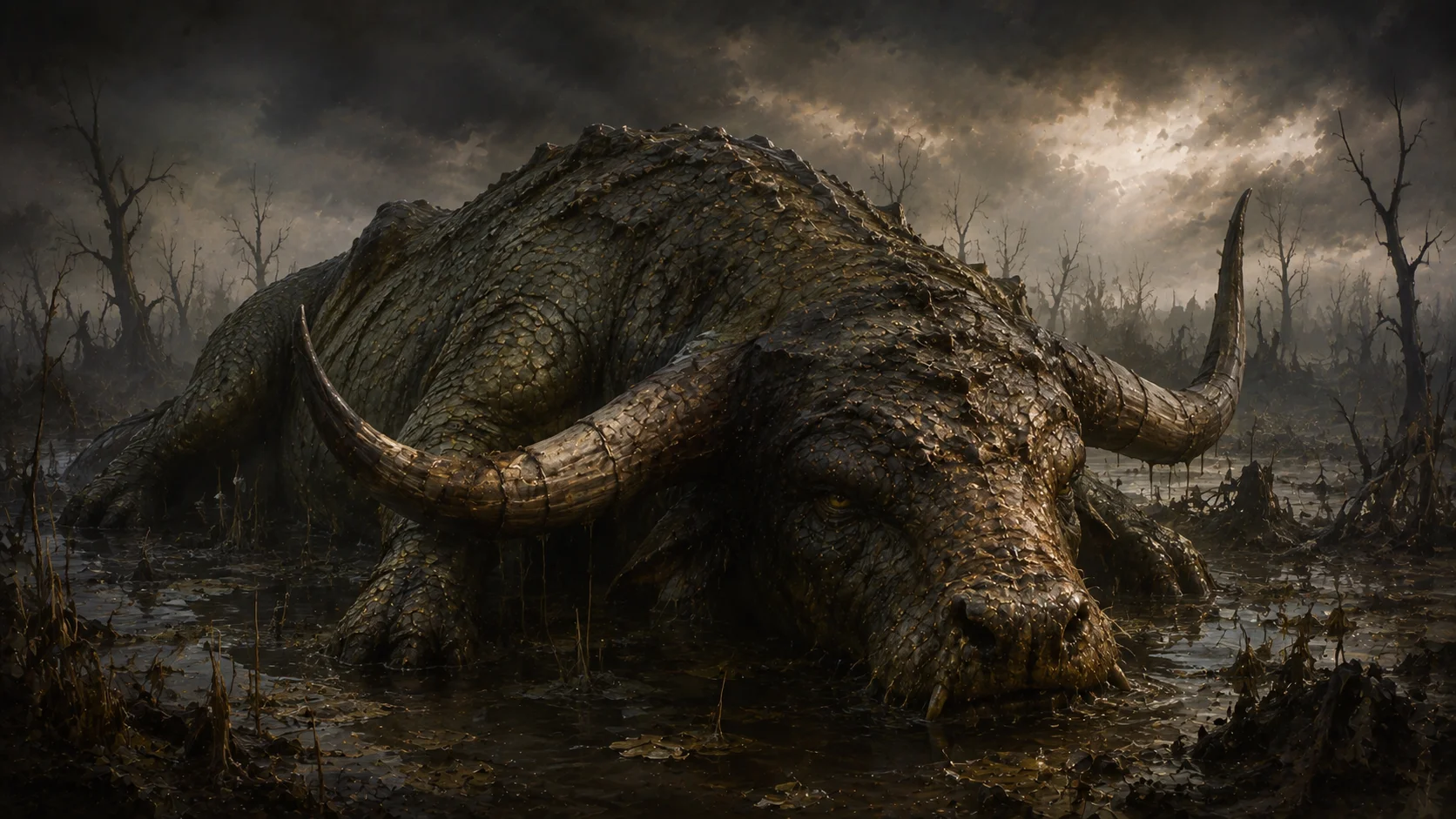
Described by ancient writers such as Pliny the Elder in his Natural History, the Catoblepas takes its name from Greek words meaning roughly "that which looks downward" — a name chosen for the one trait every account agrees on. It was said to be a heavy, sluggish, four-legged beast native to Ethiopia, in the broad sense the Greeks and Romans used that word: the vast, half-known expanse of sub-Saharan Africa that sat, in their geography, at the very edge of the inhabited world. Ancient descriptions of its exact animal affinities do not agree with one another — some writers likened it to a wild bull, others to a buffalo, still others to a boar — so no single fixed portrait of the Catoblepas survives from antiquity. What every source does agree on is the head: enormous, disproportionate, and set on a neck too thin and weak to support it, so that the animal's muzzle hung perpetually low, almost brushing the earth it grazed.
A Neck Too Weak for Its Own Skull
This was not merely an odd physical quirk to the ancient naturalists who recorded it — it was the entire premise of the creature. The Catoblepas's head was described as so large and so heavy that the animal was, in effect, a prisoner of its own anatomy. It could not raise its skull to look upward or outward with any ease; instead it dragged its head along the ground, eyes fixed on the soil, in what must have looked to any observer like a beast permanently bowed in exhaustion or shame. Ancient writers connected this directly to its diet, noting that it fed on poisonous plants — a detail offered as a possible explanation for why the animal's body, and by extension its gaze or its breath, carried such lethal potency.
The Gaze That Kills on Sight
The Catoblepas's defining and most feared trait was this: to meet its eyes was to die. Pliny records that anyone unfortunate enough to look into the Catoblepas's face when it lifted its head would fall dead on the spot, instantly, with no chance of escape or remedy. This was not described as a slow poison or a curse that could be broken — it was immediate and absolute, a death delivered by nothing more than eye contact. Other versions of the tradition placed the danger not in the eyes but in the breath, holding that the toxic plants the creature grazed upon rendered its exhalations themselves fatal to anything that drew near enough to breathe them in. Ancient sources are not fully consistent on which of these — gaze or breath — was the true mechanism of death, and both should be treated as part of the same core tradition rather than as competing, mutually exclusive claims.
Mercy Built from a Handicap
What makes the Catoblepas distinctive among ancient monsters is not simply that it killed with a look, but that its own body was described as the thing standing between it and constant slaughter. Because its head hung so low and was so difficult to raise, the beast rarely lifted its eyes to meet anything directly. A creature capable of killing everything it saw was, by the sheer weight of its own skull, prevented from seeing very much at all. Ancient paradoxography — the genre of "wonders" writing in which the Catoblepas appears — delighted in exactly this kind of built-in irony: a monster whose most dangerous power was neutralized by its own physical burden, so that the same trait which made it monstrous also made it, in practice, one of the more avoidable dangers of the exotic lands it was said to inhabit.
A Catalogue Entry, Not a Character
Unlike the mythic beasts of Greek epic and heroic legend — the Hydra faced by Heracles, the Gorgon slain by Perseus — the Catoblepas has no attested parentage, no individual name beyond its descriptive title, and no personal story. It does not appear as a character within a narrative; no hero is recorded confronting it, no god is said to have created or cursed it, and no episode comparable to a Labor or a quest survives naming it as an antagonist. Instead, the Catoblepas belongs to a different literary tradition entirely: the Greco-Roman genre of natural-history writing that catalogued marvelous, often terrifying animals reported to exist in distant, poorly known regions of the world. It sits alongside other such entries — creatures like the onocentaur — described as a type or species said to inhabit a particular exotic place, not as a mythic individual with a life story of its own. Any claim of a specific myth or heroic encounter involving the Catoblepas goes beyond what the ancient sources actually record.
An Emblem of the World's Dangerous Edge
Within the Greco-Roman geographic imagination, the Catoblepas served a symbolic purpose distinct from narrative myth: it stood for the unknown and the perilous at the furthest reaches of the mapped world. Writers like Pliny compiled long lists of marvelous and often deadly animals said to live in remote lands precisely because those lands were, to Greek and Roman readers, spaces of mystery — places where the ordinary rules of the known world might not apply, and where nature itself could produce something as strange and dangerous as a beast that killed with a glance. The Catoblepas, grazing at the edge of Ethiopia with its head bowed toward the earth, became one small but vivid piece of that larger cartographic imagination: proof, to ancient audiences, that the world's far corners held wonders no closer region could match.
A Cousin to the Basilisk, Not the Same Creature
Later tradition, especially in medieval and early modern writing, frequently paired the Catoblepas with the basilisk, since both were remembered chiefly for a gaze that brought instant death. This pairing is understandable — the two creatures share their single most famous trait — but it is also a later conflation rather than an ancient identification. The basilisk descends primarily from a different strand of ancient sourcing, typically described as a serpent or small reptile rather than a heavy-headed, bull-like grazing animal. The two should be understood as separate figures from separate origins that came to be discussed together because of a shared motif, not as two names for a single creature. Ancient readers encountering the Catoblepas in Pliny were not necessarily meant to think of it as a kind of basilisk, or vice versa.
What the Ancient Sources Do Not Say
Because the Catoblepas is attested primarily in a single major source — Pliny's Natural History — with only brief corroborating mentions elsewhere in similar paradoxographical writing, the ancient record about it is genuinely thin. Beyond the drooping, oversized head and the lethal gaze or breath, most further claims about its precise behavior, temperament, or appearance should be treated with caution. The variation in whether it was described as bull-like, buffalo-like, or boar-like across different ancient writers is itself a sign of how loosely fixed the creature's image was even in antiquity — there was no single canonical Catoblepas, only a shared core of "heavy head, deadly gaze" onto which different authors mapped different animal comparisons.
Flaubert and the Modern Rebirth of the Beast
The Catoblepas owes much of its modern visibility not to antiquity but to a single nineteenth-century work: Gustave Flaubert's The Temptation of Saint Anthony, which gave the creature vivid new literary treatment centuries after Pliny's brief, dry description. Flaubert's rendering expanded and dramatized the beast far beyond what any ancient source records, and it is largely through this later literary elaboration — not through the sparse ancient testimony itself — that the Catoblepas became a familiar figure in later fantasy and popular imagination. This distinction matters: the heavy melancholy, the elaborate voice, and much of the atmosphere modern audiences associate with the Catoblepas belongs to Flaubert's nineteenth-century imagination building on a few Roman-era sentences, not to the ancient record on its own terms.
A Monster Defined by Its Own Weight
What endures about the Catoblepas, across the gap between its thin ancient attestation and its much richer later reception, is the central irony that made it worth recording in the first place. Here was a creature granted one of the most absolute powers imaginable — instant death to anything it looked upon — and denied, by the same stroke, the ability to use that power freely. Its own skull, too heavy for its neck, kept its eyes turned toward the ground it grazed rather than toward the world around it. The Catoblepas is remembered less as an active predator stalking prey than as a hazard one might stumble upon: sluggish, burdened, dangerous only by accident of proximity, and saved from being a scourge upon everything nearby by nothing more than the physical limits of its own body.
Its gaze was instant death — and the only thing that kept the world safe was a head too heavy to lift.
Sources & traditions
- EncyclopediaWikipedia — Catoblepas
- TraditionGreek texts, inscriptions and later retellings (Greece)
Myths change from area to area and from time to time. This chronicle follows the most widely told versions; tellings in other villages, regions and eras may differ.