Cadmus was the founder-hero of Thebes and, the Greeks said, the man who brought them the alphabet — a culture-hero as much as a monster-slayer. His story braids together a dragon, a city sprung from teeth sown in the earth, and a curse that would haunt his royal line for generations.
The Search for Europa
Cadmus was a Phoenician prince, sent by his father to find his sister Europa, who had been carried off by Zeus in the form of a bull. He searched in vain, and the oracle at Delphi finally told him to give up the quest: instead, he was to follow a special cow and found a city where it lay down to rest. That place would become Thebes.
The Dragon's Teeth
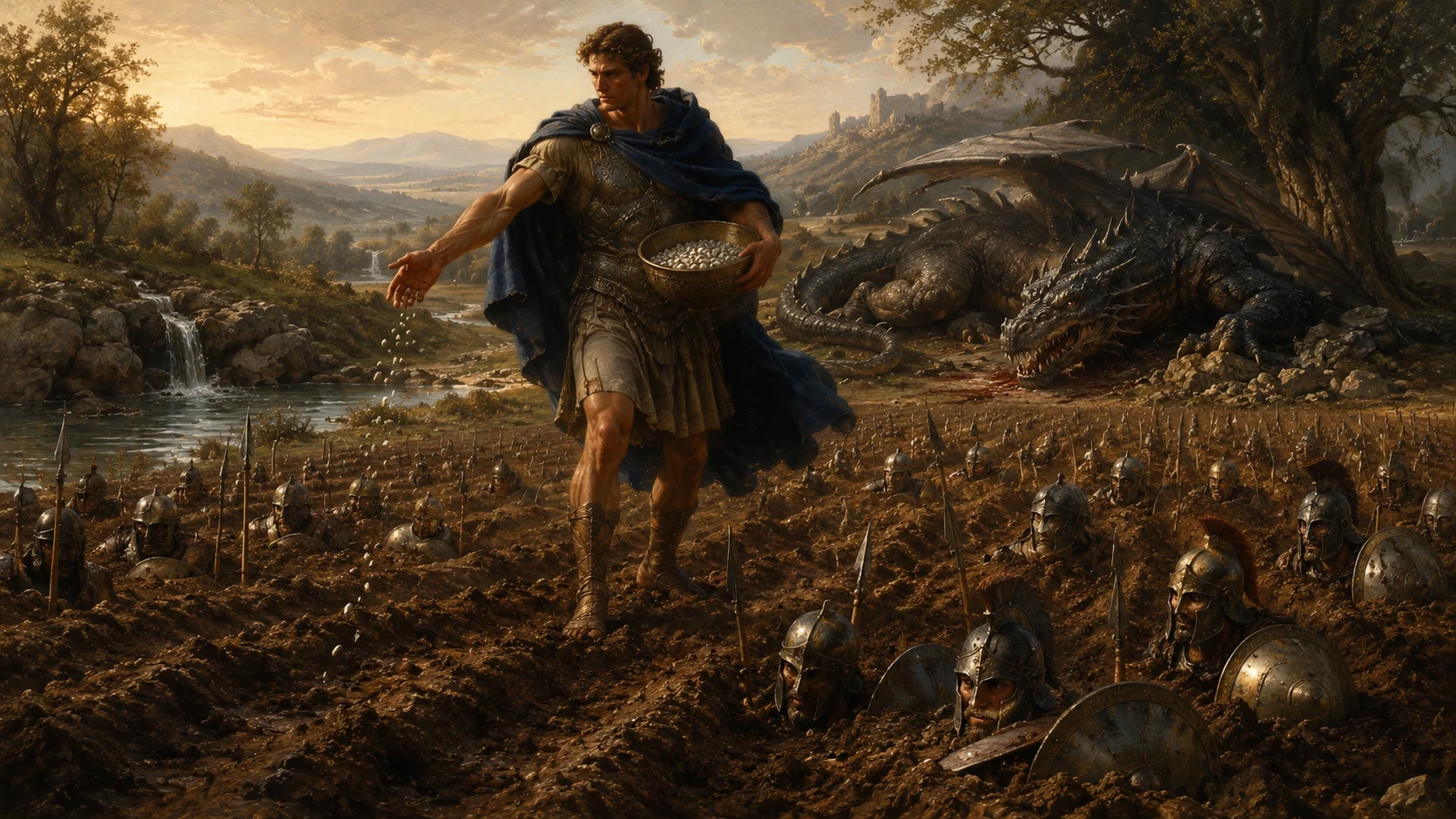
But the spring where Cadmus stopped to draw water was guarded by a great dragon sacred to Ares, which slew his companions. Cadmus killed the dragon — and then, on Athena's advice, sowed its teeth in the earth like seeds. From the furrows sprang up a crop of fierce armed warriors, the Spartoi (“sown men”). Cadmus threw a stone among them, and they fell to fighting one another until only five remained — and those five became the founding nobility of Thebes. The image of “sowing dragon's teeth” to raise an army of enemies has been a metaphor ever since.
The Gift of Letters
Cadmus is also remembered as the bringer of writing. The Greeks credited him with introducing the Phoenician alphabet — the ancestor of Greek letters and, through them, of the very alphabet you are reading now. Whatever the history, the myth honours a profound truth: that Greek civilisation owed its letters to the East.
The Serpent at the End
For killing the dragon of Ares, Cadmus and his wife Harmonia were fated to suffer; their descendants (including Oedipus and Pentheus) met terrible ends, and in old age Cadmus himself was at last transformed into a serpent — returning, in the end, to the form of the creature whose death had founded his city. Founder, dragon-slayer, and bringer of letters, his legend stands at the very root of Thebes and of writing itself.
He slew a dragon to build a city, and sowed its teeth to raise its first warriors — then became a serpent himself, the wheel come full circle.
Kadmeioi: The Name Before “Theban”
In the Iliad, the people of Thebes are not Thebans. Homer calls them the Kadmeioi — the people of Cadmus — as if the founder's name had never been displaced by the city's. Beneath the modern town, the old citadel that antiquity knew as the Cadmeia has given up the walls of a genuine Bronze Age palace and archives of Linear B tablets recording the administration of a wealthy Mycenaean centre, centuries before anyone wrote down the story of a dragon and a spring. The founder-king is late varnish on a place that was already old: Cadmus is what a literate Greek city told itself about a citadel it could not otherwise explain.
A Wedding the Gods Attended
The Greeks remembered only a handful of weddings the Olympians attended in person, and Cadmus's was one of them. His bride, Harmonia, was the daughter of Ares and Aphrodite — war and desire in one woman — and the gods came down to Thebes bearing gifts. Among them were a robe and a necklace, said to have been wrought by Hephaestus: dazzling, and ruinous to everyone who afterwards owned it. Generations later it reached Eriphyle, an Argive woman married to the seer Amphiaraus, who took it as a bribe and sent her husband to a war he had already foreseen would kill him — the doomed expedition of the Seven Against Thebes. A wedding gift meant to honour one marriage wrecked another entirely; in the house of Cadmus, blessings tended to arrive with teeth in them.
A House of Daughters
Cadmus and Harmonia had four daughters and a son, and every one of the daughters stands at the head of a violent story. Semele was loved by Zeus, tricked by a jealous Hera into demanding to see him in his full divinity, and burned to nothing by the sight — though her unborn child survived, sewn into Zeus's thigh to be born a second time as Dionysus. Ino took the orphaned infant god in and raised him, and was driven mad for it; she leapt into the sea holding her own son Melicertes, and the two became the sea-deities Leucothea and Palaemon, Palaemon honoured at Isthmia, where the Isthmian Games were said to have been founded in his memory. Autonoe bore Actaeon, the huntsman torn apart by his own hounds after he stumbled on Artemis bathing. Agave bore Pentheus, the king of Thebes she tore apart with her own hands in a Bacchic frenzy, taking her son for a mountain lion — the climax of Euripides' Bacchae. Only the son, Polydorus, lived quietly, and it was through his line that the crown passed to Labdacus, to Laius, and at last to Oedipus.
“A Cadmean Victory”
The Greeks had a phrase for a win that costs the winner everything: a Cadmean victory. Herodotus applies it to a sea battle in which the victors lost most of their fleet and the surviving ships limped away useless — and he uses the expression without pausing to explain it, as though his readers already knew it. Which episode of the saga produced the phrase was never settled: some point to the Spartoi cutting each other down until only five were left, others to Cadmus's own descendants Eteocles and Polynices, who killed one another at the gates of Thebes and left the throne to no one at all. Both explanations describe the same family habit — triumph and disaster arriving as a single event.
The Letters, Checked in Person
Herodotus does not merely repeat the claim that Cadmus brought writing to Greece; he says he went to look. In the fifth book of the Histories he describes the Phoenicians who came with Cadmus introducing their letters to a Greece that had none, and then reports that he himself saw inscriptions in old “Cadmean characters” cut into bronze tripods in the sanctuary of Ismenian Apollo at Thebes. It is one of the rare moments in which a Greek writer tells us he tried to test a myth against an object he could stand in front of. The name may preserve the same memory: a long-standing suggestion connects Cadmus to the Semitic root qdm, “east” — though the etymology is contested, and other linguists reject it outright.
Two Serpents, Not One
Retellings usually end with Cadmus alone, quietly turning into a snake in old age. The two ancient poets who actually stage the scene disagree with that image, and with each other. In Ovid's Metamorphoses, an aged Cadmus, worn down by watching his family destroyed, wonders aloud whether the serpent he killed at the spring was sacred and whether the gods intend him to become one himself — and as he speaks, the scales arrive. Harmonia, refusing to let him go alone, begs to share the change, and Ovid leaves them entwined: two gentle serpents who slip away from people rather than menace them. Euripides' Bacchae, written centuries earlier and far less kind, has Dionysus pronounce the same transformation as a sentence — Cadmus and Harmonia will take serpent form, he will lead a barbarian army against Greek cities and even against Apollo's oracle, and only afterwards will Ares carry the pair off to the land of the blessed. One version is a mercy, the other a punishment. Both agree that the man who killed a sacred serpent to build a city never stopped being answerable to it.
What keeps the story working is its refusal to let a founding be clean. Thebes exists because something sacred was killed at its water source, and the city's greatest families spend the following generations paying that bill in instalments — a debt the Greeks were content to leave permanently unsettled.
Sources & traditions
- EncyclopediaWikipedia — Cadmus
- TraditionGreek texts, inscriptions and later retellings (Greece)
Myths change from area to area and from time to time. This chronicle follows the most widely told versions; tellings in other villages, regions and eras may differ.