The Amphisbaena was the serpent with a head at each end — a creature that could never be taken by surprise, never cornered, and never had to turn around, because whichever way it needed to go, a head was already facing that way. Born, the Greeks said, from the blood of Medusa, it is one of myth's most quietly unsettling beasts.
The Two-Headed Serpent
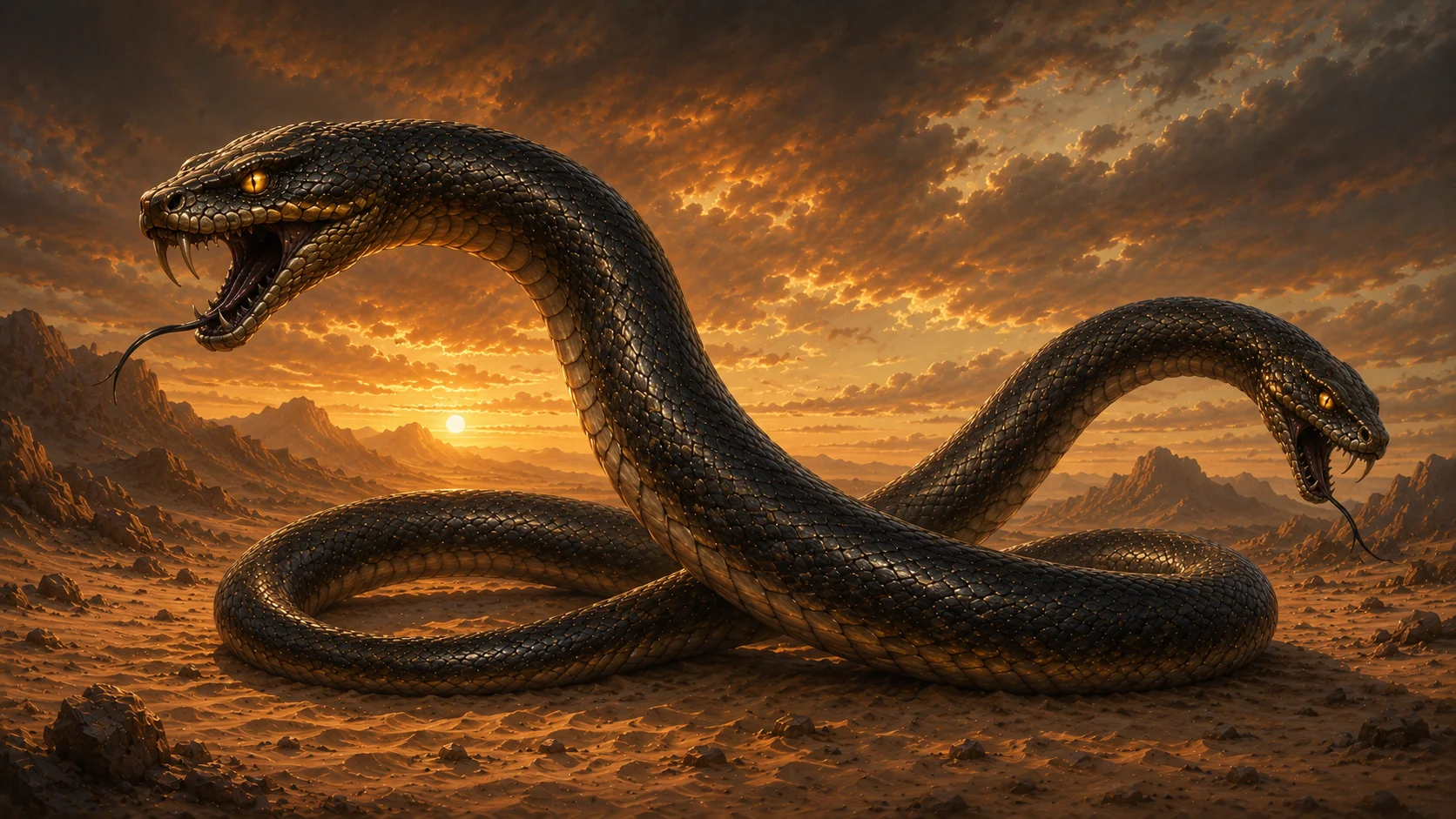
The Amphisbaena (its name means “goes both ways”) was a venomous serpent with a head at both ends of its body. To move, it could grip one head in the other's jaws and roll along like a hoop, or simply slither in either direction without ever needing to turn. With a head always watching at each end, it could never be ambushed, and could strike forward or backward with equal deadliness.
Born of Medusa's Blood
The Greeks gave it a grim origin: when Perseus flew over the Libyan desert carrying the severed head of Medusa, drops of the Gorgon's blood fell onto the sand — and from that blood sprang the venomous serpents of the desert, the Amphisbaena among them. It is a fitting birth for a monster, born from the blood of the most famous monster of all.
Cold-Defying and Death-Defying
Ancient and medieval lore credited the Amphisbaena with strange properties. It was said to be impervious to cold, able to come out even in winter, and so full of vital force that its eyes glowed like lamps in the dark. Because it had two heads and seemed to defy the normal limits of a creature, people believed parts of it had powerful medicinal and magical properties — its skin worn as a charm against the cold, or to help with various ailments. The two-headedness made it seem to possess a double measure of life.
The Beast That Faces Both Ways
The Amphisbaena endures as a richly symbolic creature — the beast that faces in two directions at once, that cannot be caught off guard, that embodies duality, vigilance, and the unsettling idea of a thing with no true front or back, no clear beginning or end. It became a popular figure in medieval bestiaries and heraldry, and remains a striking emblem of watchfulness on all sides and of the eternally self-renewing.
A head at each end, watching both ways at once — you cannot sneak up on a thing that has no back.
“As Though One Mouth Were Not Enough”
The oldest surviving descriptions of the Amphisbaena are not wonder-tales but field notes — and they are startlingly matter-of-fact. The Greek poet Nicander of Colophon, whose Theriaca is a 958-line hexameter handbook on venomous creatures and the harm they do, treats it as one more hazard a traveller might tread on: “less in bulk and slow of gait, two-headed, ever dull of eye. From either end a blunt chin protrudes, the one far from the other.” No Gorgon appears here. Nicander derives his venomous creatures from an older and stranger source altogether — noxious spiders, reptiles and vipers are, he says, sprung from the blood of the Titans. What his Amphisbaena amounts to is a small, slow, dim-sighted animal that is blunt at both ends and no less dangerous for being unimpressive.
Pliny the Elder, compiling his Natural History a couple of centuries later, gives the beast its most quotable line. The Amphisbaena has a twin head, he writes — one at the tail as well — tamquam parum esset uno ore fundi venenum: “as though it were not enough for the venom to be poured out of one mouth.” That sentence is doing something more interesting than describing an animal. It is a complaint against nature. Pliny’s Rome believed the natural world was legible, ordered, morally intelligible — and here was a thing that seemed designed by malice, given a second mouth for no reason except that one was insufficiently cruel.
The etymology carries the same unease, and it is worth noticing what the Greeks did not reach for. Amphis, both ways; bainein, to go. They had a perfectly good vocabulary for two-headedness and declined to use it. The creature is named for its freedom of direction rather than its anatomy — and what unsettled them, on the evidence of the name, was never the extra head. It was that the animal had no committed forward.
The Serpents of Cato’s March
The Amphisbaena’s most famous ancient appearance is in the ninth book of Lucan’s Pharsalia, and its power there is entirely a matter of company. Lucan is describing Cato leading the republican remnant on a death-march across the Libyan desert, and rather than narrate a battle he narrates a bestiary: a long, rolling catalogue of serpents that turns the sand itself into an enemy. The torrida dipsas, the parching one. The tabificus seps, dissolving bone along with flesh. The avidus prester, distending its victim’s foaming jaws. And, in that procession, gravis in geminum vergens caput amphisbaena — the heavy amphisbaena, inclining toward its twin head.
Read in isolation the line is a curiosity. Read in place, it is part of an argument. Lucan is not cataloguing wildlife; he is arguing that the world has become monstrous because Rome has, and that a republic devouring itself has produced a landscape where nothing has a single honest direction.
The passage matters for a second reason: it is the same passage that fixes the beast’s address. Lucan frames his entire catalogue as the brood raised from the drops that fell as Perseus carried the Gorgon’s head over Libya — so the origin and the geography arrive welded together, in one poem, as a single explanation. That is why the Amphisbaena is a Libyan serpent in nearly every later source, and why the Roman habit of stationing all impossible creatures just beyond the last known well proved so durable. Later writers were not consulting the desert. They were consulting Lucan.
Isidore, the Bestiaries, and the Eyes Like Lamps
Between the Romans and the illuminated bestiaries stands Isidore of Seville, whose Etymologies compressed late-antique learning into the reference book of the early Middle Ages. His entry is brief and consequential: the creature has two heads, “one in the proper place and one on the tail”; “its eyes glow like lamps”; and it “alone of the snakes trusts itself to the cold, and comes out first of all the serpents.”
Isidore did not invent that second detail — the early emergence is already in Nicander and Pliny, who date it to spring, before the cuckoo is heard. What Isidore did was select it, and package it in a book every medieval scriptorium owned. That is the more consequential act. His two-line entry is the channel through which the lamp-eyes and the winter-walking reach the bestiaries and get copied forward for eight hundred years, long after anyone could say where they came from.
And notice what the winter detail actually is underneath: an observation about seasonal behaviour, the sort of thing a farmer would notice, wrapped in the grammar of marvel. Somebody, at some point, watched a legless reptile out and active when every proper snake was underground, and drew the reasonable conclusion that it was not a proper snake.
The bestiary illuminators then did what illuminators always did, which was to draw the moral rather than the animal. The manuscript Amphisbaena is routinely burdened with wings and clawed legs, becoming a small dragon with a serpent budding from its rear. Pliny’s plain snake had described a creature; the medieval image describes a condition — the sin of facing two ways, the counsellor whose advice points in both directions at once. The heraldic beast descends from this line rather than from the classical one, drifting through amphistere, amphiptere and the amphisian basilisk as it went, which is why the creature on a coat of arms so rarely looks like anything that could live.
The Apothecary’s Serpent
Nothing in ancient medicine was wasted, least of all a monster — and the pharmacology here is older than the Roman sources that made it famous. It is Nicander who first sends woodcutters out in spring to strip the Amphisbaena’s skin before the cuckoo calls, for chilblains and slackened sinews. Pliny repeats him, and adds the detail that gives the practice its shape: “if it is fastened to a tree that is being felled, the fellers feel no cold and do their business more easily.” Not carried, not worn — nailed to the trunk, so that the whole work-site borrows from it.
The reasoning is worth pausing on, because it is not random. Ancient amulet logic ran on sympathy: a thing transmits the quality it conspicuously possesses. A serpent famous for walking out into frost that keeps other serpents underground is, by that logic, a reservoir of warmth, and proximity is enough to draw on it. The Amphisbaena was medically valuable for precisely the reason it was frightening. Its wrongness was the active ingredient.
Sir Thomas Browne Takes the Head Off
In 1646 the physician Sir Thomas Browne gave the Amphisbaena a chapter of his Pseudodoxia Epidemica — his great catalogue of received errors — and the way he demolishes it is more interesting than the demolition.
Browne does not appeal to evidence. He appeals to grammar. Every animal, he argues, must occupy the six positions of a body in three dimensions — infra, supra, ante, retro, dextrosum, sinistrosum — and the front is by definition the end where the senses are. Put the senses at both ends and the scheme collapses: “there is no inferiour or former part in this Animal; for the senses being placed at both extreams, doth make both ends anterior, which is impossible; the terms being Relative, which mutually subsist, and are not without each other.” A front cannot exist without a back to be the front of. The Amphisbaena is not ruled out by anatomy so much as by the meaning of the words used to describe it.
Then Browne does something better than refuting. He explains where the reports came from. Two-headed serpents, he suggests, are real but accidental — the product of eggs laid in numbers, “in chains or links together,” which sometimes fuse and “come out in mixed formations.” Sixteen hundred years of copying had treated the double head as a species. Browne is the moment somebody stops copying and asks what would have to be true — and answers with an embryological accident.
The Animal Behind the Myth
He was more right than he knew, because there is also a real animal here. Zoology eventually paid the myth the compliment of taking its name: the Amphisbaenia are a living group of reptiles, more than two hundred species of them, and almost nobody has heard of them.
They are commonly called worm lizards, which flatters neither party. They are not worms, and they are not lizards in the everyday sense — they are their own branch of the squamates, related most closely to the true lizards and only distantly to snakes, having lost their legs quite independently of them. All but one genus is entirely limbless. They spend their lives underground, and their bodies are sheathed in rings of scales forming a loose tube through which the trunk slides — which makes them look uncannily like enormous earthworms and lets them drive forward or reverse without bending. Their skulls are reinforced into shovels, keels and spades for pushing through soil. Because a burrow offers no room to turn around, they travel backwards down a tunnel as readily as forwards. The name is a zoologist’s joke that turned out to be a description.
And the tail is blunt. In many species it is short and thickened, truncated so that it vaguely resembles the head — and that resemblance appears to be the point, a decoy that draws a predator’s strike away from the real one.
Assemble that: a segmented, dull-eyed, slow-moving creature with a head at each end, which reverses without turning, which surfaces in weather that keeps other reptiles hidden, and which offers you a false head to strike at. Every element of the classical description is there, and none of it required exaggeration — only a witness who did not get a second look. One species, Blanus strauchi, lives across western and south-western Anatolia and out onto the eastern Aegean islands — Samos, Kos, Rhodes — which is to say inside the ancient Greek world, in soil that Greeks farmed.
Browne’s other explanation holds up too. Bicephaly — two functional heads on one body, arising from an incompletely divided embryo — occurs in real snakes and is well documented. Such animals are usually short-lived, and the heads famously work against each other, striking at the same prey or pulling in opposite directions. Anyone who found one and lived to describe it had seen, precisely, an Amphisbaena.
Dante, Milton, and the Long Literary Tail
The creature survived the end of belief by becoming a word poets liked. Dante puts it in the twenty-fifth canto of the Inferno, in the pit where thieves and serpents trade bodies. He reaches straight for the Libyan catalogue, names the anfisibena among the horrors — and then tells its author to be quiet. Taccia Lucano: let Lucan hold his peace. Lucan had only managed men turned to ash; Dante has men and serpents exchanging forms, and he wants the comparison made. Milton works the same seam in the tenth book of Paradise Lost, where the fallen angels are transformed into serpents and the roll-call runs “Scorpion and Asp, and Amphisbaena dire, Cerastes hornd, Hydrus, and Ellops drear.”
Both are quoting Lucan, and that is the real point. The Amphisbaena has almost no stories. It has no cult, no hero who kills it, no hoard, no maiden, no bargain. What it has instead is a name of enormous atmospheric power, and for two thousand years writers have used it the way a composer uses a low note — not for what it says, but for what it does to everything around it. When Jorge Luis Borges assembled his compendium of imaginary beasts, he built the entry almost entirely out of other people’s sentences — Pliny, Lucan, Brunetto Latini, Browne — and could hardly have done otherwise. The Amphisbaena’s biography is its citation history.
Why a Creature With No Back Still Frightens Us
Every predator we have ever feared has a front. That is the deep bargain of being prey: danger is oriented, and if you know where it is looking, you know where it is not. Flanking, circling, coming from behind, staying out of the field of view — almost every evasive instinct we possess is a technique for exploiting the fact that a hunter can only face one way at a time.
The Amphisbaena repeals that. It is the shape of an enemy against which position itself stops being useful information. There is no geometry to solve, no moment when it turns and you move. It does not need to be fast, or large, or clever — the ancients pointedly made it slow and dim-sighted — because it has quietly removed the one rule that makes escape a skill rather than luck.
And it is no accident that the same image, transplanted from the desert to the court, became the standard emblem of the double-dealer: the man who faces both ways, whose front you cannot locate because he does not have one. The bestiary illuminators drawing a winged serpent with a head where its tail should be were not confused about zoology. They were drawing somebody they had met.
Most monsters answer the question “what could kill me?” The Amphisbaena answers a colder one: what could I never get away from?
Sources & traditions
- EncyclopediaWikipedia — Amphisbaena
- TraditionGreek texts, inscriptions and later retellings (Greece)
Myths change from area to area and from time to time. This chronicle follows the most widely told versions; tellings in other villages, regions and eras may differ.