Tengri (Old Turkic Täŋri, Mongolic tngri or tenger) is the word for Sky and for the sky-god in the languages of the Eurasian steppe, and the oldest named power in the religious life of the Turkic and Mongol peoples. It is attested in Chinese reports of the Xiongnu around the turn of the era, in the Old Turkic stone inscriptions of the eighth century, in the Secret History of the Mongols and in the letters of thirteenth-century khans to the kings and popes of Europe. It is also a living word: in Mongolia, Siberia and Central Asia people still say “Tengri” or “Tenger” in blessing and oath; some communities practise a revived Tengrism; and many Muslims, Buddhists and Christians of the steppe use the same word for God. This article describes what the early sources do and do not say, how scholars read them, how the word was carried into later religions, and how the modern movement that bears the name differs from the ancient evidence.
The name
The Old Turkic form Täŋri appears with many variants in later languages — Tengri, Tangra, Tengeri, Tanrı (the modern Turkish word for God), Tenir — and the Mongolic equivalent tngri is cognate. Its origin is not settled. One proposal derives it from a word meaning “dawn” or “daybreak.” Another, advanced by the linguist Stefan Georg, treats it as a loanword from Proto-Yeniseian, a family spoken in Siberia, with the sense of “high.” Chinese chronicles transcribe the Xiongnu word as chengli (written with the characters meaning “support” and “plough”), which is generally taken as an early form of the same word; the Han histories gloss it as “heaven.” Some popular sources give a date as early as the fourth century BC for this attestation; the Chinese record that actually survives is of the Han period, and the earlier date should not be repeated without a source.
The modern term Tengrism, or Tengrianism, is not ancient. The Kazakh scholar Shoqan Walikhanov used a form of it in the nineteenth century; Jean-Paul Roux popularised it among specialists in a study of 1956; and the Kazakh poet Olzhas Suleimenov spread the word “Tengrianism” in Russian after his book of 1975. The steppe peoples themselves spoke of Tengri, not of an “-ism.” Whether the umbrella label describes a single religion or a family of related practices is a matter of discussion among scholars.
The earliest sources
The Xiongnu, the steppe confederation that confronted China from the third century BC, are known almost entirely through Chinese historians. The Han sources report that their ruler was called chanyu and that the Xiongnu word for heaven was chengli, so that the ruler’s full style meant something like “son of heaven.” This is a record of a title and a word, filtered through a Chinese understanding of kingship, and it should be read with that in mind.
The richest early source is the group of Old Turkic inscriptions of the Second Turkic Khaganate, found in the Orkhon valley of Mongolia. Nikolai Yadrintsev’s expedition located them in 1889; Vasily Radloff published them; and the Danish philologist Vilhelm Thomsen deciphered the runiform script in 1893. The two great monuments commemorate the brothers Kül Tigin (died 731) and Bilge Qaghan (died 734), and are usually dated to 732 and 735; the texts name a relative of the khagan, Yollıg Tigin, as their writer, and sources differ on how much of the wording is his and how much the khagan’s. They are the oldest substantial texts in a Turkic language. A third inscription, that of Tonyükuk, comes from the same period.
What the inscriptions say about Tengri
The inscriptions use the word Tengri in three main ways. First, as the sky: the opening of the Kül Tigin text gives, in a common English rendering, that when the blue sky above and the brown earth below were created, human beings were created between them, and above human beings the ancestors of the Turks became rulers. Here Tengri is part of the frame of the world, together with the earth, and the ancestral rulers take their place within it. Second, as a power that acts: victories are credited to Heaven’s favour, and the khagan describes himself in a phrase usually translated “Tengri-like and Tengri-born Turk Bilge Qaghan.” Third, as the source of kut, a word for fortune, sacred power and the quality that legitimates a ruler. The texts speak as though Tengri can give kut and can take it away, which is why some scholars describe the mandate as conditional.
A famous passage asks who could destroy the Turkic state so long as the sky above did not fall and the earth below did not open, and blames the people’s own faults — their disunity and their turning to Chinese ways — for the earlier collapse. The inscriptions also speak of mortality in terms of Heaven’s decree: deaths, including those of khagans, are said to occur as Tengri ordained, though the exact wording varies between translations. These statements are phrased in the monumental style of a political memorial, composed to persuade, so they tell us how a khagan wished heaven to be understood as much as how ordinary people did.
Other early Old Turkic sources speak of Tengri in more intimate registers. The Irk Bitig, a book of divination found at Dunhuang and usually dated to the ninth century (a date of 930 has also been argued), mentions the “Turkic Tengri” (Türük Täŋrisi) among its omens. The Orkhon texts and the Irk Bitig together show that the same name could be political and ordinary, a matter of state and a matter of the household.
The sky, the earth, and the other powers
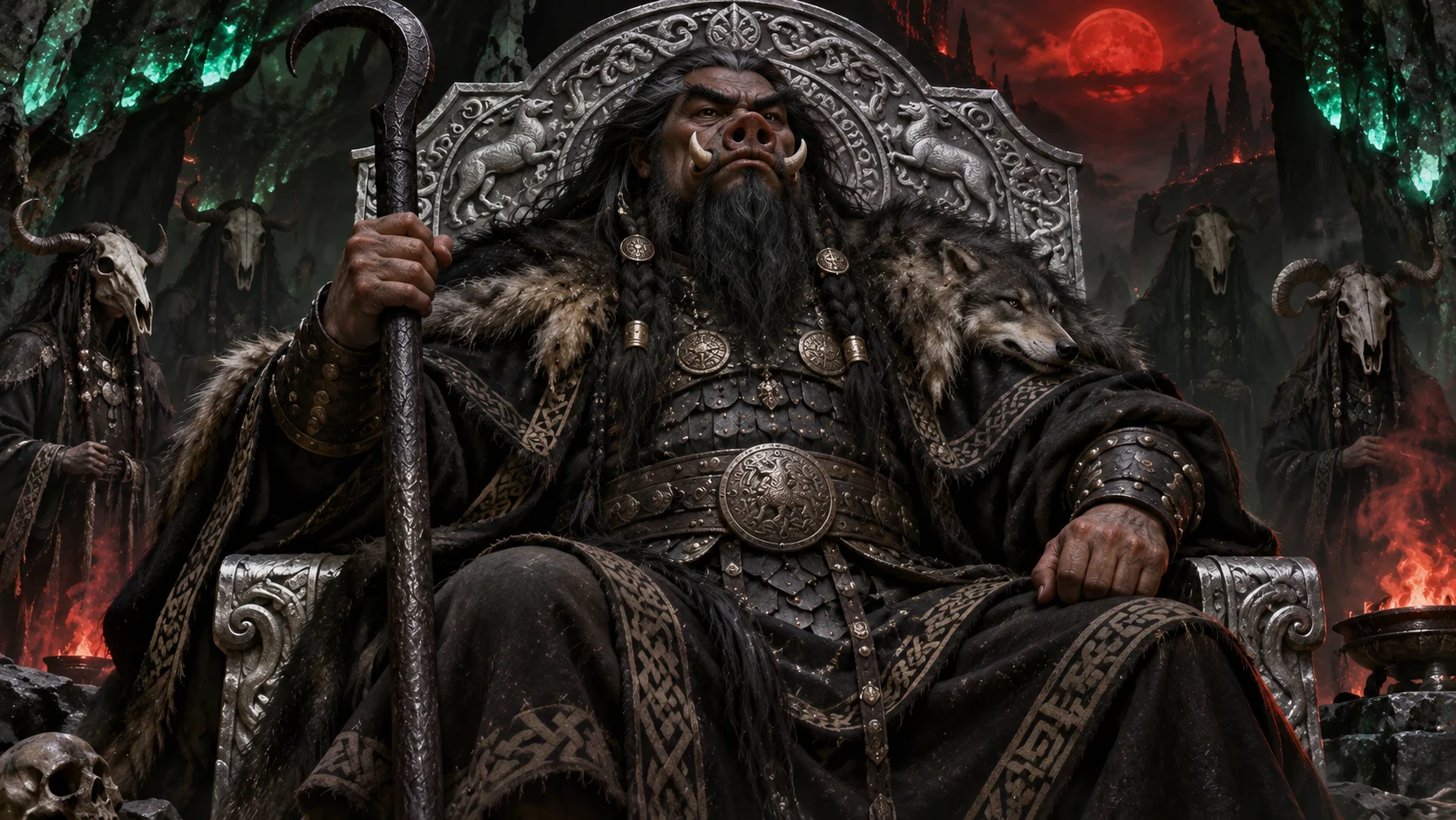
In the inscriptions Tengri is often paired with the earth-and-water, yer-sub, the sacred land itself, and the pair presides over the Turkic people. The sky is not anthropomorphic in these texts; later scholarly summaries speak of Gök Tengri, “Sky Tengri,” as an abstract and never-depicted power. Other figures appear in the broader tradition: the goddess Umay, protector of women and infants; the earth-spirit Etugen among the Mongols; in some Altai accounts a creator Kayra, with Ülgen and Erlik as his offspring or rivals; and a multitude of spirits of mountains, rivers and ancestors. A well-known cosmology has three worlds — upper, middle, lower — joined by a world tree or pillar, the road of the shaman.
In Mongolic sources the single Tengri becomes a class: the tngri are the highest order of beings, traditionally numbered ninety-nine and divided into fifty-five “white” benevolent and forty-four “black” wrathful, or into western and eastern groups. The supreme figure among them is called Möngke Tngri, “Eternal Heaven,” or Köke Möngke Tngri, “Blue Eternal Heaven,” with Qormusta (Khormusta) Tngri as another chief. A complete list is impossible, because the names attested in different texts exceed ninety-nine, and local and Buddhist figures were folded in over time. Individual tngri have functions: patrons of warriors, of horses, of riches, of fire.
Tengri and the Mongol empire
In the Mongol period the ideology of Heaven’s mandate is explicit. The Secret History of the Mongols, composed in the thirteenth century (1240 is the date commonly given, though earlier and later dates have been proposed), repeatedly speaks of Heaven and of the power of Eternal Heaven. The imperial documents are more formal: the seal of Güyük Khan in 1246 reads, in translation, “under the power of the eternal heaven,” and the same formula opens his letter to the pope. The Ilkhan Hulegu, writing in Latin to Louis IX of France in 1262, and the Ilkhan Arghun in letters of 1289 and 1290, also invoke Heaven. The concept is of a single supreme authority in heaven whose delegate rules on earth; a formula the Mongol court used toward foreign rulers, recorded for example in Möngke’s letter of 1254 to Louis IX, ran that as there is one eternal Heaven above, so there is one lord on earth.
An episode in the Secret History shows the complexity of the relation between Heaven, shamans and power. A shaman called Teb Tenggeri, who had risen to prominence in Chinggis Khan’s circle, claimed to speak for Heaven and to be a channel of divine favour; he was killed by men acting for the khan’s brother Temüge after a quarrel over his influence in the family, with the khan’s acquiescence in the account’s telling. Scholars generally read this as evidence that the khan understood the mandate as his own, not as something mediated by a priestly rival. The story is told by a source hostile to Teb Tenggeri and written within the family, so its details need caution.
Many works say that Chinggis Khan was a Tengrist who practised tolerance of all religions. The tolerance is well documented: the Mongol rulers consulted Buddhist, Christian, Daoist and Muslim leaders. Whether to call Chinggis a “Tengrist” is a different question, since the word is modern; he and his successors used the language of Heaven in a way that was both devout and political.
Beyond the Orkhon: Bulgars, Khazars, Huns, Hungarians
The word travelled with the steppe peoples. The Danube Bulgars, who founded a state in the Balkans in the late seventh century, are often said to have venerated Tangra; the evidence is thin and mostly inferred from inscriptions and later tradition, and it is overshadowed by their conversion to Christianity under Boris I in the 860s. The Volga Bulgars are likewise described in modern literature as Tengri-worshippers before their conversion to Islam. For the Khazars, who adopted Judaism at the elite level, a Tengri tradition is inferred from steppe parallels and is a matter of scholarly argument, not a direct record. An Armenian-language history of the Caucasus, attributed to Movses Kaghankatvatsi (Daskhurantsi), describes the Caucasian Huns of the seventh century offering horses to a god it calls Tangri Khan. The Arab traveller Ibn Fadlan, who met the Oghuz in 922, reports that in distress they look up to the sky and say “bir Tengri,” usually rendered “one God,” though that rendering is a translation choice. And some Hungarian archaeologists and historians hold that the religion of the Magyars until the late tenth century was a form of Tengrism combined with shamanism. In each case the evidence is smaller than the confidence of popular writing about it.
Practice
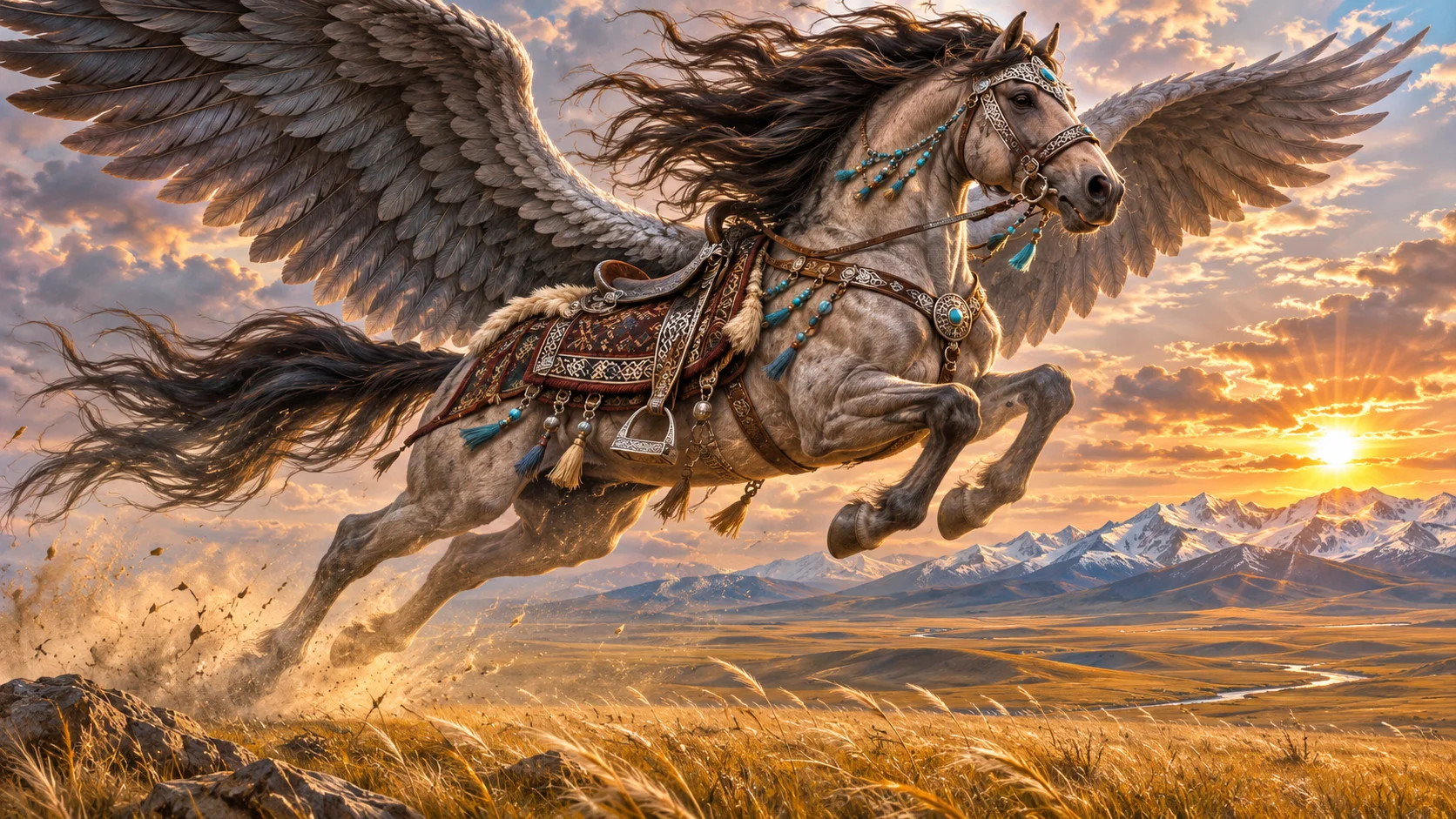
Tengri was not housed in temples or imaged. The sources and later ethnography describe prayer under the open sky, the raising of the hands, the sprinkling of milk or kumis toward heaven, libations on mountain passes, and cairns called obo in Mongolia, where travellers add a stone and circle the pile; modern obo ceremonies combine Buddhist and older elements and are directed to local mountain spirits and to Heaven. The shaman — Turkic kam, Mongol böö — was the specialist who travelled to the sky or the underworld. How far the shaman’s work stood at the centre of the older religion, or beside a more organised cult of Heaven, is itself discussed among scholars.
Scholarly debate: was it monotheism?
A long argument concerns whether the Tengri of the inscriptions is one god in a monotheistic sense. One position, with roots in the nineteenth century and a new life in the twentieth, holds that the steppe peoples were essentially monotheists: the sky-god alone, with the other powers as subordinate. Many specialists have argued instead that the religion was originally polytheistic or animistic, with a sky-god at the head and with the monotheistic emphasis emerging at the level of imperial ideology, perhaps by the twelfth and thirteenth centuries. Others read Tengri as one god among many in the texts. A third point is that modern adherents, especially in political movements, have proposed monotheism for their own reasons. The fair summary is that the inscriptions treat Tengri as supreme in a way that sits comfortably with later monotheism, but they do not exclude other powers.
Buddhism, Islam and Christianity
Later religions did not erase Tengri; they used the word. In Mongol Buddhism, which became dominant from the sixteenth century (Altan Khan’s meeting with the Tibetan hierarch in 1578 is a landmark), the tngri were absorbed into the Buddhist universe: some are said to have been created by the Lord Buddha, and a war-god called Daichin Tengri was invoked; reports from 1921, which are second-hand, say that the Baron Ungern-Sternberg was hailed as an incarnation of a war-god, in some accounts under this name. Among the Turks, the conversion to Islam took place over centuries, with the Golden Horde’s conversion under Özbeg Khan in the fourteenth century as a well-known moment. Some scholars see Sufi channels, and the poetry of Ahmad Yasawi, as mixing the older and the new; Shoqan Walikhanov thought only the name changed, so that Tengri became Allah. The twelfth-century Syriac chronicle of Michael the Syrian lists, among the reasons for the Turks’ conversion to Islam, that they had always proclaimed one God and thought the sky to be that God. Whether this should be called syncretism is itself debated. In modern Turkish, tanrı is the word for “god” in general, and in Kazakh and Kyrgyz the Islamic and the older word live side by side.
Modern revival, and its politics
The modern movement known as Tengrism is a twentieth- and twenty-first-century creation, with roots in earlier nationalism. In Turkey, the period after 1908 and especially after 1923 gave rise to interest in pre-Islamic Turkic identity; the writer Nihal Atsiz (1905–1975) and others made the ancient religion part of a nationalist ideology, and some far-right groups are reported to have adopted the word Tanrı in their oaths. In Kazakhstan and Kyrgyzstan the post-Soviet leaders spoke of Tengrism as a natural or traditional faith; an international symposium was held in Bishkek in 2003, and Dastan Sarygulov founded the Tengir Ordo movement in 2005. In the Turkic republics of Russia, activists of the Sakha, Khakas, Tuvan and Altai peoples developed organised forms, such as the Aiyy faith in Sakha; the Altai Burkhanist movement of 1904 is an earlier case. In Tatarstan and in Bulgaria similar movements exist. In Mongolia, a small percentage of the population identifies primarily with the old faith, while many combine Buddhist, shamanist and older customs.
It is important to say respectfully and clearly that these are living faiths with real devotion, and to say with equal clarity that what they teach is a modern reconstruction. They are built from the Orkhon texts, from the Mongol sources, from ethnography and from nationalist and Eurasianist ideas; some claims made on their behalf — that Tengrism was the single universal religion of all Turks and Mongols, that it was a pure monotheism, that it is the “natural” religion of the Turkic peoples — belong to ideology and are not what the inscriptions say. Some writers have also drawn from Tengrism a claim of racial or national superiority, which is a political use and not a feature of the sources.
Kindred beings
Within the steppe tradition, the nearest figures are the earth-mother Etugen or Umay, the creator Ülgen, the underworld lord Erlik and the sky-deities of the Mongol tngri. Comparisons outside the steppe have been drawn with the Chinese tian (heaven), whose mandate is another form of the same idea of divine delegation, and with Indo-European sky-fathers; but the word itself is not an Indo-European borrowing, and the comparison is typological. The Chinese influence on Turkic and Mongol kingship has itself been debated, in both directions.
A closing reflection
Tengri is the rare divine name that can be followed from a Chinese chronicle of the Han to a prayer said today in a yurt, a mosque, a temple and a new shrine. It names a sky that is both the roof of the world and the source of rightful rule, and it was strong enough to survive the arrival of every other religion on the steppe. What it meant to a herder, a khan, a shaman and a modern revivalist differs, and the sources do not allow one to speak for all. It is enough to say that when those who lived under the open sky said “Tengri,” they were naming the largest thing they knew.
Sources & traditions
- EncyclopediaWikipedia — Tengri
- TraditionTurkic/Mongol folk and village traditions (Central Asia)
Myths change from area to area and from time to time. This chronicle follows the most widely told versions; tellings in other villages, regions and eras may differ.