Erlik (also Erlik Khan, Turkish Erlik Han, Mongolian Erleg or Erlig Khan) is the lord of the underworld and judge of the dead in the religious traditions of the Altai Turks, the Khakas, the Tuvans, the Buryats and several neighbouring peoples of southern Siberia and Inner Asia. He is the god of death, darkness and disease, brother and rival of the bright creator Ülgen, and the figure with whom a shaman must bargain when a soul has been taken below. English-language writing, from missionary reports to modern games and websites, often calls him “the Turkic devil” or “Satan of the steppe.” That label is not what the sources say, and it flattens a figure who was feared, argued with and, in some rites, fed. This article describes what was recorded, by whom and when, how Buddhism and other faiths re-described him, and where scholars still disagree.
The name
The origin of the name is not settled. One account, popular in encyclopedic summaries but weakly supported, connects it with the Turkic er or yer, “earth,” so that he is the one of the earth’s depths. A second, widely given in specialist literature, derives it from a form erklig, “having power,” built on erk, “power, will,” and notes that Erklig Khan is used as a title of the king of the dead in Old Turkic Buddhist writings from Central Asia. If that reading is right, the name was already used in a Buddhist sense long before the Altai ethnographies, and the figure the Russian observers met in the nineteenth century may in part have been shaped by it. The Mongol forms Erlig and Erleg are taken from the Turkic. Some writers have also proposed a link between the name and the Hungarian word ördög, “devil”; the origin of the Hungarian word is itself disputed, and the link should be treated as unproven. In some Turkic usage the underworld itself has a separate name, Tamag, the word for hell in older written texts.
Who recorded him, and when
Erlik is not named in the Old Turkic Orkhon inscriptions of the eighth century; those texts speak of Tengri, of the earth-and-water and of death, but not of a king of the underworld. The material that gives Erlik his shape was gathered mostly between the 1860s and the 1920s.
- Vasily Radloff (Wilhelm Radlov) recorded Altai myths and shaman prayers in the 1860s and published them in Aus Sibirien (1884) and in the texts of his Proben der Volkslitteratur. His earth-diver creation story, in which the first man steals earth, is the most quoted version.
- Vasily Verbitsky, a missionary of the Russian Orthodox Altai Mission, published material on the Altai peoples in the later nineteenth century; he wrote as a missionary, and his terms for spirits are coloured by that.
- Grigory Potanin, explorer and ethnographer, collected Siberian and Mongolian tales in the later nineteenth century and his work is often cited for northern Mongolian and Siberian variants.
- Andrei Anokhin, whose Materials on Shamanism among the Altaians appeared in 1924, is the main source for shamanic ritual from field work with Altai shamans in the early twentieth century.
- Uno Harva (Holmberg), whose Finnish and German syntheses of the 1930s set the comparative framework.
Two caveats apply to all of them. First, the Orthodox mission had been active among the Altai since the 1830s, and the ethnographers’ informants lived in a world in which Christian ideas of a creator and a devil were available; some scholars have argued that this shaped how the creation myth was told. Second, there was no canon: the traditions varied from valley to valley, and the written versions are snapshots.
Creator and rival: the Altai myth
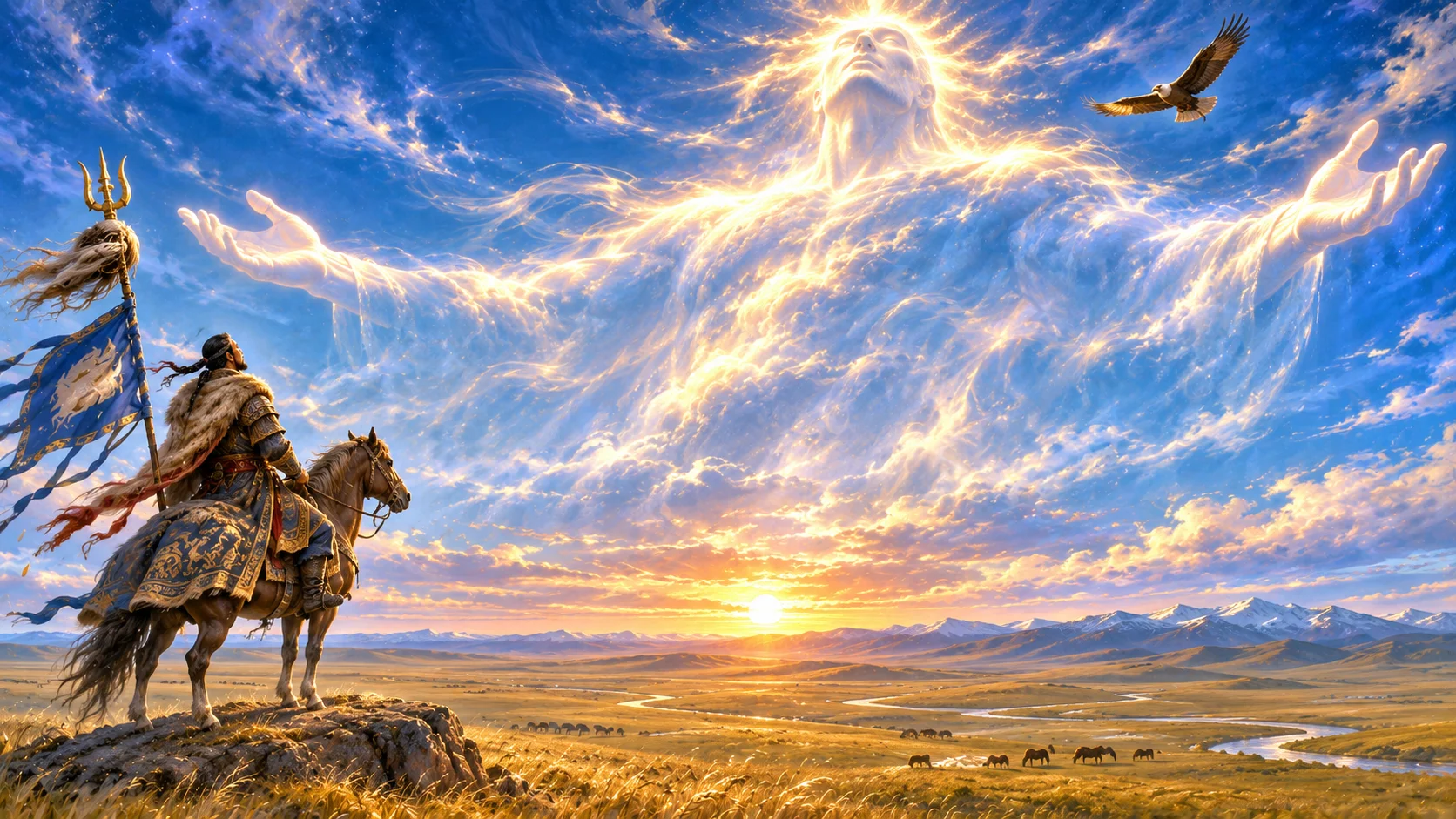
In the best-known form of the myth, a supreme being — named Kayra, or Tengere Kayra Khan, or simply Tengri or Ülgen in different tellings — creates the world. Several versions agree on the main points and differ on details.
- The earth-diver. In the version Radloff recorded, there is only water at first. The creator (or a helper) sends the first man down to bring up earth from the sea floor. The man hides some of the earth in his mouth; when the earth he has been given swells and grows, he must spit it out, and that is how hummocks and swamps came to exist. For this the creator casts him from heaven and names him Erlik, and he becomes the lord below. This form belongs to the widely distributed earth-diver myth of northern Eurasia and North America, and some scholars, following Harva and others, have argued that the Altai form shows the influence of Iranian or medieval dualist stories of a devil who acts as helper; that argument is plausible but not proved.
- The two brothers. In another form, Ülgen and Erlik are both made by Kayra, and Erlik, jealous, wants to be his brother’s equal. He makes his own land or his own creatures, is imprisoned or cast down, and becomes the opponent of the upper world. In some versions the brothers divide the work, with Ülgen forming the human from clay and Erlik giving the soul; which animals each made varies too much between summaries to list. In one telling, Erlik makes spirits before his fall, claims divinity, and is expelled with them; in another, the god gives him a hammer and anvil for work and takes them back when they are used to make evil.
- The coming of death. A third story concerns mortality: once people were deathless, and as the earth filled, a crow suggested summoning death into the world (in some summaries, summoning Erlik). In some tellings the creator then hid the day of death so that humans do not know it.
The stories do not sort neatly. Sometimes Erlik is a cunning but not wholly wicked younger brother; sometimes he is an arrogant rebel; sometimes he is the one to whom the work of death was assigned. Scholars of the dualist version caution that a rigid good-and-evil pair is more Christian or Iranian than steppe; the same stories can be read as describing two necessary territories, an upper and a lower, with rulers.
The lord of the lower world
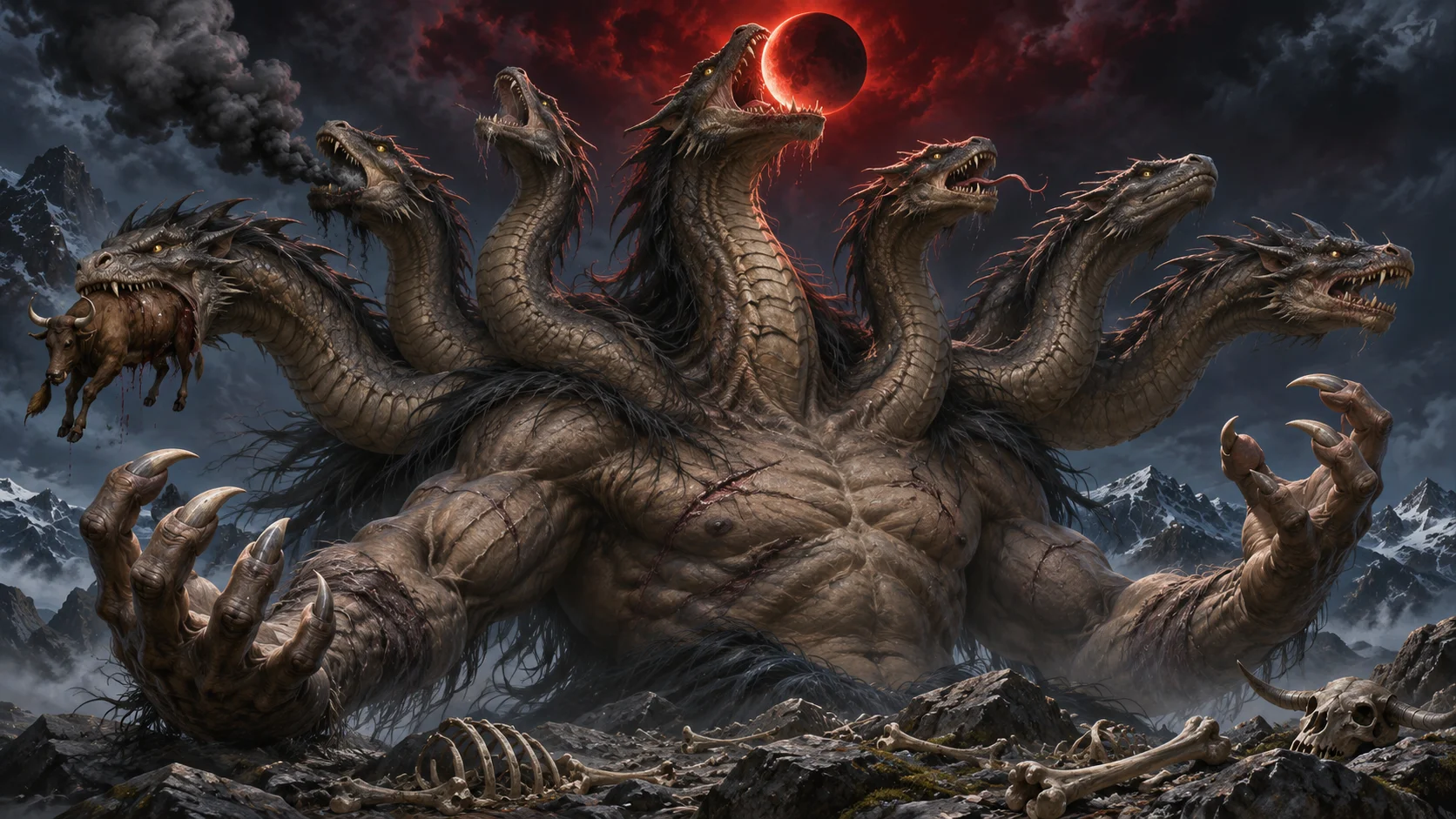
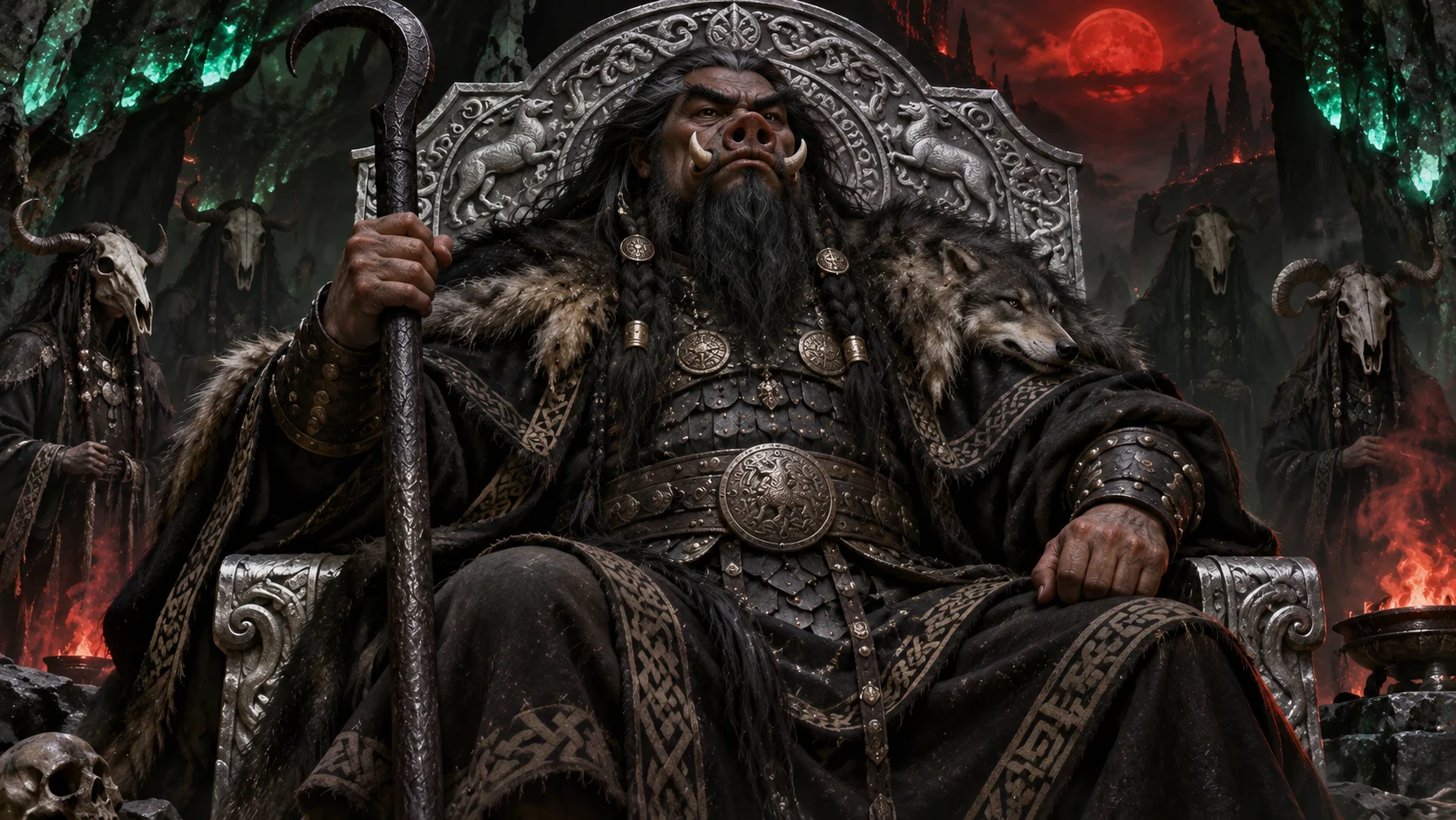
Erlik’s realm is the lowest of the layers of the cosmos. The Altai and Khakas pictured a sequence of layers beneath the earth, and he dwells in the deepest. Descriptions differ: a palace of black mud or blue-black iron on the bank of a river of tears, called the Toibodym in summaries of one account, with a single horsehair bridge to it; a land of cold and darkness. Among the Dolgan, a Siberian people far to the north, a story says that Erlik took the mammoths underground, and they die if they try to return to the light, which is one way of explaining the frozen bones found in the north. The picture of Erlik himself also varies between accounts, from an old man to a horned figure, and a totemic bear is sometimes associated with him.
The dead go to him. In some accounts, at death a messenger called a kormos sent by Erlik competes with a spirit from the sky for the soul, and the soul’s leaning decides where it goes. Erlik is judge of the dead and the cause of disease: sickness is explained as his servants carrying off a part of the soul, and the shaman’s remedy is to go and retrieve it.
Family and servants
One tradition gives Erlik nine sons, called the Karaoğlanlar or “dark boys,” and nine daughters, the “dark girls.” That detail appears in modern summaries with incomplete citation and should be treated as one tradition among others. The more widely attested picture is of a host of servants and evil spirits, and of the kormos and other messengers who do his errands.
The shaman and Erlik
In Altai ritual the shaman’s work involves a choice of direction: a journey up through the heavens, represented by climbing a birch pole in the rite, to Ülgen, usually on behalf of the community and after a white-horse sacrifice; or a journey down to Erlik to recover a soul or to bargain. The second is the more dangerous. Summaries of the Altai shaman’s songs, which draw on Anokhin and others, describe the language of the descent as one of negotiation: offerings, persuasion and, at times, trickery. Shamans who work chiefly with Erlik are called black shamans (kara kam) and are viewed with unease; the white shaman works with Ülgen and the upper spirits. This is not a simple moral division: even the white shaman must on occasion deal with the lower world.
People also made offerings to Erlik themselves: to ward off illness, to ease a dead person’s entry into the underworld, or to obtain a better position there. The point of these rites was not worship in the sense of love but a kind of prudent recognition of a power which could not be avoided. That is a significant difference from the missionary description of “devil-worship.”
The shape of the question: dualism and borrowing
The Altai creation myth in which a bright and dark brother share the world has attracted much comment. One line of interpretation sees it as an old steppe structure of an upper and lower rule beneath a high god. Another, followed by Harva and discussed in Mircea Eliade’s survey of shamanism, sees the earth-diver devil as the result of contact with Iranian, Manichaean and Christian dualism in Inner Asia; others note that the earth-diver motif, with a dualist twist, is widely distributed across Eurasia and need not have been borrowed. A third point is that the Altai collectors worked in the era of the Orthodox mission. A cautious position is that the figure of a lord of the dead is almost certainly old, since it is hard to imagine a Siberian cosmology without one, but that the specific “fall” narrative may incorporate foreign material. It is also a reminder that not every Turkic or Mongol group has the same figure: many have a lord of the dead under another name or with no single name.
Buddhist and other overlays
Where Tibetan Buddhism took hold, Erlik was identified with Yama, the Indian god of death who became, in Tibetan and Mongolian Buddhism, a king of the law and judge of the dead. The Mongolian Buddhist name Erlig Nomun Khan, “Erlig, king of the Dharma,” is the Buddhist king of the dead, and he appears in Mongolian temple painting, in the Wheel of Life that depicts rebirth, and among the protector deities. This is a different being from the Altai Erlik in function and attitude: he is part of a moral universe of karma and is also, in a sense, subordinate to the Lord Buddha. But the name and the role were close enough for the two to merge in popular religion, and Buddhist texts in Mongolian and Buryat used the name for their own figure. Among the Buryats, whose tradition is a layered one, he appears as Erlen Khan.
The Yama parallel therefore has two layers. At the level of Buddhist transmission, the identification is historical and documented: translators took the Turkic or Mongol name for the Indian figure. At the level of the older myths, the similarities — a lord of the dead, a judge, a figure associated with the first death — are of a kind found in many cultures. In the Vedic hymns, Yama is the first mortal to die and to find the path; Erlik, in the myths above, is not the first dead but a being who brings death into a world meant to be deathless. The parallels should not be pressed into a single genealogy.
In regions that became Muslim, the name may have been assimilated to that of Iblis or Shaitan, and in Christian missions it was glossed as the devil. The result is a figure whose English-language reputation was set by translation. An older text speaking of Erlik as the devil may be a translator’s gloss. In the Altai itself, the movement called Burkhanism, which appeared in 1904 and presented itself as a “white” faith, is a reminder that Altai religion was changing in the very decades when it was recorded.
Modern use, and care in reading it
Erlik is used in the modern revival of steppe religion as the dark counterpart in a dualistic cosmos beneath Tengri, and he appears in popular culture: in video games, role-playing books, music, and fantasy fiction, as a demon lord or arch-fiend, sometimes in forms with no source in the tradition, such as horned or hoofed demons or a ruler of fire. Such portrayals borrow the name without the context. Readers should be careful with websites and compilations that assert that Erlik is the “Turkic Satan,” list a fixed set of names, powers and rituals, or give detailed lists of his children and servants without sources; much of this is derived from a few summaries. For communities in which the old practices survive, the lord of the underworld is not a character in a game but a real part of the way death and illness are understood, and should be discussed with the same respect as any other religious figure.
Kindred beings
Nearest to Erlik in his own tradition are Ülgen, his brother; Kayra, the creator above them; Tengri, the sky; and the goddess Umay, who protects the newborn. In the Buddhist register, he is Yama, called Erlig Nomun Khan in Mongolian and Chos-rgyal, “king of the law,” in Tibetan. In neighbouring traditions there are other lords of the dead, among them Yama of India, Yanluo of China, and the Hungarian ördög if the etymological link is accepted. In each case comparison should be done with sources in hand.
A closing reflection
Erlik is a figure assembled from a few dozen recorded stories, a handful of shaman’s songs, and the labels given by those who recorded them. What those materials suggest is a power that is neither to be loved nor to be denied: the one who holds the dead, who cannot be driven out of the world, and with whom a prudent person keeps terms. That the same name could serve a shaman’s negotiation, a Buddhist king of the Dharma and an English-language devil shows how much the meaning of a god depends on who is speaking about him, and why it is worth returning to the earliest sources and to the people who still speak of him.
Sources & traditions
- EncyclopediaWikipedia — Erlik
- TraditionTurkic/Mongol folk and village traditions (Central Asia)
Myths change from area to area and from time to time. This chronicle follows the most widely told versions; tellings in other villages, regions and eras may differ.