Saulė (Latvian Saule) is the Baltic sun — and, in the folk songs of Lithuania and Latvia, a goddess: a woman who rises with a red face, drives a horse-drawn team across the sky, rests in a castle or a tree at the sea’s edge, mothers orphans, and has daughters whom the sons of God come courting. She is one of the clearest cases in European tradition of a sun that is grammatically and mythically female, and the Latvian songs that sing her are among the largest bodies of oral poetry ever collected. The same word also means, simply, “the sun,” and the line between a goddess and a natural object is not one that the singers themselves drew. This article follows what is attested, flags what is reconstructed, and notes where later enthusiasm has outrun the evidence.
Name and etymology
Lithuanian saulė and Latvian saule are both the ordinary word for the sun and the name of the deity, descending from a Proto-Baltic form usually written *Saulē. The word belongs to the same Indo-European root as Latin sōl, Old Norse sól, Gothic sauil and Slavic slunce, and as the Greek hēlios. In Baltic and in Old Norse the noun is feminine; in Latin and Greek it is masculine and in Slavic neuter. The Norse goddess Sól is the nearest parallel, and scholars including Martin West have discussed the Baltic and Germanic sun-maiden as a possible inherited Indo-European figure. That comparison is a hypothesis; what is certain is that Baltic grammar and Baltic song both say “she.”
The Latvian adjectives for her are tender: Saulīte, “little Sun,” and in the songs Saules māte, “Mother Sun,” are common. Lithuanian songs also speak of her with diminutives and with the kinship terms for mother and sister. A key piece of the ancient vocabulary is the Latvian Viņsaule, “the Other Sun,” used for the world beyond, the realm of the dead; the word suggests, though it does not prove, that her course was tied to ideas of death and return.
The evidence: chronicles, travellers, and songs
As with other Baltic deities, there are no texts from the pagan period written by Balts. The evidence falls into three layers.
- Chronicles and travellers. The Slavic version of John Malalas’s chronicle carries an interpolation, usually dated to about 1261 and surviving in fifteenth-century copies, about the smith Teliavelis, who forged the sun and threw it into the sky, with people honouring the sun afterwards. A story told by Aeneas Sylvius Piccolomini (the later Pope Pius II) as heard from the missionary Jerome of Prague, who travelled in Lithuania around 1413 (the date usually given), has the sun imprisoned in a tower by a powerful king until the signs of the zodiac broke the tower with a giant hammer; the retelling adds that the hammer was venerated, a detail that rests on the same second-hand account. Such reports are second-hand and hostile, and some scholars question how much is Baltic and how much is the writer’s comparison with classical myth.
- Place and event names. The Battle of Saule in 1236, in which Samogitians and their allies defeated the Livonian Brothers of the Sword, is named in the chronicles after a place called Saule. Whether the name derives from the sun-word or only coincides with it is debated; it should not be quoted as evidence of cult.
- Folk songs. The Latvian dainas, gathered from the nineteenth century onward and edited above all by Krišjānis Barons, run to hundreds of thousands of texts: Barons’s six-volume edition (1894–1915) alone counts about 218,000 texts, variants included. Lithuanian dainos are far fewer on the solar theme. Most of what is said below about Saulė comes from these songs, and the great majority are Latvian. This asymmetry is important: the “Baltic” sun-goddess of many popular books is largely the Latvian Saule, with Lithuanian parallels and a thin chronicle record.
Scholars who have worked this material include Wilhelm Mannhardt, whose nineteenth-century lists of images for the sun are still cited; Haralds Biezais, whose studies of the “heavenly family” of the Latvians are still much cited; Jonas Balys, Norbertas Vėlius and Gintaras Beresnevičius for the Lithuanian side; and, as a folklorist and as a public figure, Vaira Vīķe-Freiberga, who analysed the sun’s role in the songs. Marija Gimbutas interpreted Baltic deities as survivals of a pre-Indo-European goddess religion; that reading is contested and is not assumed here.
The sun in the songs: appearance and journey
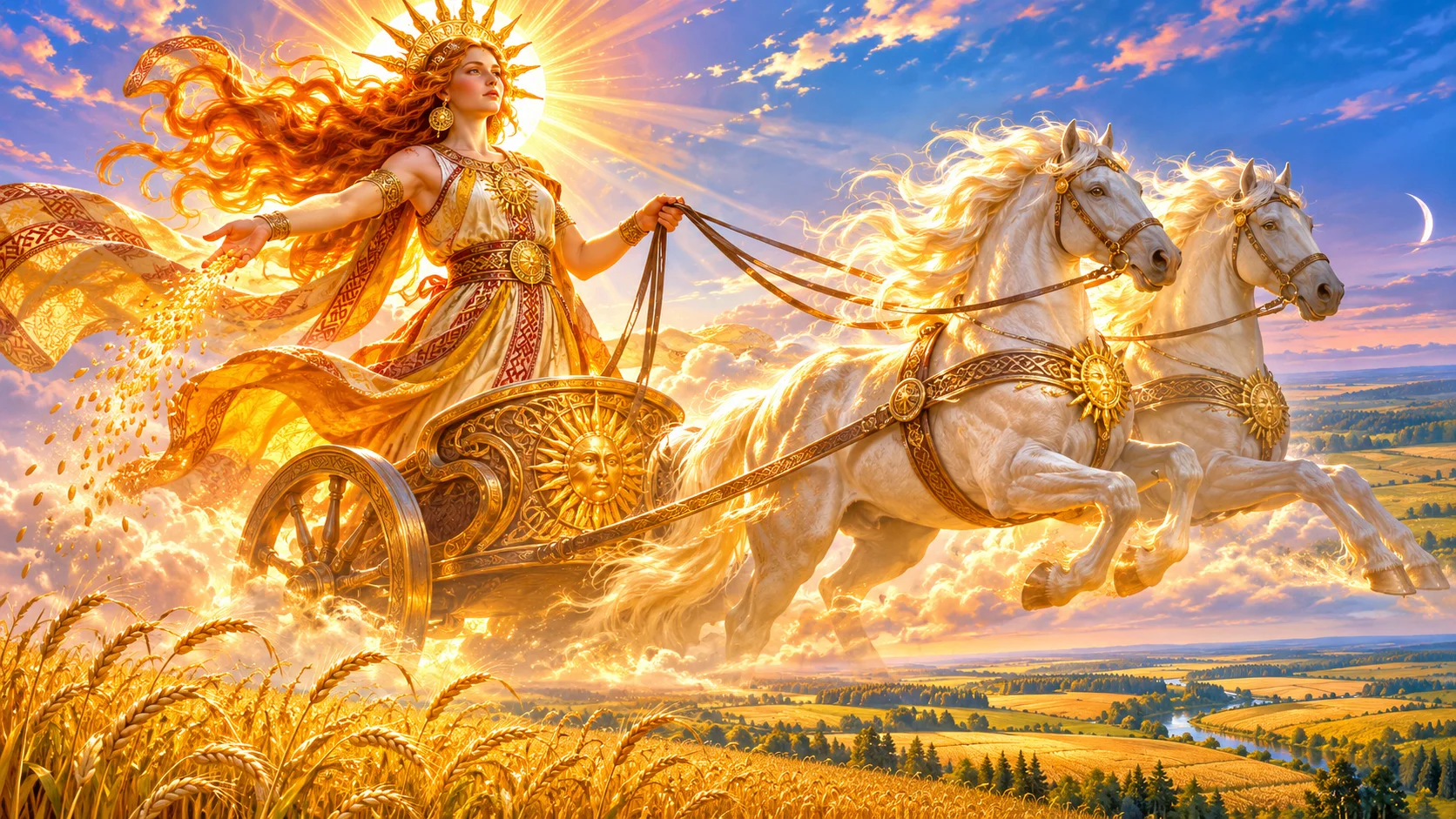
In the Latvian songs the sun’s appearance changes with the day: she is described as waking red and travelling white, a colour pattern that follows the sky. Her clothing is rich in gold — golden shoes, a gold-threaded shawl, a sparkling crown. In many songs she travels by a horse-drawn vehicle: the horses may be white, or in three colours of gold, silver and diamond, or yellow and fiery, with golden hooves and bridles. Lithuanian riddles describe the sun as a ball drawn by a hundred horses. Chariots with copper wheels, golden carriages and sleighs of fish-bone are named. At night the vehicle becomes a boat, silver or gold, crossing the world-sea; and the songs speak of the sun “swimming her horses,” understood as washing them in the sea at day’s end. A Lithuanian image has the setting sun as a golden wheel rolling down a hill.
She has a home. The songs place a silver-gated castle at the end of the sea in the east, or an island in the sea where she rests, or a silver cradle at the bottom of a lake. Her day is a working day: she is up early, sometimes depicted weeping when the sun is hidden, or is cast as the one who comes to the house of the orphans, or to a woman’s own door. The vivid domesticity of this image is typical of the genre: she is a farm-wife of the sky.
Mother of orphans, giver of warmth
One of the most distinctive roles in the Latvian songs is that of Saule as the comforter of the unfortunate. Orphans and mistreated daughters-in-law address her as their mother; she warms them, dries their clothes, hears their complaints. Scholars have connected this to the slowness of sunrise, which seems to come and soothe after a night of suffering, a reading offered by several scholars of the songs. Lithuanian songs share the theme in smaller measure. The effect in a society in which orphanhood and the harsh treatment of young wives were everyday realities is of a divine ally for the weak, which is a social function of the songs as much as a religious one.
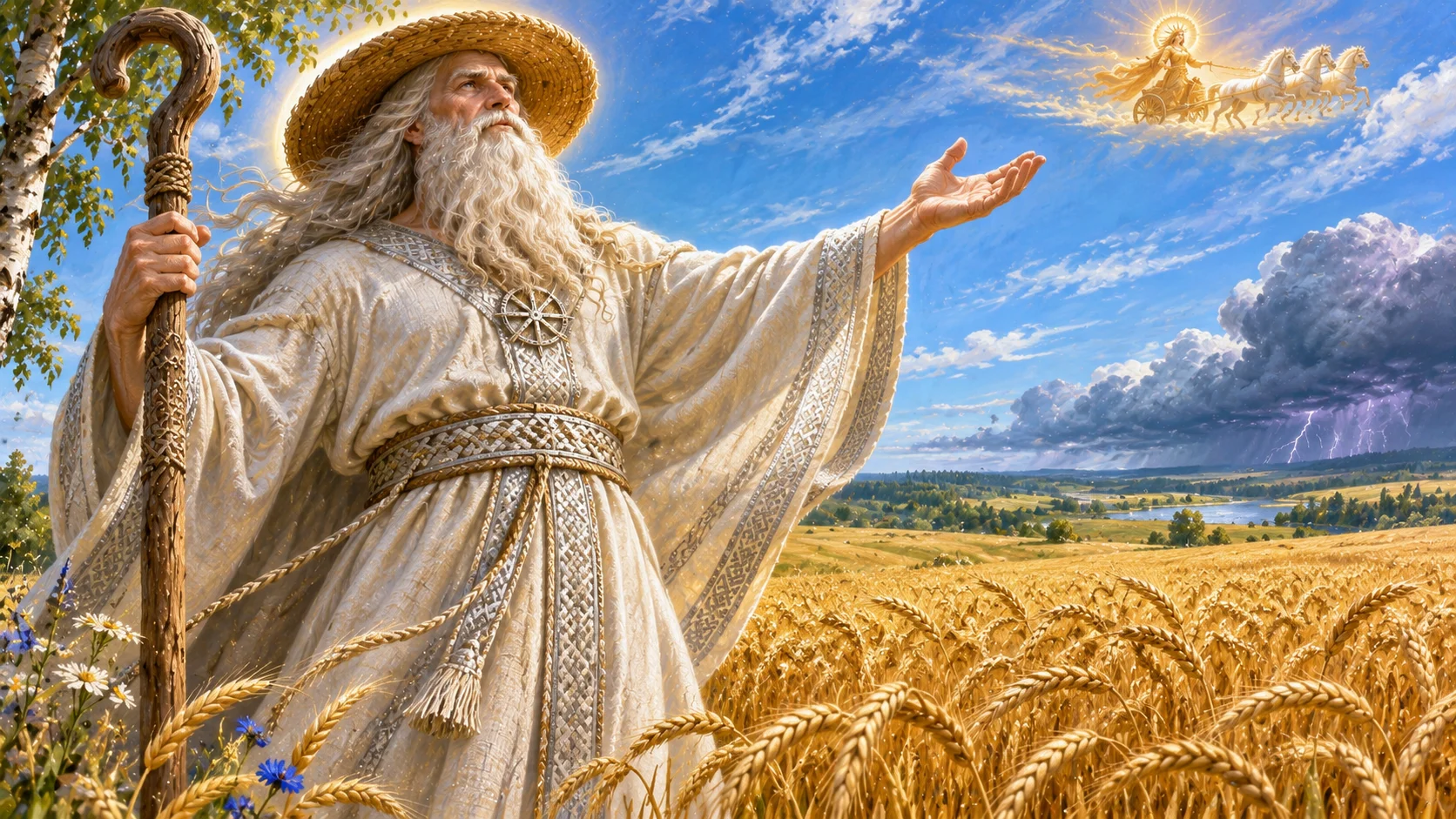
She is also, of course, what her name says: the source of heat and growth. The songs have her ripen the grain, shine on the dew, and look down on both the rich and poor household. Her vision is sometimes made explicit: nothing hidden escapes the sun, and she is a witness to wrongdoing.
The family in the sky
The songs place Saule in a heavenly family. Her husband is the moon, Latvian Mēness, Lithuanian Mėnuo, in both languages grammatically masculine. Her children are sometimes given as the planets: Lithuanian sources of the sixteenth century onward name planet-beings Indraja (Jupiter), Sėlija (Saturn), Žiezdrė (Mars) and Vaivora (Mercury), and popular modern accounts present them, with the earth-goddess Žemyna, as her daughters; that family tree is partly a modern synthesis. The Latvian songs speak more often of Saules meita, “the Sun’s daughter,” or in the plural Saules meitas. In many songs they are the sun’s own light personified — the Sun’s Maiden is in some cases a synonym of the sun at rising or setting. In Lithuanian versions the morning star Ašrinė is a servant (in some versions a daughter) who prepares her for the daily journey, and the evening star Vakarinė makes her bed.
The Latvian songs are full of the wooing of these daughters. Suitors include the sons of God, the Dieva dēli, who come riding; the morning star Auseklis, himself a suitor; and in some songs the moon himself, or Pērkons the thunder, who may be a guest at the wedding or may be the one who strikes a golden oak at the gate. A large body of Latvian songs follows the daughter’s wedding: the bride is dressed, rides away in a procession, crosses a sea, and is received in a new household. Scholars speak of a “celestial wedding” complex, and the sun-maiden and her wooers have parallels in Finnic song, a reminder that the Baltic material belongs to a regional pattern.
The sun, the moon, and the thunder
The best-known sun myth in Baltic tradition concerns the moon’s infidelity. In the Lithuanian form the moon, Mėnuo, falls in love with the morning star Ašrinė, and Perkūnas punishes him by cleaving him; in one telling the punishment repeats monthly because he never learns, which explains the waning. In another version the sun and moon divorced but both wanted to see their daughter, which is why sun and moon cross in the sky without meeting; in a third the moon’s face was marked by a blow from the sun herself. The Latvian songs have their own variants, in which Mēness, married to Saule, pursues the morning star and is punished by Pērkons with a sword.
It is worth saying how this should be read. The songs give several parallel explanations of the same thing, the moon’s changing form. Scholars generally treat the story as an aetiological myth with a moral shape: the unfaithful husband is punished, and the wife and child are protected. The details vary by region, and there is no canonical text; the version told in a popular book is a harmonisation.
Trees, apples and berries
Mannhardt’s list of Latvian and Lithuanian images for the sun includes fruit and bush images such as the apple and red berries. The sun sleeps or is described as waking in a “red tree,” and the apple-tree and the golden-leafed tree recur in the songs of the sun and of her daughters. The “sun-tree” motif, associated with Latvian songs in which the sun’s daughters swing in its branches, belongs to the same complex as the cosmic world-tree, which is a central symbol in the Latvian songs. The identification of the sun-tree with a single, defined cosmic axis is a scholarly synthesis; in the songs the tree appears in different guises.
Feasts and practice
The great feast of the sun is the summer solstice, in Lithuanian Rasos or Joninės, in Latvian Līgo or Jāņi. Elements well documented in later folk practice include bonfires, wreaths of herbs and flowers, the search for the fern flower, leaping over fires, the singing of the refrain of the festival, and greeting the sunrise. The festival has been Christianised as Saint John’s feast, and the names Joninės and Jāņi come from that. It is difficult to say how much of the pre-Christian rite survives; the evidence for fire and sun ceremonies at midsummer in the Baltic region is strong, but the continuity from pagan cult is a reasoning from analogy rather than a documented chain. The winter solstice was also marked, and Latvian and Lithuanian customs of the season include the return of the sun and the dead, with Christmas customs taking over the older meaning.
The sun has no recorded priesthood or temple in the sources. Practice was domestic and agricultural: greetings at sunrise, songs sung at work, a meal laid out for the dead, a gesture in the direction of the sun when a child is born. The songs themselves are the main evidence.
Saule and the dead
Latvian tradition ties the sun to the afterlife in a way that distinguishes it from the simple solar worship found in other places. The sun sets into the sea or into the “other sun” (Viņsaule), the realm of the dead, to which she carries the day; the souls cross the sea or the sky to the place where she goes. In the songs the dead are said to see the sun in the land they have gone to, and the term for the dead, veļi, belongs to the autumn season of remembrance, not the sun-feasts. Scholars link the setting sun with the passage of souls across the sea, a link that Latvian mythology handbooks note. The relationship is a matter of symbolism and image, not of a documented eschatology.
The sun and the goddess question
Is Saulė a goddess in the sense of a person with a cult, or a personified sky body in a poetic tradition? Scholars differ. One tradition, from Mannhardt through the nationalist-era scholars, saw a great “solar mythology” with Saule at the centre of a Baltic pantheon, which is also how she appears in popular accounts: a mother-goddess of the Baltic peoples. Others point out that the sources which can be dated give very little cult for her, that the songs treat her as a being of the sky who is addressed rather than worshipped, and that the vocabulary of the songs is pervaded by Christian forms. Beresnevičius wrote of the solar tradition as a stable part of Lithuanian religion, as part of a wider sky cosmology, without insisting on a personal cult. There is a middle position: the sun was divine in the sense that she was a being with a will, a family and a moral life, and that she was honoured in the festivals of the year, even though she may not have been the subject of sacrifices of the kind reported for the thunder-god.
Modern revival and nationalism
In Latvia, Saule is a figure of the dainas on which the twentieth-century Dievturība movement draws (its own theology centres on Dievs, Māra and Laima), and of folk song revivals; the sun symbol and the sun-wheel (saulesrats) appear in national-romantic art, in folk costume design and on the badges of many groups. In Lithuania, Saulė is celebrated by the Romuva community and in the broader summer-solstice festivities. Both revival movements are living faiths, treated with respect, but they are not identical to what the songs once meant. The Soviet period suppressed pagan-inspired practice in both countries, and the songs became a space of national memory, so the sun-goddess took on an identity beyond religion: she is a sign of the nation’s old poetry.
A word of caution is needed about the claims that sometimes accompany her in modern writing: that the Baltic peoples were “matriarchal,” that the sun was their supreme deity, that the Balts preserved an unbroken Neolithic goddess cult. None of these claims is established by the sources. What is established is more modest and remarkable enough: a very large, consistent body of songs in which the sun is a woman, a mother and a neighbour, and in which that image survived into the age of print.
Kindred beings
The closest relatives in Baltic tradition are the moon Mēness/Mėnuo, the morning star Auseklis/Ašrinė, the evening star, the thunder-god Pērkons/Perkūnas, the sons of God, and the earth-power Žemyna. Among related peoples, Estonian and Finnic songs have a sun-maiden and a moon-maiden; the Norse Sól is the nearest female sun in the Germanic world, and Sanskrit Sūryā is a female solar figure in the Vedic hymns. The comparison with these is suggestive, and scholars such as West have used it, but the lines of inheritance are not secure.
A closing reflection
The Baltic sun is a mother who warms orphans, a rider with golden horses, a bride-giver, a witness. The tradition does not describe her as a ruler of the world; it describes her as a presence in the daily life of those who sing. That is perhaps why it lasted: a tradition centred not on sacrifice or doctrine but on a repeated, shared recognition that each morning, someone comes up over the field, and that she is kind.
Sources & traditions
- EncyclopediaWikipedia — Saulė
- TraditionBaltic folk and village traditions
Myths change from area to area and from time to time. This chronicle follows the most widely told versions; tellings in other villages, regions and eras may differ.