The Nommo (also written Nummo) are the water spirits and primordial ancestors of Dogon religion as it is set down in the books of the French ethnographers Marcel Griaule and Germaine Dieterlen. In those books they are the first living beings made by the creator Amma: twinned, amphibious, associated with water and with the speech and order that make a world fit for people. One of them is sacrificed to repair a creation damaged by disorder, and their descent from the sky founds human society. They have also, since the 1970s, become the central figures of a modern legend about visitors from the star Sirius, a legend that astronomers reject and whose ethnographic basis is disputed.
The Dogon are living people with a living religion, and much of their sacred knowledge is restricted to initiates. What follows is limited to what scholars have published, and it begins with a warning that applies to the whole article: the elaborate Nommo of the French books is the most disputed figure in Dogon ethnography.
The name
The spelling varies between Nommo and Nummo, a difference of transcription. A gloss that circulates for the word is “to make one drink”, which fits the water association, though it appears only in secondary summaries and its support in the Dogon language itself is not established here.
The sources and their reliability
The Nommo reached the wider world through two books. Dieu d’eau (1948), whose English title is Conversations with Ogotemmêli, records conversations that Griaule held with an elderly Dogon man, Ogotêmmeli, in 1946; the book is arranged as thirty-three days of talk. Le Renard pâle (1965), by Griaule and Dieterlen, gives a different and more complicated cosmogony drawn, in the usual summaries, largely from other informants, among them Ambara. A later book by Eric Guerrier (1975), Essai sur la cosmogonie des Dogon: l’arche du Nommo, takes the “ark of the Nommo” as its subject. A Griaule and Dieterlen paper of 1950 on a “Sudanese system of Sirius” carried Dogon star lore into the debates of astronomers.
These texts are of a different standing from the earlier French work on the Dogon, which is regarded as sound. The anthropologist Walter van Beek, in his 1991 restudy, distinguished between the earlier French work on the Dogon, which is generally regarded as sound, and the cosmology of the books published from 1948 to 1965, which he did not find as general Dogon belief; he has stressed that he never meant to criticise Griaule himself. That judgement is contested by Griaule’s daughter, Généviève Calame-Griaule, and what follows should be read with both positions in mind.
Nature and attributes
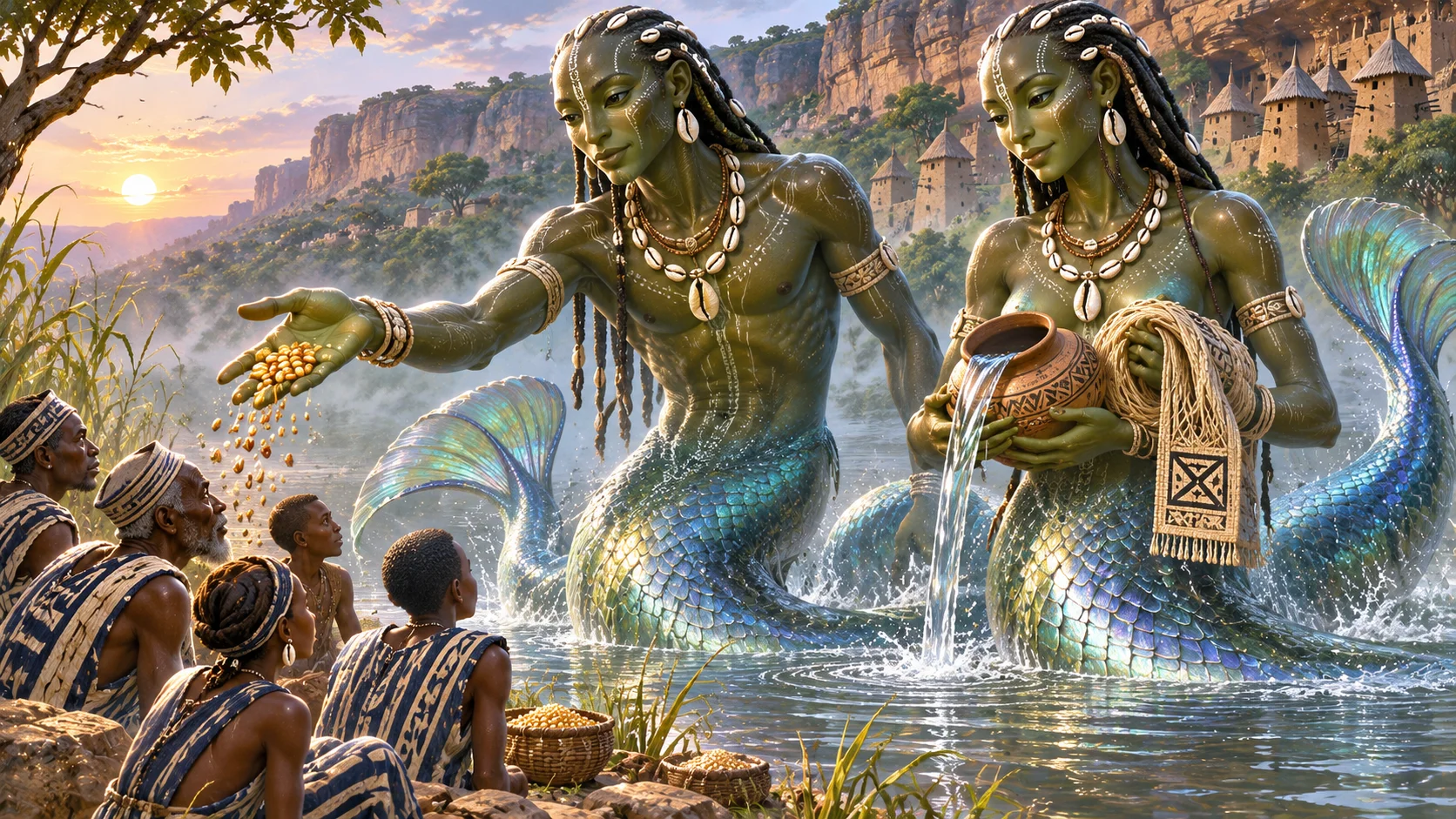
As the French texts present them, the Nommo are amphibious beings, sometimes described as hermaphroditic or fish-like, and are often pictured, in popular reproductions, with a human upper body and a fish-like lower body. They are linked to water as the principle of life. They are conceived in twins, which gives expression to the Dogon concern, as Griaule and Dieterlen saw it, with pairs, balance and the completion of a thing by its double. They are teachers as well as creatures: bringers of the order, speech and techniques by which human society is said to have been organised.
The Nommo are not the supreme god; that is Amma, who made them. In the Griaulian scheme they stand between the creator and humanity, and in the standard summaries the human ancestors themselves come in four pairs of twins, four male and four female.
The cosmogony as recorded
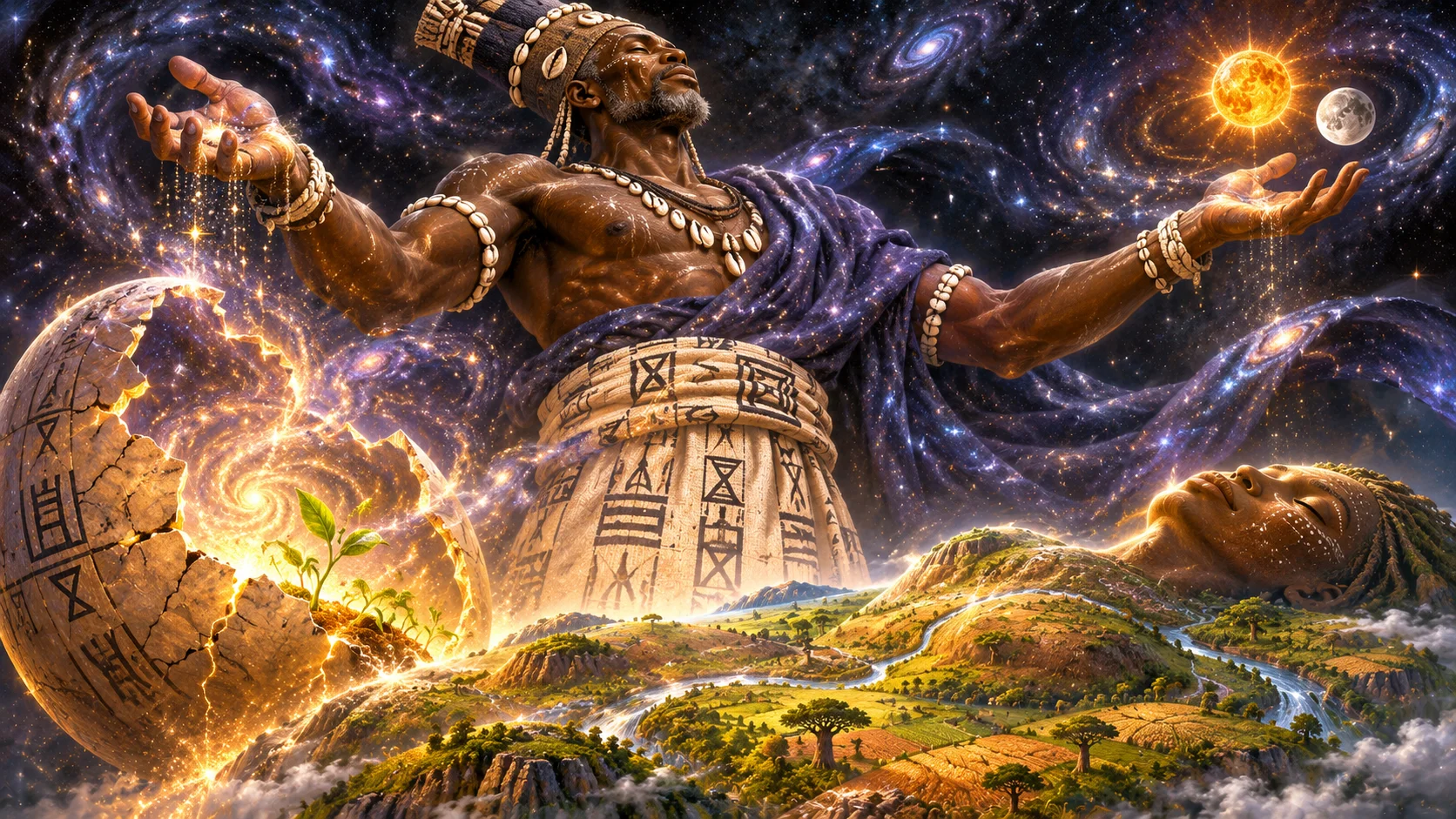
The standard summary runs as follows. Amma created the Nommo as the first living creatures. Shortly after their creation they multiplied into four pairs of twins. One of them rebelled against the order Amma had established. In the version of the Pale Fox this rebel is the being Ogo, also called Yurugu, who broke out of the primordial egg too soon and alone; in Dieu d’eau the disorder is told differently, in terms of a first union of Amma and the earth that went wrong and produced a jackal. In both books a figure of disorder sets off the need for repair.
To restore order, a Nommo was sacrificed. In the standard summary its body was dismembered and scattered across the universe, and the Dogon see in this dispersal the origin of the many binu shrines of their territory: wherever a part fell, a shrine was raised. This is how the French account is retold in general sources, not a check against Griaule’s own text, and the existence of binu altars as an institution is a separate matter from the explanation attached to them. The sacrificed Nommo is described as brought back to life, and the sacrifice and renewal are among the features of the story that Christian-minded readers have noticed, as discussed below.
The descent is the part of the story best known to the public. In the summary of Griaule and Dieterlen’s late-1940s material, the Nommo came down from the sky in a vessel, with fire and thunder. Having landed, they created a reservoir of water and plunged into it, since they could not live wholly on land. They divided their bodies to feed humans and gave them the principles of life. In some summaries the Nommo are also described as the origin of the first hogon, the Dogon spiritual leader. The vessel is the “ark” of the Guerrier book’s title. The framing matters: this is a mythic description of the origin of human beings and their institutions, not a literal report of a visit.
Cult and practice as published
Here the published record is thin where the legend is fat. The Griaulian system ties the Nommo to water, to rain and to the fertility of the fields, and to a world of shrines, but a restudy by van Beek reported something different on the ground: in outline, a religious life organised around ancestors and altars at the levels of lineage and village, with a basic opposition between village and bush, in which the Nommo, the Pale Fox and Sirius did not carry the weight the French books give them.
The Dogon do have a rich public ritual life, documented by earlier researchers. Funerals include the long and costly dama; initiated men of the Awa society dance masks; and the great Sigui cycle is celebrated about once every sixty years, the last cycle running from 1967 to 1973 and the next expected from about 2027 (sources differ on the exact year). What the Nommo mean in ritual to an ordinary Dogon person today cannot be reliably said from the printed sources, and this article does not attempt to say it.
The contested ethnography
The restudy deserves a fuller account than the fragments above. Van Beek worked among the Dogon over many years from the late 1970s, notably in the village of Tireli, and published his findings in Current Anthropology in 1991 (with comments and replies) and a reflection in History in Africa in 2004. His conclusion was that he could not find the Griaulian cosmology or the detailed Sirius lore among the people he asked. On Sirius specifically, he reported that his informants disagreed about which star sigu tolo was, and that all of them said they had learned of it from Griaule.
The explanations offered for the gap, by van Beek and others, are interpretations rather than established facts. They include the suggestion that Griaule, determined to demonstrate the complexity of African religion, questioned his informants so forcefully that they produced new myths in the telling; that a small number of creative informants, Ogotêmmeli and Ambara among them, were consulted repeatedly; that the colonial setting made informants eager to please; and that some material may echo Christian or Islamic stories current in the area. None of these shows that every element of the Nommo story is borrowed or invented.
Other scholars read it in different ways. Mary Douglas wrote critically about the Griaule school in the late 1960s (her 1968 essay was “Dogon Culture: Profane and Arcane”) and, in the 1991 exchange, allowed that the esoteric knowledge of elders described by Griaule could have been lost over half a century; James Clifford, in 1981, wrote on ethnographic surrealism. Calame-Griaule defended her father and Dieterlen; her argument, as summarised, is that van Beek had not gone through the proper steps for acquiring esoteric knowledge, and she questioned his own methods. The two sides have not reached agreement.
The Nommo and the Dogon today
The Dogon live on and below the Bandiagara escarpment, a sandstone cliff up to about 500 metres high and some 150 kilometres long, and on the plateau and plains nearby. The Tellem occupied the cliffs before them, and their granaries and burial caves remain; sources differ on when, usually placing them from about the eleventh century to the fifteenth or sixteenth. Dogon tradition speaks of a migration from Mande, and many accounts connect the settlement in the cliffs with Islamisation and slave raiding. UNESCO inscribed the Cliff of Bandiagara (Land of the Dogons) on the World Heritage List in 1989.
Estimates vary, but traditional religion remains widely practised alongside Islam and a smaller Christian community, and they often coexist within a family. Tourism once brought many visitors. Since the 2010s the conflict in central Mali has closed much of that tourism and has brought violence between Dogon and Fulani communities; observers have worried about the future of cyclic ritual ceremonies. Whether the next Sigui can be held on schedule is not known.
The Sirius claim and the Nommo in popular culture
In 1976 the American-born writer Robert Temple published The Sirius Mystery. He argued that the Dogon had accurate knowledge of the white dwarf companion of Sirius, called Sirius B, which is invisible to the naked eye, and that they could have learned it only from amphibious beings from the Sirius system, whom he equated with the Nommo, roughly five thousand years ago. His argument relied on the 1950 paper by Griaule and Dieterlen, in which a dense companion star, po tolo, orbits Sirius in about fifty years. A further companion, sometimes given as emme ya, has been read as a hint of a third star; a 1995 dynamical study found a third star unlikely though not impossible, and none has been confirmed.
This is a modern pseudo-archaeological claim, and the critique runs in several directions. First, it rests on a source of disputed reliability: the Dogon statements were published in 1950, after Sirius B had been predicted in 1844, first seen in 1862 and widely discussed in the astronomical and popular literature of the early twentieth century, so that knowledge could have reached West Africa through European contact, as Ian Ridpath argued in The Skeptical Inquirer in 1978 and Carl Sagan in Broca’s Brain in 1979. Second, van Beek reported that the people he asked disagreed about which star sigu tolo was, that all said they had learned of it from Griaule, and that he found no evidence that the Dogon thought of Sirius as a double star. Third, it is not agreed that the 1950 paper records general Dogon knowledge at all, as opposed to the views of a few informants. The defence of Griaule, from Calame-Griaule among others, answers that such knowledge was restricted and would not be shared with an outsider; to date, no independent field confirmation of the Sirius lore has been reported by the restudies.
None of that stopped the Nommo from entering the culture at large. Philip K. Dick’s novel VALIS mentions them and the Dogon, and Larry Niven and Steven Barnes drew on Nommo belief and Temple’s conclusions as background in The California Voodoo Game, a Dream Park novel. The jazz bassist Jymie Merritt dedicated a composition called “Nommo” to them about 1965, and since 2017 the African Speculative Fiction Society has given an annual Nommo Award for work by African and diaspora writers.
Closing reflection
The Nommo are really two things that share a name. One is a water-spirit figure that appears in a body of French texts and that a small number of informants are said to have told and retold; the other is a symbol that has travelled far from the Bandiagara, into science-fiction shelves, music and a persistent belief in visitors from the stars. Neither is simply “what the Dogon believe”. What can be said safely is that the French texts describe, with great literary power, a version of Dogon religion whose elaborate content is, on the evidence of the restudies reported so far, not common Dogon knowledge. The figure endures in the books, and much of what it means to the people themselves has never been written down.
Sources & traditions
- EncyclopediaWikipedia — Nommo
- TraditionDogon folk and village traditions (West Africa)
Myths change from area to area and from time to time. This chronicle follows the most widely told versions; tellings in other villages, regions and eras may differ.