Amma is the name of the creator god in the religion of the Dogon, the farming people who live along the Bandiagara escarpment and on the plateau and plains around it in central Mali. In the books of the French ethnographers Marcel Griaule and Germaine Dieterlen he is the maker of everything: the stars, the sun and moon, the earth, the first twins and the first disorder. He is also the centre of one of the most argued-over episodes in the history of African ethnography. Later researchers who restudied the region reported that the elaborate story that bears Amma’s name in the French books was not part of the general knowledge of the people they asked, though the idea of a creator god, Amma, was not in doubt.
This article therefore does two things at once. It sets out what the published record says about Amma, and it says plainly how far that record can be trusted. Dogon religion is a living tradition, and much of its knowledge belongs to initiates: the hogon, the members of the Awa mask society, the keepers of the Sigui. Nothing here goes beyond what is already in print, and nothing here claims to open what is closed.
The name and the figure
The name is written Amma in most of the literature and Ama in some. It is the Dogon word for the high god, usually glossed simply “God”. The Griaulian texts speak of Amma as a he, while at least one modern summary describes the god as genderless and as embodying both masculine and feminine principles, in keeping with the weight Dogon thought is said to place on twinness and balance. The sources do not settle which the Dogon themselves would choose.
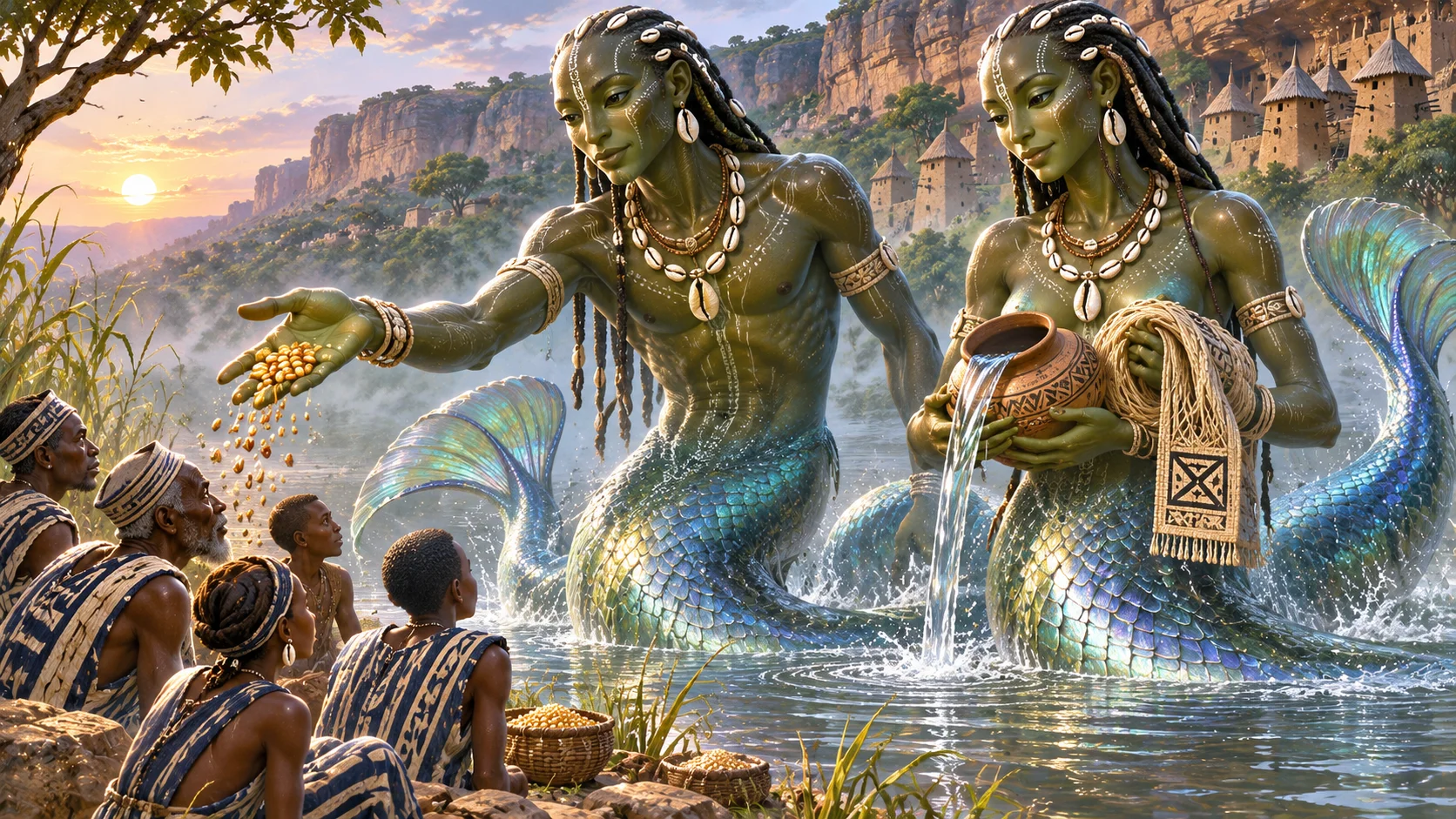
In the summaries that circulate widely, Amma is the single creator, all-powerful, all-knowing and present everywhere. He heads a small group of powers that includes the Nommo, the water spirits who are his first creation, and Lebe (also written Lewe), an earth power whose cult is linked to the office of the hogon, the elder who serves as the community’s priest. The everyday business of religion, however, runs through the many altars of lineage, village and field, through ancestors and spirits, and through the masked societies. How a Dogon person addresses Amma in private prayer is not something the published sources describe well, and this article will not guess.
The sources and how reliable they are
Almost everything written about Amma in English comes, directly or at one remove, from the French school founded by Marcel Griaule. His fieldwork among the Dogon began in the early 1930s, with the Sangha region as the ethnographers’ base. His monograph on masks, Masques dogons, and the studies by Denise Paulme (1940) and Germaine Dieterlen (1941) are widely regarded as sound ethnography, and later researchers still build on them.
The famous cosmology belongs to a later phase. In the autumn of 1946 Griaule held a long series of conversations, set out in the book as thirty-three days of talk, with an elderly Dogon man called Ogotêmmeli. They were published in 1948 as Dieu d’eau (“God of water”; in English, Conversations with Ogotemmêli). A second, far more elaborate cosmogony, drawn, in the usual summaries, largely from other informants, among them one named Ambara, appeared in 1965 as the first volume of Le Renard pâle (“The Pale Fox”), by Griaule and Dieterlen, nine years after Griaule’s death. The two accounts of what Amma did are not the same account.
One distinction should be kept in mind throughout. The pre-1948 work describes village society, masks, funerals and the altars of the cult; it is broadly accepted. The post-1946 “revelations” describe a unified cosmic system built on number, sign and myth; that is what is contested.
Amma in the conversations of 1946
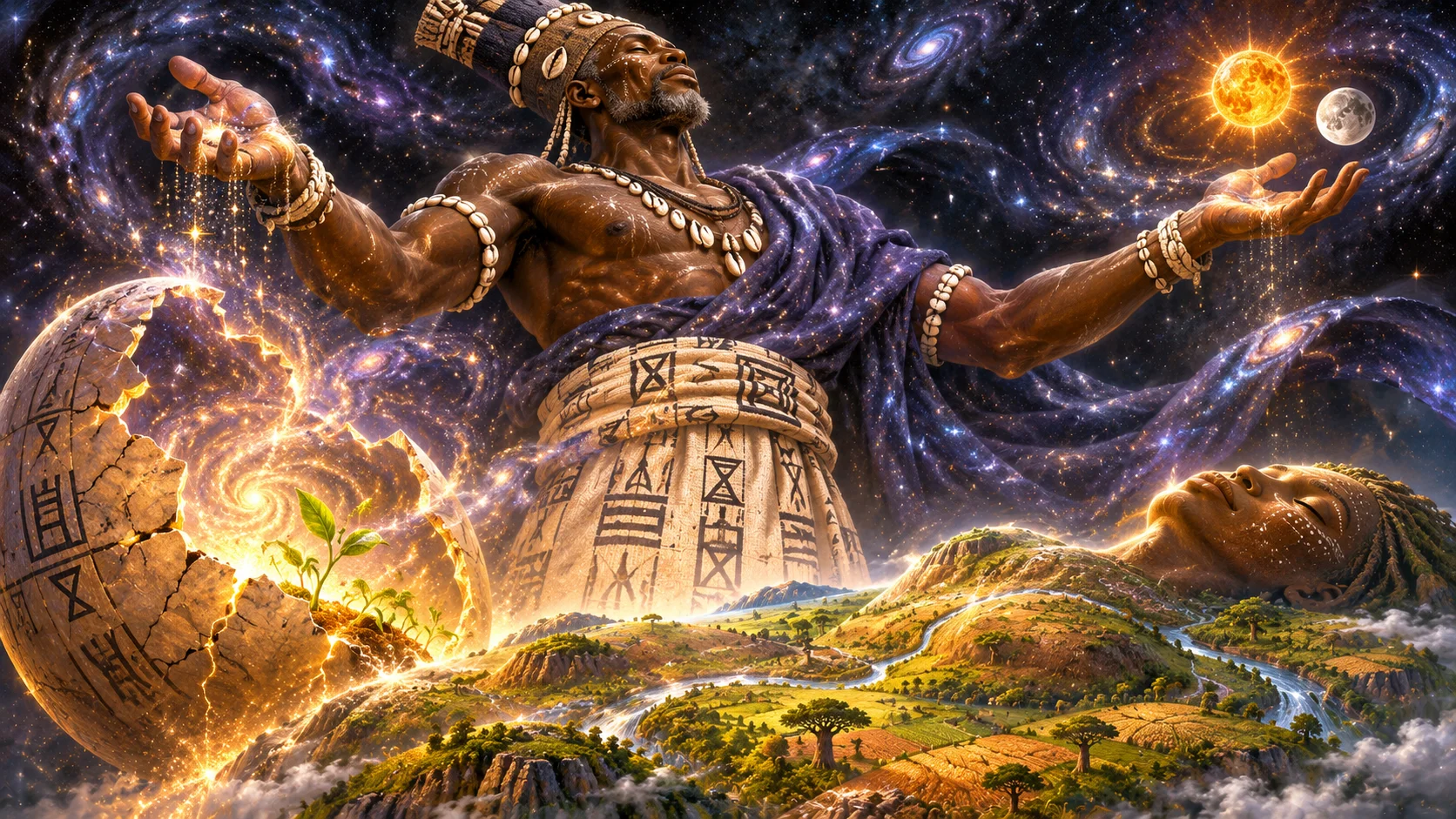
In Dieu d’eau Ogotêmmeli tells, over successive days, a story that unfolds in layers. Amma is the sole god and the origin of all. He made the stars by flinging pellets of earth into space. He made the sun and the moon as great vessels of fired clay, the sun ringed by a spiral of red copper and the moon by white copper. He then made the earth, conceived as a woman lying with her body spread across the world, and approached her. A termite mound rose as a barrier to the union and had to be cut away. The first union went awry and produced a single jackal rather than the twins that were intended. A second union, after the excision, produced the Nommo, the twin beings who are the first order of living creatures. The jackal is a figure of solitude and disorder, wandering outside the proper pattern of twinned things.
The cosmogony of the Pale Fox
The 1965 account is denser. It begins with a potentiality in Amma, a seed or egg containing the order of everything to come, and it speaks of vibrations and a spiralling movement through which creation unfolds. The egg, in the accounts as summarised, held twin pairs of Nommo. One creature, Ogo (also Yurugu, the Pale Fox of the book’s title), broke out before his time and alone, tearing away part of the envelope that surrounded him and bringing disorder into a creation not yet complete. Amma then acted to set things right, and the sacrifice of a Nommo is the pivot on which the restoration turns.
The idea that the cosmos began in a disruption, and that order is a repair made afterwards, is the most striking feature of the system as Griaule and Dieterlen present it. Because the knowledge in question is described in the literature as restricted to initiates, this article goes no further into it. It is enough to say what the account claims and what the criticism says about it.
The contested ethnography
In 1991 the Dutch anthropologist Walter E. A. van Beek published “Dogon Restudied: a Field Evaluation of the Work of Marcel Griaule” in Current Anthropology, together with published comments and replies, and in 2004 he returned to the subject in “Haunting Griaule” in History in Africa. He worked among the Dogon over many years from the late 1970s, notably in the village of Tireli at the foot of the cliff. He reported that he could not find the elaborate cosmology of the French books in the field, nor the detailed Sirius lore, and that the people he questioned did not hold it as general knowledge. On his account the stories he did find were fragments that Griaule had fitted into a grand synthesis. He did not say that the Dogon lack myth, and he has stressed that he never meant to criticise Griaule himself; the earlier French work on masks, social organisation and the altars of the cult is generally still regarded as sound. In outline, he described a religious life organised around ancestors and altars at the levels of lineage and village, with a basic opposition between village and bush.
The explanations offered for the gap, by van Beek as summarised by others and by further commentators, are interpretations rather than established facts. They include the suggestion that Griaule, determined to demonstrate the complexity of African religion, questioned a small circle of informants so forcefully that new myths were produced in the telling; that the colonial setting, in which a French scholar held great status, made it easier to elaborate than to say “I do not know”; and that some material may echo Christian or Islamic stories current in the region. None of these shows that every element of the Griaulian account is invented, and the question of how much of it, if any, reflects older esoteric lore remains open.
He was not the first to raise doubts. The British anthropologist Mary Douglas had written critically about the Griaule school in “If the Dogon…” and, in 1968, in a review essay, “Dogon Culture: Profane and Arcane”, in Africa. She was also a commentator on van Beek’s 1991 article, where she allowed that the esoteric knowledge of elders described by Griaule could simply have been lost over half a century. James Clifford, in an essay of 1981 on ethnographic surrealism, set the French school in the intellectual climate of Paris between the wars.
The defence came mainly from Griaule’s daughter and colleague, Généviève Calame-Griaule, who replied in the same volume of Current Anthropology. Her position, as summarised, is that van Beek had not gone through the proper steps for acquiring esoteric knowledge, which is restricted, and she questioned his own informants and methods. The exchange has not produced agreement.
The honest summary is that a restudy cannot prove a negative, and some elderly informants may genuinely have held esoteric lore never shared with outsiders. Yet the restudies reported so far point mostly one way: the elaborate system is not part of the general knowledge of the Dogon.
Amma and the Dogon today
The escarpment rises as a sandstone cliff of up to about 500 metres over some 150 kilometres. The Dogon were not its first inhabitants: the Tellem lived there before them, and their granaries and burial caves are still visible in the rock. Sources disagree on the dates, with the Tellem usually placed from about the eleventh century to the fifteenth or sixteenth. Dogon oral tradition tells of a migration from Mande, with a first settlement at Kani-Na, and of a move north along the escarpment, reaching the Sangha area around the fifteenth century; many sources link the retreat to the cliffs with Islamisation and slave raiding. In 1989 UNESCO inscribed the Cliff of Bandiagara (Land of the Dogons) on the World Heritage List.
Estimates vary, but traditional religion remains widely practised alongside Islam, with a smaller Christian community, and in many families they coexist. Since the 2010s the region has been caught in the conflict of central Mali; cultural tourism has largely collapsed, there has been bloodshed between Dogon and Fulani communities, and observers have worried about the future of cyclic ritual events. Whether the next Sigui, expected from about 2027 on a sixty-year count from 1967 (sources differ on the exact year), can proceed as before is uncertain.
The Sirius claim
No account of Amma in popular culture can avoid Sirius. In 1950 Griaule and Dieterlen published a paper, “Un système soudanais de Sirius”, in the Journal de la Société des Africanistes, which set out a Dogon system in which a tiny, very dense companion of the star Sirius, called po tolo, circled it in about fifty years. Sirius does have a white dwarf companion, predicted from the wobble of the bright star in 1844, first seen in 1862, and known to orbit in roughly fifty years. In 1976 the American-born writer Robert Temple, in The Sirius Mystery, argued that the Dogon could only have learned this from amphibious visitors from the Sirius system, whom he identified with the Nommo, some five thousand years ago.
This is a modern pseudo-archaeological claim. It is not accepted by astronomers, and the ethnographic basis on which it rests is itself disputed. The Dogon material was first published in 1950, after the white dwarf had been discovered and widely discussed in the astronomical and popular literature of the early twentieth century. Ian Ridpath, in The Skeptical Inquirer in 1978, concluded that any accurate information most probably came through contact with Europeans, and Carl Sagan, in Broca’s Brain (1979), likewise argued that European sources were the more likely origin. Van Beek reported that the people he asked disagreed about which star the Sigui star (sigu tolo) was, that all said they had learned of it from Griaule, and that he found no evidence that Sirius was thought of as a double star. Defenders of Griaule, among them Calame-Griaule, answer that such knowledge was restricted and would not be shared with a visiting outsider. To date, no independent field confirmation of the Sirius lore has been reported by the restudies. This is the contaminated-source argument in brief: a single field episode, passing through a small circle of informants and an inquiring ethnographer, becomes in print a story about visitors from the stars.
Closing reflection
Amma survives all of this. The Dogon creator is real in Dogon thought, whatever the French books made of him. What the controversy leaves is a lesson about how a god becomes a text. A living religion speaks differently at the altar, at the mask dance and in a long afternoon with a visiting scholar who wants a system. The Griaulian Amma, with his egg and his vibrations and his pale fox, is a magnificent literary construction that tells us much about the encounter between France and the Bandiagara in the middle of the twentieth century. The Amma of the Dogon is quieter, and much of what is known of him within the community has never been written down.
Sources & traditions
- EncyclopediaWikipedia — Amma (deity)
- TraditionDogon folk and village traditions (West Africa)
Myths change from area to area and from time to time. This chronicle follows the most widely told versions; tellings in other villages, regions and eras may differ.