Sabazios is the sky-father and horseman-god whose worship arose among the Thracian and Phrygian peoples of the ancient Balkans and Asia Minor, and who was carried into the Greek and later Roman religious world as the object of private, ecstatic mystery initiation rather than public temple sacrifice. From at least the fifth century BCE, Greek and Roman writers, inscriptions, and votive reliefs attest to a cult that both fascinated and unsettled the societies it entered — a foreign god who was simultaneously mocked on the comic stage and embraced in candlelit initiation halls.
A God Claimed by Two Peoples
Ancient sources themselves could not settle whether Sabazios belonged to the Thracians or to the Phrygians of Asia Minor, and modern scholarship has largely stopped trying to force a single answer. He is better understood as a Thraco-Phrygian deity, a figure who moved fluidly across an ethnic and linguistic boundary that ancient geography rarely respected on its own terms. This dual attribution is not a gap in the evidence to be explained away but a genuine feature of how his cult is remembered — a reminder that the religious landscape of the northern Aegean and Anatolia was woven together long before Greek writers tried to sort it into tidy ethnic boxes.
Lord of the Open Sky
At the core of Sabazios's identity is his role as a sky-father, a celestial ruler whose authority mirrored that of Zeus in the Greek imagination. This was the aspect of him that let Greek worshippers absorb Sabazios into their own religious vocabulary with relative ease: a foreign god who governed the heavens above was not so different, in outline, from the Zeus already enthroned over Olympus. Alongside this celestial sovereignty ran an association with fertility, tying the god of the sky to the renewal of the land and the cycles that sustained agrarian life.
The Horseman Who Rides Between Names
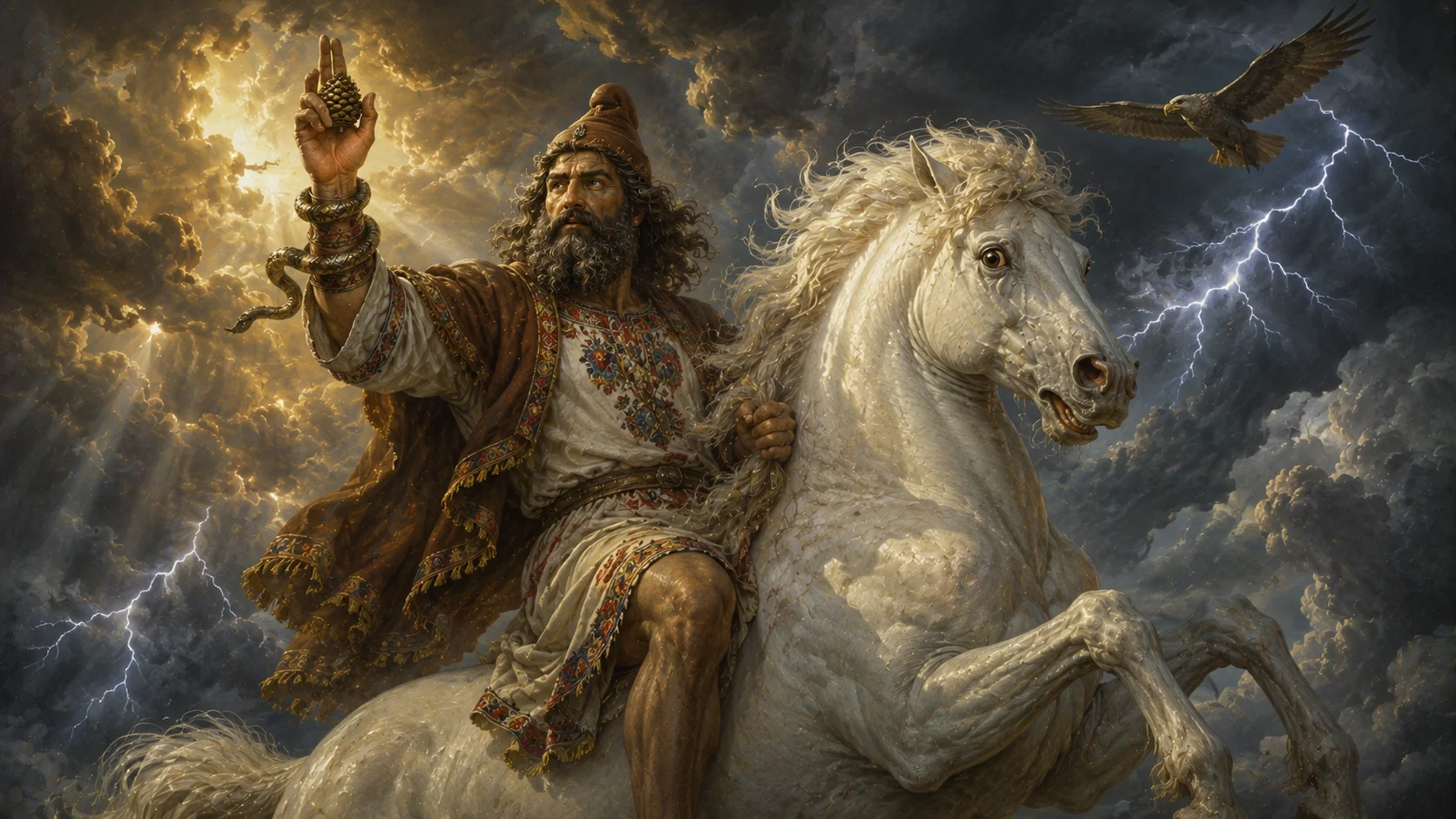
Sabazios is consistently remembered as a horseman god, an image that placed him within a wider Balkan visual tradition of mounted divine and heroic figures. The so-called Thracian Horseman reliefs, widespread across Thrace and the Roman-era Balkans, are sometimes read as depictions of Sabazios himself, and sometimes treated as an entirely separate, often unnamed hero-god venerated in his own right. The honest position is that this is an open interpretive question rather than a settled identification — the horseman iconography of the region was rich and multivalent, and Sabazios may be one thread within it rather than its sole author.
Dionysus Sabazios: A Double Name
Perhaps the most striking feature of his Hellenized reception is how thoroughly Sabazios became entangled with Dionysus. Greek sources sometimes call him outright "Dionysus Sabazios," a fused title that reflects how naturally his ecstatic, initiatory mystery cult was mapped onto the Dionysian religious imagination already familiar to Greek audiences. Where Zeus lent Sabazios his celestial authority, Dionysus lent him the vocabulary of wine, trance, and transformative rite — two Greek gods stretched across one foreign deity to make him legible.
The Bronze Hand Raised in Blessing
The single most distinctive physical trace of Sabazios's cult is the so-called Hand of Sabazios: bronze votive hands, numerous examples of which survive in museum collections today, cast with the fingers arranged in a benediction-like gesture. These hands are not left plain — they are crowded with small cast figures and symbols, among them a snake coiling along the fingers, a pinecone, a lizard, and a ram, each presumably carrying meaning within the initiatory framework of the cult. These objects stand as the primary archaeological witness to a religion that otherwise left little monumental architecture behind, precisely because its worship was conducted in private rather than in state sanctuaries.
The Serpent Across the Breast
The snake recurs throughout Sabazios's cultic imagery, not merely as a decorative element on the votive hands but as an active participant in ritual practice. Clement of Alexandria, writing as a hostile Christian critic of pagan mystery religion, describes a rite in which a golden snake was passed across the initiate's body or breast. This detail should be read with appropriate caution: it survives only through polemical Christian apologetic writing, composed by authors such as Clement and Arnobius whose explicit purpose was to make pagan mystery cults appear grotesque to their readers. The image of the serpent is almost certainly genuine to the cult; the precise ritual choreography surrounding it comes to us filtered through hostile eyes.
Initiation in the Shadows of the City
Unlike the great civic cults of the Greek polis, worship of Sabazios took the form of private mystery initiations conducted by small associations, or thiasoi, rather than public sacrifice sponsored by the state. This structure placed his religion in the same broad family as other Thracian-linked mystery traditions — the secret rites associated with Zalmoxis and with Dionysus both promised initiates some form of transformed status or benefit in the afterlife, achieved through participation in a guarded rite rather than through open civic participation. It was precisely this secrecy, and its foreignness, that made the cult an object of suspicion among more conservative Athenians.
Glaukothea's Rites and a Son's Shame
The tension between Sabazian worship and mainstream Athenian propriety is nowhere sharper than in the courtroom rhetoric of Demosthenes, who attacked his rival Aeschines by savaging the reputation of Aeschines's mother, Glaukothea, for leading initiation rites into the mysteries of Sabazios. The attack only works as an insult because it assumes its audience already regarded such ecstatic, foreign-flavored ritual leadership as disreputable — a mark of low and irregular religion rather than respectable civic piety. Aristophanes, too, found the cult of Sabazios ripe material for comic mockery on the Athenian stage, evidence that his worship was visible enough in daily life to be a recognizable target for satire, even as it was pushed to the margins of official acceptance.
A Name Carried on Roman Roads
Far from remaining a marginal curiosity, worship of Sabazios spread widely across the Roman Empire in the centuries that followed his Greek reception. Votive hands and altars dedicated to him have been recovered across an enormous geographic range, from Italy through the Balkans to Asia Minor, tracing the movement of soldiers, traders, and migrants who carried his private, portable mystery religion with them wherever they settled. This diaspora pattern is itself part of what defines Sabazios as a historical figure — his cult is known to us mainly through this scattered, mobile evidence rather than through any single central sanctuary or founding myth.
A Name Mistaken for the Sabbath
One curious thread in the later record deserves to be named plainly as an error rather than treated as genuine religious blending. Some later sources, largely Christian polemical writers, confused or conflated Sabazios with Jewish Sabbath worship, apparently on the strength of a phonetic resemblance between "Sabazios" and "Sabbath." This was not an authentic syncretism arising from shared ritual practice or theology — it was a documented ancient mistake, born of sound-alike names rather than any real connection between the two traditions, and it should be understood in the historical record for exactly what it is.
Neighbors in the Phrygian Mystery Landscape
Because Sabazios's cult shared the same broad Anatolian and Thracian mystery-religion milieu as the worship of Cybele and Attis, some interpreters have drawn connective lines between them. These links remain interpretive rather than documented fact, resting on shared geography and a shared ecstatic, initiatory temperament rather than on direct textual testimony placing the figures together. It is worth stating clearly what Sabazios is not: he should not be conflated with the Thracian goddess Bendis or with the figure of Kotys, both of whom belong to a different strand of Thracian religious life attested chiefly through Herodotus's ethnographic writing on Thrace, rather than through the diaspora mystery-cult evidence that defines Sabazios.
What the Silence and the Bronze Together Preserve
Sabazios survives in the historical record as a figure defined as much by absence as by evidence — no grand temple, no continuous priesthood recorded in detail, no native Thracian or Phrygian text in his own voice. What remains instead is a scatter of bronze hands raised in blessing, a serpent's coil remembered through hostile Christian pens, a mother mocked in an Athenian lawcourt for leading rites in his name, and altars left behind by travelers from Italy to the Balkans. Together these fragments describe a god who lived, for most of his worshippers, not in civic ceremony but in the private, guarded space of initiation — a sky-father and horseman whose true face was reserved for those who had already crossed into his mysteries.
Sources & traditions
- EncyclopediaWikipedia — Sabazios
- TraditionThracian texts, inscriptions and later retellings (Thrace)
Myths change from area to area and from time to time. This chronicle follows the most widely told versions; tellings in other villages, regions and eras may differ.